

Give Your Heart - February 19, 2017
Last week, we started our series on spiritual disciplines to help us start thinking about how we might invest ourselves in spiritual growth during Lent. Last week we talked about building our relationship with Christ through Bible study and prayer. This week, we will be talking about fasting.
It seems to me fasting is a commonly known spiritual practice and yet one of the least practiced. How many of you have ever heard of people fasting as part of their faith life? How many of you have done it? How many of you have done it more than a half dozen times? More than a dozen? It's just not that common in the mainline north American practice of faith. But I think maybe it
should be.
Now, I will confess, fasting is not one of my regular practices. Certainly not a regular food fast. I think I've done a food fast fewer than 6 times in my life. I have done media fasts, social media fasts, and phone fasts. I've used those to try and shut out the noise in my life and help create some space for time with God. But studying for this sermon has created a new level of conviction in my heart about the power of a fast.
I'm not fully sure, but I think a lot of us feel like a fast is for the really devout...not a necessary part of faith development for the average Joe or Jane. Anybody feel that way? I don't know that there's harm, so to speak, in not doing a fast....whereas I think there is a big loss if we don't pray or don't worship or don't serve others. But, as I've studied the scriptures and read various folks...it seems there are some pretty incredible blessings available when we do fast.
Are you interested in what those might be? If not, you can go downstairs and have an early coffee hour. =) I bet most of us are at least a little curious. Fasting is a practice that is found in both the Old and the New Testament. It is used in conjunction with prayer...both those of petition and those of confession and repentance. And, unlike some faith practice, fasting is never discouraged as out of date or useless. (Though we are admonished not to use it to be showy about our faithfulness, or to fool ourselves into thinking that what God wants is for us to fast...what God wants is our hearts and our devotion...fasting is simply a means of offering that).
So, who in the Bible used fasting? (this list is not exhaustive)
• Esther
• Moses
• Elijah
• Daniel
• Moses
• Joel
• Jesus
• Peter
• Paul
• the widow in Luke 2
• The rich man in Luke 18
• King David
• King Ahab
• Ezra
Esther asked the Israelites to pray before she went and spoke with the king (which legally she could have been killed for). They fasted and when she went, the king heard her and heeded her requests.
Daniel fasted for 21 days and on the 24th day on the banks of the Tigris river, a heavenly figure appeared to him and gave him a vision. It was overwhelming and Daniel fell to the ground, but the figured lifted his face and spoke to him. He gave him wisdom, knowledge, and insight. The heavenly figure also encouraged him for the work God had set before him.
Jesus fasted for 40 days in the desert and the devil came to him and tempted him. But he stayed rooted in the scriptures and strong in God. When the devil had fled, the angels came and attended to him.
Elijah spent days without food as God's prophet and then had an angel appear to him before he spoke again to the King.
In the scriptures, when the people fasted, God showed up, took action, sent angels, or spoke through the Holy Spirit. It is a very regular practice of faith in the scriptures. Which might suggest it is a good one. It's not prohibited in the scriptures, though it is admonished that fasting simply too fast or say you did something pious isn't really what God wants. It can be a powerful way to purify your palette, so to speak, and also a way to sacrifice in a way that is meaningful to connect with God.
The most common fast is from food...for a set period of time...often 12 hours or two meals. But it could be 24 hours, or it could be one meal. Lots of people also choose to fast from certain foods as a sacrifice, test of will, and practice of self-control. People give up coffee, ice cream, chocolate, junk food, fast food, or meat. But there are other forms of fasting. A common one these days is too fast from Facebook. Another is too fast from TV. I did that one year when my TV broke. Instead of getting a new one, I just fasted! One year Rick fasted from watching Basketball, which was a really big deal in our house. One year, I fasted from self-deprecation. Any time I did negative self-talk, I reminded myself of the fast. And each day, in its place, I offered a blessing for myself. It felt a little silly blessing my body from my head to my toes, but by the end of 40 days, I was no longer chastising myself for every little thing I did wrong. There are a variety of ways to fast. The key is to find something that will require a sacrifice on your part, to set a dedicated time for the fast, and to do it. And if you struggle, just get back at it.
Now, it's not a magic trick, so there's no guarantee for how God will respond. But if the scriptures are any indication, it's quite likely that God will show up in a significant way. Maybe offering encouragement, maybe offering conviction, maybe offering instruction, maybe offering forgiveness. It could be a variety of things, but it is a proven way of how to listen for and hear God's voice.
Current Church News
Get Directions
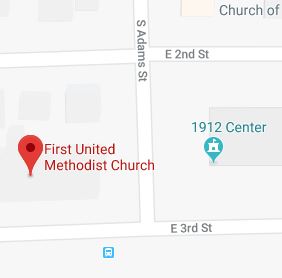
Sunday morning parking at the church is available in the high school parking lot on Third Street across from the church and in the city lots west of the church. These lots are available only on Sunday mornings. A small lot for handicapped parking is available just off of Adams Street on the north side of the church, with an accessible entrance directly into the sanctuary. A lift operates between the Fellowship Hall (3rd Street level) and the Sanctuary. William Sound System Receivers and Headsets are available to assist with hearing problems.
322 East Third Street
Moscow, ID 83843
Church Mission
The First United Methodist Church of Moscow, Idaho takes as our mission to be the body of Jesus Christ, ministering to a community which draws strength from its diversity. Our mission centers on the worship of God, expressed through varied forms of prayer, preaching, music, and ritual. See more...