

A Tall Order - October 2, 2016
Action #1
Forgiveness is a powerful part of our faith journey. We experience forgiveness for ourselves through the life, death, and resurrection of Jesus. And we are also invited to forgive others as we have been forgiven. Unfortunately there has been a lot of mixed up teaching about forgiveness. We have been taught to "forgive and forget". In essence, to put the past behind us, and move on as if nothing had happened. Now, in some cases that's easy. Little things that happen in our daily lives can certainly be forgiven and left behind us. But the big things, the ones that mark us and scar us are not easily forgiven, let alone forgotten. Some hurts take years to forgive, and yet, by the grace of God it is possible to let go of the anger,
hurt, pain, shame, and bitterness that come from betrayal, abuse, manipulation, neglect, racism, sexism, homophobia, classism, and general hurts of our lives.
We understand forgiveness to be letting go of the anger, hurt, shame, resentment, and bitterness that result from our hurts. Forgiveness does not necessarily require reconciliation, reconciliation is the restoration of a relationship that happens only after forgiveness takes place. We will be addressing reconciliation next week. Today, we are just focused on forgiveness...removing the weight and hardheartedness of our hurts.
The first step in that process is to identify what and who needs forgiving. It may be a spouse, a child, a friend, a parent, a sibling, an extended family member, a neighbor, a boss, or a stranger. It might be yourself. Or it might even be God. It could be an event, a time period, an attitude, an action or a lack of action. In these moments of silence and prayer, we invite you to listen to the Spirit's leading to tell you who or what needs forgiveness in your life. And as the person or event comes to mind, write it or them down on the papers that are being passed through the pews. You will hold onto this paper for later in the service. Feel free to write whatever you need to. It is only for you and will only be seen by you.
This conversation between Jesus and Peter comes right after some discourse about being hurt or sinned against by someone else. Earlier in Matthew 18 in the lesson about "if a brother (or sister) sins against you, go to them and speak to them directly, and if they don't hear you, bring another brother or sister of the faith to talk with them, and if they still don't hear you, then bring them before the church." Now, sometimes we'd like to think that that's so the person can REALLY know what they did wrong and that they offended us. But the purpose of those lessons is to help someone be restored into the community, not so they would be ostracized and alienated from it...that's why we start with a one on one conversation and don't go blabbing to the whole church first.
So, after that, Peter is basically following up...ok, but how many times do we do that?
Now, Peter offers 7 times...which we might be quick to criticize, "come on Peter, you're sort of low balling it there." But actually, the traditional teaching was 3 times...so Peter has gone way above and beyond by suggesting double plus one. And yet, he's still missing the point. Jesus says, "No Peter, not 7 times, but 7 times 70 times (now some people say 77...both could be the translation, but if we focus on the exact number just like Peter did...then we've missed the point too."
In essence, by making it a huge number Jesus is saying, "No Peter it's not about keeping a record of wrongs and knowing when you've hit the max number of offenses. It's not about 7 times, or 30, or 50, it's really not about 77 times or even 490 times. Because forgiveness is about grace....it's about giving a gift that isn't deserved. Your numbers and offense tracking become about justice...what's "right" and what's "fair" but when you do that you get consumed by the wrong thing. I want you to be consumed by grace. So, STOP COUNTING. Be overcome by grace and grace will overcome your hurts, bitterness and anger.
And then it's almost like Peter, or someone else in the room, piped up and said, "But why?!" And Jesus shares the parable. Now, Jesus loved parables...I think because they made the lesson memorable. You can forget a lot of things, but a story stays with you more readily. So, when people were inclined to forget why they should forgive so often, this story is meant to come to mind.
The gist of the story is there's a king who has someone who owes him TONS of money....1000 talents. A talent was about 130 lbs. of silver and was the equivalent to about fifteen years of a laborer's wages. Which means that the servant owed his master about 150,000 years of labor. He owed him a TON. And the servant knew there was no way for the debt to be paid and he begged for mercy...and the king took pity on him and forgave his debt. And then no sooner is the man out, but he finds someone who owes him something...100 denarii. A denarius, by comparison, was worth about a day's wage, which meant that the second servant owed the forgiven one about a hundred days of labor. And the man shows no mercy. He insists on everything being paid.
This man just had 150,000 YEARS of debt forgiven and he's all cranky over 100 DAYS of debt...he's totally missed the point of what just happened. He cried out for mercy but all he wants for the others is justice. And other people see it and can see things are sketchy and they go back and tell the king and he gets mad and so he calls the man back and punishes him.
Some of us are inclined to get hung up on the eternally awful punishment, but remember, this is a parable...it's figurative...it's meant to tell a story not write the law. And even if the king called the man back and said, "you are so concerned with justice, let's be fair then. You want what's fair for him, so here's what's fair for you. You owe me 150,000 years of debt...start working. To know you had been fully forgiven, washed of your debt completely and then been blinded by greed or "justice" and lost it all to return to the bondage of your debt...that alone is an eternal punishment.
So what's the point of the parable? Well, to answer the "why?" of what there should be so much forgiveness....because we've been shown mercy and because God's ways are about grace and not about the scales of justice. Ultimately, God is above the numbers and the measures and stands for grace and mercy. So, in recognition of what we've received, we should offer grace. Or, in simple recognition of wanting to be more like God in our daily lives, we offer grace.
Today, we are invited to live into this passage. We are invited to stop keeping count of how many times we've been offended or how many times we've chosen to offer grace. We are invited to be people of mercy and grace over justice and fairness. Which isn't to excuse the offenses. It isn't to condone the action. It is to allow us freedom in the midst of God's grace.
Current Church News
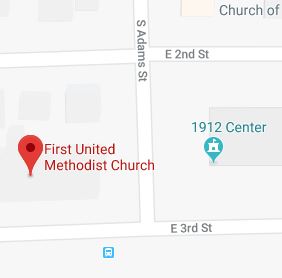
Get Directions
Sunday morning parking at the church is available in the high school parking lot on Third Street across from the church and in the city lots west of the church. These lots are available only on Sunday mornings. A small lot for handicapped parking is available just off of Adams Street on the north side of the church, with an accessible entrance directly into the sanctuary. A lift operates between the Fellowship Hall (3rd Street level) and the Sanctuary. William Sound System Receivers and Headsets are available to assist with hearing problems.
322 East Third Street
Moscow, ID 83843
Church Mission
The First United Methodist Church of Moscow, Idaho takes as our mission to be the body of Jesus Christ, ministering to a community which draws strength from its diversity. Our mission centers on the worship of God, expressed through varied forms of prayer, preaching, music, and ritual. See more...