

Who Is Really Saved? - August 7, 2016
Romans 10:1-17 (The Message Version)
10 1-3 Believe me, friends, all I want for Israel is what's best for Israel: salvation, nothing less. I want it with all my heart and pray to God for it all the time. I readily admit that the Jews are impressively energetic regarding God—but they are doing everything exactly backward. They don't seem to realize that this comprehensive setting-things-right that is salvation is God's business, and a most flourishing business it is. Right across the street they set up their own salvation shops and noisily hawk their wares. After all these years of refusing to really deal with God on his terms, insisting
instead on making their own deals, they have nothing to show for it.
4-10 The earlier revelation was intended simply to get us ready for the Messiah, who then puts everything right for those who trust him to do it. Moses wrote that anyone who insists on using the law code to live right before God soon discovers it's not so easy— every detail of life regulated by fine print! But trusting God to shape the right living in us is a different story—no precarious climb up to heaven to recruit the Messiah, no dangerous descent into hell to rescue the Messiah. So what exactly was Moses saying?
The word that saves is right here,
as near as the tongue in your mouth,
as close as the heart in your chest.
It's the word of faith that welcomes God to go to work and set things right for us. This is the core of our preaching. Say the welcoming word to God—"Jesus is my Master"— embracing, body and soul, God's work of doing in us what he did in raising Jesus from the dead. That's it. You're not "doing" anything; you're simply calling out to God, trusting him to do it for you. That's salvation. With your whole being you embrace, God setting things right, and then you say it, right out loud: "God has set everything right between him and me!"
11-13 Scripture reassures us, "No one who trusts God like this—heart and soul—will ever regret it." It's exactly the same no matter what a person's religious background may be: the same God for all of us, acting the same incredibly generous way to everyone who calls out for help. "Everyone who calls, 'Help, God!' gets help."
14-17 But how can people call for help if they don't know who to trust? And how can they know who to trust if they haven't heard of the One who can be trusted? And how can they hear if nobody tells them? And how is anyone going to tell them, unless someone is sent to do it? That's why Scripture exclaims,
A sight to take your breath away!
Grand processions of people
telling all the good things of God!
But not everybody is ready for this, ready to see and hear and act. Isaiah asked what we all ask at one time or another: "Does anyone care, God? Is anyone listening and believing a word of it?" The point is: Before you trust, you have to listen. But unless Christ's Word is preached, there's nothing to listen to.
SERMON
"Too often, I am just a critic rather than an evangelist. A critic is focused on finding people who are wrong and communicating clearly how wrong they are. An evangelist wants other people to share in the weight of the truth and beauty s/he has found." -Morgan Guyton
Over the last few weeks, we've been learning about the Roman church and their struggles. We know that part of their conflict was because they included both Jewish believers and Gentile believers. (Remember, there were no "Christians" as such). We've heard their arguments over various issues, but the core often boils down to this:
You Jews only follow the law. You lack faith and aren't really saved. to which the Jews seem to retort:
You Gentiles think you're so special because you "believe" in Jesus...but you ignore the laws that have allowed us to connect with God for centuries. How can you claim to love God if you shrug off all the rules?!
Do you hear the distinction? One focuses on the law, the other on faith. And while they might have been the first, they certainly weren't the last to argue about these issues. This is a regular struggle in the Christian story...is it about what we believe or about what we do? Who is really saved?
In the 1500s, the Catholic Church was focusing a lot on what people did. And Martin Luther came and said, "hey! it's not about works, it's about faith. You can't save yourselves, only Jesus can do that."
Even the Methodist movement has had it's struggles with this....the Salvation Army broke off of the Methodist movement saying that we didn't DO enough as part of our faith. in the other direction, the Pentecostals said we were too consumed with our doing and not enough with the movement of the Holy Spirit.
Do you see a trend? A regular and constant tension between our believing and our doing. It seems decently obvious...falling back on those famous words from James, "Faith without works is dead." If we have faith, then our actions will fall in line. Straight forward, simple and easy. Right? Wrong. Wrong because as we equate the two, we often think they are interchangable...not mattering which comes first and which comes second. It's wrong because we begin to confuse our right action as influencing our saved-ness.
And yet, it's exactly the opposite. Our saved-ness is meant to influence our actions. It may seem like a simple switch, but if we get it wrong, we deflate the work of Christ and over-inflate our work here on earth.
So, how do we get it right? how do we know? How can we determine who is really saved and who isn't? Well, first off, we can go to this passage from Romans. Paul does a pretty good job of laying it out. He basically starts out by saying he cares that people are saved. Then he says, he's worried because some people think the law...acting a certain way, is the most important thing...they're consumed with their actions but are barely focusing on Christ's actions. He says that Jesus' actions are the most important... they're important because that's how we know that God saves us. We don't save ourselves. And if we can see that Christ saves us and if we can believe it, then we will be saved. We won't be saved because we do all the right things or follow the most pertinent laws. We will only be saved—rescued, redeemed, and revived—by Christ. And if we can believe that, if we trust that as true...then we'll stop trying to save ourselves.
We won't stop loving. We won't stop caring. We won't stop seeking to heal the hurt and find the lost. We won't stop visiting the imprisoned or feeding the hungry. We'll do those things and more as we learn to live like Christ, but we won't worry if we're doing enough to be saved...because if we really trust that we are saved by faith through Christ we'll know, beyond a doubt, that it's not about what we do, but what Christ does.
I almost feel redundant saying this. It seems I've been saying it each time as we've learned from Paul these last few weeks. And yet, over and over again the temptation is we begin to believe the lie that our actions are what make us or break us; and it simply isn't true. The truth is, we are sinners in need of saving and Jesus comes and does that saving work through his life, death and resurrection, and we have full access to that gift of grace not because of our successes but instead because of Christ's sacrifice.
I know, you all get it. We've stopped struggling with this. We get it and we are ready to move on. And yet, I'm not so sure. The church has a good long habit of making rules, or setting standards about who is acceptable and who is not. Think about it. These are some of the folks the church has said don't meet the measure of behavior that is necessary for "true faith". Over the years, at different times and in different places, these people haven't measured up:
• Divorcees
• people who smoke
• people who drink
• people who dance
• people who gamble
• people who have piercings
• people who have tattoos
• people who have spiked hair
• people with green hair
• women who have had an abortion
• bikers
• gang members
• teenagers who have gotten pregnant
• addicts
• felons
• prostitutes
• skate boarders
• people of color
• people who are gay
• the homeless
• people who simply don't fit the "mold"
We'd like to think we've moved beyond all that. That we are much more inclusive. And we've made some good strides...but we still struggle. We still use standards of behavior as a litmus test for determining who is in and who is out, who is worthy and who is not, who is saved and who is not. And Paul comes and bats all that down. He says it's not about what we've done. We don't save ourselves. God does the saving work. So no matter who you are, how you dress, what you've done, what other people think about you...Jesus does the saving work.
And that is news that needs to be shared. People need to know they can stop fighting for their own redemption, doubting their own worth, and holding onto shame for not being good enough or not getting it right. If we begin to believe it's true for them, maybe they'll begin to believe it's true for them. People need to know they can cling to Christ as their source of hope and life.
Paul emphasizes the need to share the good news at the end of this section. He says, "But how can people call for help if they don't know who to trust? And how can they know who to trust if they haven't heard of the One who can be trusted? And how can they hear if nobody tells them?" Our job is to be the tell-ers, to be the ones who say, "You can trust Jesus". Our job is to stop trying to figure out who is in and who is out, who has sinned too much and who is righteous enough. Our privilege is to share that the same one that saved us has already saved them...if only they'll stop trying to save and redeem themselves. And if we'll stop thinking that they need to. Trusting and believing in Christ involves allowing his actions to be greater than our own. It means humbly submitting our will and our ways to his. Quoting the book of Isaiah, Paul reminds us, "No one who trusts God like this—heart and soul—will ever regret it."
Current Church News
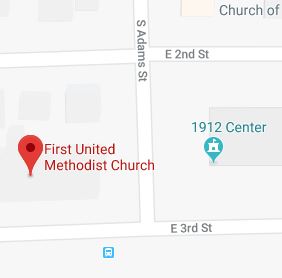
Get Directions
Sunday morning parking at the church is available in the high school parking lot on Third Street across from the church and in the city lots west of the church. These lots are available only on Sunday mornings. A small lot for handicapped parking is available just off of Adams Street on the north side of the church, with an accessible entrance directly into the sanctuary. A lift operates between the Fellowship Hall (3rd Street level) and the Sanctuary. William Sound System Receivers and Headsets are available to assist with hearing problems.
322 East Third Street
Moscow, ID 83843
Church Mission
The First United Methodist Church of Moscow, Idaho takes as our mission to be the body of Jesus Christ, ministering to a community which draws strength from its diversity. Our mission centers on the worship of God, expressed through varied forms of prayer, preaching, music, and ritual. See more...