

He Did It! - July 10, 2016
Children's time:
Dad and Patti at the dinner table.
Bow your heads and close your eyes to pray. And so the family would pray. And John opened his eyes and looked around. And once they said, "Amen" Patti spoke up and told her parents that John had his eyes open during the prayer. He wasn't following the rules, and she wanted him to get in trouble for it. But there was another problem. How do you think Patti knew John had his eyes open during the prayer? She had her eyes open too! That means she wasn't following the rules either! She wanted John to get in trouble but what she didn't realize was that she would have gotten in trouble too because she did the same thing.
Now, can we pray with our eyes open? Yes. But should we follow the directions if our parents ask us to
quiet down? Or bow our heads or close our eyes? Of course. But what's really important is that if we are upset about someone else not following the rules, we better make sure we set a good example. What do think might have happened if Patti had closed her eyes with everyone else and then John opened his? He would have seen that everyone else was following the rules and he might have closed his eyes too. Patti could have been the example for John instead of being part of the problem.
Sometimes it's hard to follow directions. But what's most important is to try and be a good example for others. (maybe for our younger brothers and sisters, or maybe for someone at school, or maybe even for grown ups!)
Let's pray.
Last week we began a sermon series in the book of Romans. We started by understanding 3 key things about the book of Romans in the New Testament.
1) It's a letter from Paul to the church in Rome, responding to the issues the church was facing. We never see the church's letter to Paul, only his response to them.
2) Rome was a hub for trade and migration meaning there was lot of diversity in language, nationality, religion, and culture.
3) The 2 main groups in the Roman church were the Jewish believers and the Gentile believers (no one was yet termed "Christians"), they were simply believers from Jewish tradition or from Gentile tradition.
a. These 2 groups came together in the church because they believed in Jesus as the Son of God but aside from that place of connection they also faced a lot of conflict because of what they believed culturally and how they lived.
Each passage in the book of Romans builds on the last; so to better understand today's passage, we need to be reminded of last week's message. Last week, we heard Paul's message to the Jewish and Gentile believers who were arguing about who was more sinful. Basically, Paul told them, "We're all sinners. The Gentile believers are no better or worse than the Jewish believers and the Jewish believers are no better or worse than the Gentiles." He emphasized that we are all sinners and unless we can recognize we need saving, we really have no need for God.
So that refreshes our memories and catches us all up. We are all sinners in need of saving. Unfortunately, recognizing that truth doesn't fully resolve the conflict and so Paul lays it out a different way. It's what ______________ read this morning.
Romans 2: 17-23
Listen, if you claim to be a Jew, count on the law [it will teach you how to live, but] boast in your relationship with God. If you know God's will and can determine what is essential (because you have been instructed in the law); and if you are convinced that you are chosen to be a guide to the blind, a light to those who live in darkness, a teacher of foolish wanderers and children, and have in the law that is essentially the form of knowledge and truth, then tell me, why don't you practice what you preach? If you're going to [preach] against stealing, then stop stealing. If you're going to teach others not to commit adultery, then be completely faithful to your spouse. If you hate idolatry, then stop robbing the temples. If you pride yourself in having God's law, then stop dishonoring God by failing to keep its teaching."
Paul does not pack any punches. He is incredibly direct—Practice what you preach. If you say something matters, then live like it matters. Don't just talk about it.
It's a pretty simple message. And most of us hear it and kind of go, "Uh yeah, it really would be nice if you practiced what you preach." It's easy to hear this message for other people—(pointing finger), "You really need to get it together buddy." Or "Sister, you have a lot to work on." And all that time we're busy pointing out where others are falling short, Paul is saying, "Hold on a minute, you're still missing the point." Yes, it's true for them. It matters what they say and how they live. AND it matters what you say and how you live.
I don't know about you, but it sure seems like one of the biggest problems the Roman church was facing was finger pointing...who was more sinful, who needed to do better, who was off track...and unfortunately, if we look at the modern church and particularly the state of affairs in our country, that's STILL a big problem. We want to know who is responsible and we keep looking for someone to blame, instead of finding our own culpability and working on ourselves to be better.
There's gotta be some humble pie for everybody. Even for those who seem to have it all together, guaranteed there's a place where their talk is a whole lot better than their walk.
Paul names a couple of examples
-don't steal
-don't commit idolatry
-don't commit adultery
Those are all true. And they are definitely real issues for real people. And, we have other issues. If Paul were writing to the modern North American church, he could very well remind us to avoid racism, eschew sexism, to stop politicizing and start relating (which is far easier said than done). It's not enough to name issues. We have to live our faith, every day, in ways that help give rise to the Kingdom of God.
Here's the thing. While we may not agree politically, or even theologically and we could probably argue well into the night about gun control or race relations, or how to fight injustice, or any other myriad of issues, one thing remains true...we live in a very broken world and we can see that brokenness daily in what's reported in the news. This is not kingdom living. This is not God's desire for us as a society or us as a community. We'd maybe like to believe that being up here in Moscow, we're out of the mix of things and these issues really aren't our issues. But, the fact of the matter is, this is a problem for all of us in the United States. And if we want our country to be better, then we have to be better as a community. We have to be willing to broach the tough subjects and swallow our pride. We have to learn the stories of others even when our natural reaction is to argue or refute them. We have to choose to be part of the solution if we want to leave this world a better place for our kids. Maybe yours are grown, but I imagine you have grandkids or great grandkids who you want to live in a more peaceful place than our nation currently is. I know I want something better for my kids...and for yours.
That said, making our world, our country, our community, even just our church a better place is an overwhelming task. I have to admit that on more than a few occasions this week, I have thought, "I don't know what to say. I don't know where to begin. I'm not sure I can make any difference."
But then the Spirit would remind me...you believe in God right? You believe in Jesus Christ as his Son who hung on the cross and sacrificed his life so that we might have something better, something different, right? And you believe that in Him and through Him, there is forgiveness, redemption, and reconciliation that is possible when there is no other way, right? And, I do believe each of those things. And God reminds me, then let me use you as an agent of change. You can't do it on your own. But I can work through you.
You see, being a follower of Christ is about believing in God's saving work through Jesus. Being a believer is about loving God with all that I am and my neighbor as myself. Being faithful is about living my faith and choosing to follow God in my daily life. Can it teach me how to listen more earnestly and more openly? It already has and continues to push me in those ways. Can it help ease racial tensions? Hopefully. Can God make a way where there seems to be no way? Undeniably? Do I need to be part of God's redeeming work? If I want it to happen around me, probably so.
Will I still fall short? Yes.
Will there be days where I am an awful example of what it means to be a Christian? Probably.
Does that mean I don't have a relationship with God? No.
Having a relationship with God is about connecting with God and growing in Christ. It's not just about following rules, though the rules God provides should help us stay on God's path. And while there are days where I, or you, may need to hold someone else accountable in their faith walk, I need to be sure I start with my own self first. Because it's not fair for me to call out the next guy if I'm not walking the walk myself. What we believe matters. How we live our faith also matters. And, for Paul, it's not enough to know the laws, we have to live what we believe. So, if you say something really matters to your faith (maybe that's prayer, or generosity, or compassion, or worship), make sure you're really living it in your own life.
Let us pray.
Current Church News
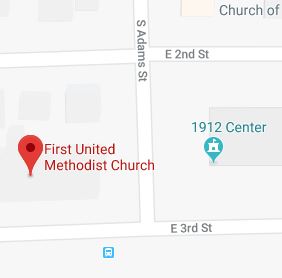
Get Directions
Sunday morning parking at the church is available in the high school parking lot on Third Street across from the church and in the city lots west of the church. These lots are available only on Sunday mornings. A small lot for handicapped parking is available just off of Adams Street on the north side of the church, with an accessible entrance directly into the sanctuary. A lift operates between the Fellowship Hall (3rd Street level) and the Sanctuary. William Sound System Receivers and Headsets are available to assist with hearing problems.
322 East Third Street
Moscow, ID 83843
Church Mission
The First United Methodist Church of Moscow, Idaho takes as our mission to be the body of Jesus Christ, ministering to a community which draws strength from its diversity. Our mission centers on the worship of God, expressed through varied forms of prayer, preaching, music, and ritual. See more...