

It Is Enough - March 20, 2016
"Hosanna!" we sang at the start of our worship this morning as the children passed out the palm branches. "Blessed is the king who comes in the name of the Lord!" people chanted when Jesus rode in triumph into Jerusalem. We wave palms, but in Luke's gospel they placed their cloaks on the road before Jesus. Imagine what a sacrifice that must have been for people who didn't have a closet full of coats. After all, the hooves of even a donkey's colt weren't going to do a cloak many favors. Not to mention a dusty road and whatever else a donkey might leave behind.
Our worship then moved from palms to passion. Jesus anticipates the opposition he will face as he tells his disciples, "the one who has no sword must sell his cloak and buy one." Another sacrifice of a cloak, though in a very different way. Jesus will then pray in the Garden of Gethsemane that the cup of suffering might pass from him, and yet, "Not my will but yours be done."
Sure enough, a gang of soldiers from the high priest shows up, led by Jesus' buddy, Judas, who kisses
Jesus and the soldiers arrest him. From here, as we know, Jesus goes to the cross – to deep suffering and death.
And so it is that our worship today moves from joy and triumph to fear and sorrow. It is a whirlwind of emotion.
Let's back up a bit. Actually, let's back up a lot. Quite some time before this – maybe as much as a year or two, Jesus had appointed seventy of his followers to go out in pairs as laborers in the harvest. They were to proclaim Jesus' message in "every town and place where he himself intended to go." He charged them, "Carry no purse, no bag, no sandals." They were to travel light and trust God to provide for them.
Back to our reading today: at what will turn out to be the end of his earthly ministry, Jesus asks his disciples (eleven of them at this point) "when I sent you out without a purse, bag, or sandals, did you lack anything?" They answer, "No, not a thing." God has provided for them. They had enough.
Jesus then says to them, "But now, the one who has a purse must take it, and likewise a bag." So far this charge reverses the former one and also echoes the items listed. Instead of sandals, however, Jesus says, "And the one who has no sword must sell his cloak and buy one." Instead of sandals Jesus tells them to get a sword.
Jesus is no fool. He knows the opposition to him has been mounting. Despite the cries of Hosanna as he rode into Jerusalem, anger against him is building. So he prepares the disciples for the ways that anger will extend to them. The era of persecution will begin. "Look, we have two swords," they tell him and Jesus says, "It is enough." Once again God will provide. They don't need an entire arsenal with swords for all, and spears and chariots and all the other tools of war. Two swords is enough.
The odd thing about this is that when Jesus is arrested and they realize what is happening, they ask, "Lord, should we strike with the sword?" Before Jesus can answer, one of them lashes out. Remember, these were fisherfolk. One was a tax collector, and others perhaps came from other professions, but to the best of our knowledge, no soldiers. The best this swords wielding disciple can do is to cut off the right ear of a slave of the high priest. Just the right ear -- Luke alone is that specific. Hardly a lethal wound, though enough to draw blood and heighten the tension. And Jesus cries out, "No more of this!" One minor injury and it is enough.
It seems like Jesus has conveyed a mixed message here. "Sell your cloak to buy a sword," and "No more. It is enough." Get a sword, but don't use it. What's going on here?
Let's back up again. After the charge to buy a sword, Jesus led them to a favorite spot. "As was their custom, to the Mount of Olives." He told them, "Pray that you may not come into the time of trial." Jesus went further into the garden and prayed, "remove this cup from me; yet not my will but yours be done." I wonder, might Jesus not have faced his own time of trial? The tradition is that he prayed so fervently that he sweated blood.
Take this cup from me, yet not my will but yours be done. Back at the start of his ministry Jesus had wrestled with the form his ministry would take. He could feed the world by changing stones into bread. He could draw thousands of followers with a flashy demonstration of faith by throwing himself off the temple so God would send angels to carry him to safety. The devil offered him the kingdoms of the world – wasn't that what he came for? --- in exchange for worship of the devil. Jesus turned all that down. He refused to take any short cuts. Instead he took the hard road of feeding only a few, healing some, telling stories no one understood, and calling followers one by one.
In the garden Jesus faced one last temptation. Should he resist the mounting opposition with an armed defense? Sell his cloak for a sword? Tradition had it the Messiah would be a military conqueror. I've always thought Judas' betrayal was his attempt to force Jesus' hand, to push him to demonstrate his power and might by calling down the wrath of God on the Romans. In the garden Jesus faced his own time of trial.
When the moment came, Jesus knew his answer. "No more of this." Jesus' way was not that of armed resistance. He had known that all along, of course. Two swords was enough, yet inevitably hardly sufficient to fend off the opposition. When the battle began he knew that two swords was two too many. "No more of this."
And then Jesus reached out to the slave with the bleeding ear, touched it, and healed it. In the heat of what could be a nasty battle, Jesus knew his way to be that of compassion and peace. Luke is the only Gospel to tell us of this healing. It was not as dramatic as raising Lazarus from the dead or healing lepers. Just a slave's right ear. An unimportant person in the grand scheme of things. Just his outer ear – his hearing was probably intact. And Jesus healed it. In the face of the opposition Jesus stopped the bleeding, eased the pain, and restored the slave's appearance.
Jesus emerged from the garden with his course clear. He would not resist the opposition but neither was he passive. He seems to be in charge.
Jesus' course was clear. Hours later he would suffer a fate far worse than the loss of his right ear. He would be nailed to a cross – and die. On the cross he demonstrated for us the depth of God's love and forgiveness.
As the followers of Jesus in the 21st century our course is clear. We do not face much persecution in this day and age. No crowd of soldiers is likely to show up today to arrest us for coming to worship this Palm Sunday. We're more likely to be ignored than arrested. Nobody here will die today for saying you are a Christian.
Our course is clear. We are to sell our cloaks, not for a sword but for compassion. We are to be agents of healing and grace and peace in this world.
The recent and unexpected death of Supreme Court Justice Antonin Scalia brought forward a story I did not know. Scalia was one of the most conservation justices on the court. Justice Ruth Bader Ginsberg continues to be one of the most liberal. In the courtroom Justices Scalia and Ginsberg were often on the opposite sides of an issue. If the pen is mightier than the sword, then each of them was well armed indeed.
After Justice Scalia died, however, and Justice Ginsberg was asked to describe him, she not only noted his keen intelligence and his legal prowess, she called him her friend. Turns out that outside the courtroom they were good friends. They held firmly to their opposing positons and they walked the way of peace. In this bitter election year, I pray our country could do the same.
Two swords? It is enough. In fact, Jesus would tell us, "No more." Rather than selling our cloaks to buy a sword let us give our cloaks to those who have none. Let us turn what swords we already have into plowshares. Let us bring healing to a wounded world and live as agents of peace. It is enough.
Current Church News
Get Directions
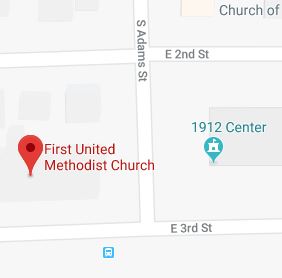
Sunday morning parking at the church is available in the high school parking lot on Third Street across from the church and in the city lots west of the church. These lots are available only on Sunday mornings. A small lot for handicapped parking is available just off of Adams Street on the north side of the church, with an accessible entrance directly into the sanctuary. A lift operates between the Fellowship Hall (3rd Street level) and the Sanctuary. William Sound System Receivers and Headsets are available to assist with hearing problems.
322 East Third Street
Moscow, ID 83843
Church Mission
The First United Methodist Church of Moscow, Idaho takes as our mission to be the body of Jesus Christ, ministering to a community which draws strength from its diversity. Our mission centers on the worship of God, expressed through varied forms of prayer, preaching, music, and ritual. See more...