

The Best Resume - March 13, 2016
How many of you have ever applied for some sort of scholarship? Some of you may be in the process of that right now, while others of us are more likely to be the ones who read those applications. This is when a student tries to present him or herself in the best possible light: not only your GPA but also the hardest classes you have taken, athletics and Scouts and music. "See what a great person I am," you say.
Job applications and resumes do much the same thing; they list a person's education and previous work experience, papers you have published, awards you've been given, and even volunteer activities. "Here is why you should hire me," you say to prospective employers.
In our reading today from Philippians, the Apostle Paul lists his credentials; "If anyone else has reason
to be confident in the flesh," he writes, "I have more: circumcised on the eighth day, a member of the people of Israel, of the tribe of Benjamin, a Hebrew born of Hebrews, as to the law a Pharisee; as to zeal a persecutor of the church; as to righteousness under the law, blameless."
Paul's credentials as a Jew were impeccable. From infancy on he had lived according to the requirement of the law. He could trace his family all the way back to the favored tribe of Benjamin. Though his family lived in the Greek city of Tarsus, he spoke Hebrew – an increasingly limited skill. He was such an ardent Jew that he became a Pharisee – a subset of Jews who worked extra hard at obeying the law. His zeal for the faith was unparalleled.
All of these were good things. Paul was proud of them and well respected by his peers for them. Writing to the Philippians, however, Paul looks at all his accomplishments and then says, "I regard them as rubbish." Rubbish is the way the New Revised Standard Version of the bible translates the word. The translators were being delicate here. The Greek word he uses actually means dung. You can perhaps think of some even more basic words which mean the same thing.
Paul looks at his religious resume and says, "this is dung." This is fit only to be flushed down the toilet.
As you know by now, this June I will leave Moscow to become the pastor of the Mill Plain United Methodist Church in Vancouver, Wa. You will receive a new pastor. A huge piece of me grieves at the thought of leaving Moscow – and you. I have loved being here.
After a great deal of prayer, I also feel I have given to this congregation the best I can give and after twelve years it is time for me to serve a new church and for you to receive a new pastor. I know some of you think that's overdue by several years. Others of you are not ready for it.
Methodist pastors do not send out resumes to prospective congregations. Instead we are appointed by our Bishop, who together with the District Superintendents, discerns the best match between pastors and churches. We don't submit resumes, but we can offer a profile which presents our gifts and graces. In past years, knowing that some wanted me to move I did send in a picture of my credentials. I have a Doctor of Ministry; under my leadership this congregation has expanded our outreach to include hosting Family Promise, sponsorship of three children at Jamaa Letu. We've attracted young families as seen by the six babies in last summer's bounty of babies.
And, by Paul's standards in Philippians, all those are dung. They are good things, and I'm proud of them and of this congregation. And with Paul I can say they are worthless.
Today is the fifth Sunday of Lent. If you have chosen to adopt some form of Lenten discipline the good news is that you have only two weeks to go before Easter Sunday. Perhaps you gave up chocolate, or fasted one day a week. Maybe you've gotten up early to pray. I've been trying to do a once a week examen, a self-examination, using I Corinthians 13, asking myself if I've been patient and kind or insisted on my own way.
Or maybe your Christian credentials include lifelong membership in the church, tithing your income, or committing to be in worship every Sunday. Those are all good things and I appreciate every one of you. And you know what Paul would say? "It's all dung."
Let's hear the fullness of Paul's words: "Yet, whatever gains I had, these I have come to regard as loss because of Christ. More than that, I regard everything as loss, because of the surpassing value of knowing Christ Jesus as my Lord." For Paul, all that he had once treasured, including his religious credentials, was nothing compared to the value of knowing Christ Jesus as Lord.
He goes on to say, "for his sake I have suffered the loss of all things, and I have come to regard them as rubbish" (read dung here) "in order that I may gain Christ and be found in him, not having a righteousness of my own that comes through the law, but one that comes through faith in Christ, the righteousness from God based on faith." Paul came to realize that he could not achieve righteousness on his own merits; not on family lineage, strict adherence to the law, or deep knowledge about the law. None of that mattered. What mattered was Christ.
"The righteousness that comes through faith in Christ."' I've always struggled a bit with this because it sounds to me like an emphasis on faith in Christ is just another form of works righteousness. Turns out there is a different way to translate it. Instead of saying "faith in Christ," an equally valid translation is "through the faith of Christ."
Faith in Christ becomes another human accomplishment. While there are people who boast about their faith, I know more people who wonder if they are really Christians because they fear death or other traumas, because they sometimes doubt that God exists, or they have never really had any sense of God's presence.
I like the alternative translation, "through the faith of Christ," because it puts the emphasis not on us but on Christ. And Christ had enough faith in us that he came to us. God took the initiative and was born among us as a human child. God's love is so profound that God believes in us, like a parent who stands at the sidelines cheering, "You can do this!" as her child runs in a race. Lo and behold, the child who doubted he could even run completes the race.
When the emphasis is on God then my own achievements seem less notable, including belief itself. It begins and ends with God.
That doesn't mean that what I do or say or even believe doesn't matter. Paul goes on to say, "I want to know Christ and the power of his resurrection and the sharing of his suffering by becoming like him in his death"
As Christians we are called to share in Christ's suffering. We get a teeny, tiny glimpse of that through our Lenten disciplines. Not eating chocolate for seven weeks is at most a trivial sacrifice compared to Christ's death on the cross – and giving up a pleasure is still a step. Some of you share in Christ's sufferings by agreeing to serve as overnight hosts for Family Promise even though you know you won't sleep well that night. Or perhaps you sacrifice your preferences – style of music or a church goal – for a larger purpose. Some of you have hung on here at church even though you thought I should have moved four years ago. And now some of you will stick with this church even though you wish I could stay here and maybe you are a bit hurt that I am going. We let go of our preferences for the broader good of the church and for the ultimate purpose of Christ.
Jesus' humility and death are both the basis and the pattern of the Christian life We not only do not get our own way; we recognize God can be at work in the very things we do not like.
"I want to know Christ and the power of his resurrection." We share in the risen life of Christ. Yes, we certainly look ahead to the hope of immortality – that we will live on even after our bodies die. We look forward to the promise of heaven and the chance to meet again with our loved ones who have preceded us in death.
Sharing in the risen life of Christ is more than the hope of heaven, for the power of Christ's resurrection comes to us in our earthly lives.
Our best resume turns out to be Christ.
Current Church News
Get Directions
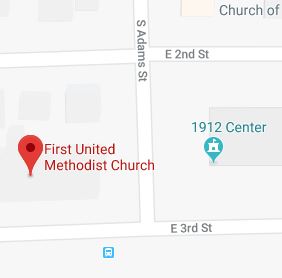
Sunday morning parking at the church is available in the high school parking lot on Third Street across from the church and in the city lots west of the church. These lots are available only on Sunday mornings. A small lot for handicapped parking is available just off of Adams Street on the north side of the church, with an accessible entrance directly into the sanctuary. A lift operates between the Fellowship Hall (3rd Street level) and the Sanctuary. William Sound System Receivers and Headsets are available to assist with hearing problems.
322 East Third Street
Moscow, ID 83843
Church Mission
The First United Methodist Church of Moscow, Idaho takes as our mission to be the body of Jesus Christ, ministering to a community which draws strength from its diversity. Our mission centers on the worship of God, expressed through varied forms of prayer, preaching, music, and ritual. See more...