

The Ministry of Reconciliation - March 6, 2016
In case you hadn't noticed, our country is in the middle of an election year. Candidates for President move from state to state as primaries and caucuses are held. The rhetoric becomes more heated as the season progresses. Right now that battle is on within political parties so that people who actually have a lot in common with each other try to distinguish themselves to gain their party's nomination. Sadly, it often leads to negative ads and even name calling.
Along the way the two major parties also criticize each other, implying or even stating outright that the other party's policies are leading this country to doom.
As the rest of us listen to the various candidates, we too can get caught up in heated debates with each other. Family members and good friends who have different opinions can become estranged. It
happens on both sides of the political divide as people's passions separate them from each other.
People are estranged from each other by any variety of things. Brother George never paid back that loan from Grandpa, so Sister Joan is angry that George got the same amount of inheritance as she did when Grandpa died. "Mom always did like you the best and let you get away with murder." When a couple divorces, their friends and even their church seem to get divided up in the custody battles, though seldom by a court of law. People who used to be good friends are as estranged as the couple.
The Apostle Paul had founded the church in Corinth. He lived there for a year and a half and continued to relate to them after he left. He wrote at least four letters to them and they clearly wrote back to him. As much as they loved each other, they also had their difficulties. We've been following their correspondence for much of this winter. We've seen how Paul chastised them for their foibles. He refers to one of his missives as the painful letter. They risked becoming estranged from each other.
Estrangement – think about that word. The root of it is "strange." At core it seems to imply becoming strangers with someone who was once a good friend.
"What a friend we have in Jesus," we just sang. We often become estranged even from God. The Greek word for sin means missing the mark. We miss the mark when we fail to love our neighbors as ourselves. We miss the mark when we do not love ourselves. We miss the mark through sins of commission: wrong acts, from lying to cheating on a test to telling a hurtful joke. We miss the mark through sins of omission – the good things we fail to do: keeping quiet when someone gets picked on at school or not bothering to pick up the litter someone else left on the trail.
I also define sin as anything that separates us from God, anything that estranges us from God. I've known people who resented God because of some tragedy in their lives. "I prayed and God did not heal Bob from his heart attack," said one woman after her husband died. Three months later she told me she couldn't pray. "Why does God do this to me?" another man asked after his wife's sudden death and his own financial woes.
In those cases, it was not that people had done anything wrong, but that God did not live up to their expectations. The process of grief often includes anger and depression, which can lead us to pull away from God. It's ok to be angry with God. Just read the Books of Psalms and Jeremiah. Anger at God is not a sin, as long as one is willing to tell God about it. Unexpressed anger, like giving your spouse the silent treatment, however, can separate us from God.
More often we separate ourselves from God by putting things before God. They can be good things: family, sports and other fun activities, even success like working to get good grades in school or win a promotion at work. The problem is when those things become so important to us that we forget about God.
In our reading today from 2 Corinthians, the Apostle Paul writes, "in Christ, God was reconciling the world to himself, not counting their trespasses against them." No matter what separates us from God, anger and disappointment, the misuse of good things, or even the value on bad things, God works to bring us together again, to reconcile with us.
Reconciliation is the work of God. Paull uses the word reconciliation only to talk about God. The amazing good news of our faith is that God came to us to cross the barriers that separate us from God. We don't have to earn our way to heaven. Indeed, we cannot. God took the initiative by coming to us as one of us, by letting go of divinity and taking on human flesh and being born as Jesus.
Paul notes of himself that he used to judge Jesus from a human point of view. He looked at Jesus' worldly accomplishments and found him wanting. But after the Risen Jesus appeared to Paul on the road to Damascus, Paul recognized that in Jesus God had done a new thing and that changed everything. "So if anyone is in Christ, there is a new creation; everything old has passed away: see everything has become new!"
Because God came among us in Jesus, God has reconciled with us. Because God came among us in Jesus, God has reconciled US.
Reconciliation includes forgiveness. God does not keep a tally of the wrongs we have done, nor of the good we have failed to do. When reconciling our account, God erases all our sins and simply comes to us to make things right.
In Greek the word reconcile means to alter or to make otherwise. God's reconciliation is more than just an electronic transaction – it is a spiritual transformation. God makes us otherwise than we were.
Paul's very existence was altered in light of God's work in his life. Once a persecutor of the faith he became Christianity's most ardent promoter and was himself persecuted.
We too are new creations in Christ. Jesus has taken on himself all that might have once estranged us from God. Angry and resentful because God didn't answer your prayer in the way you wanted? Most of us have been there and likely will be again. Jesus can handle your anger and pain and comes to us each to say, "I understand, I too have felt abandoned by God. And I love you." Guilty and ashamed because you have sinned? Jesus proclaims, "Your sin is forgiven."
Paul went on to say to the Corinthians, these people from whom he was estranged, "In Christ God was reconciling the world to himself, not counting their trespasses against them, and entrusting the message of reconciliation to us." Forgiven by God, we are then freed to forgive others. "We are ambassadors for Christ," Paul tells us.
An ambassador is an official representative of someone or something else. The US ambassador to China does not live in Washington DC. The ambassador lives in Beijing.
As ambassadors of Christ we are the visible representation of Christ to the world. We carry the message of Christ through our ministry of reconciliation. We don't stay at home. We don't live in heaven. We live out that reconciliation in the world
In this Lenten season, I ask you to reflect on the spiritual discipline of reconciliation. From whom are you estranged and where do you need to go to be reconciled? Perhaps it means getting on a plane to go visit your brother in Buffalo, NY to tell him you love him and forgive him for never paying back that $10,000 Grandpa loaned him? Or inviting your old friend out to lunch so you can learn to be friends again after you spoke out for her ex-husband in the custody hearings. Perhaps you need to go visit your nephew with whom you exchanged angry words because you each support different candidates for President. You will likely never agree – and you can recognize that you both want the best for our country even if you disagree on the best way to make that happen.
Those are HARD things to do. They take a lot of prayer and that faith to know that as God has forgiven you, so you can forgive others. God has entrusted the ministry of reconciliation to us. We are a new creation. Thanks be to God.
Current Church News
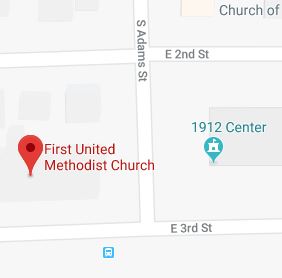
Get Directions
Sunday morning parking at the church is available in the high school parking lot on Third Street across from the church and in the city lots west of the church. These lots are available only on Sunday mornings. A small lot for handicapped parking is available just off of Adams Street on the north side of the church, with an accessible entrance directly into the sanctuary. A lift operates between the Fellowship Hall (3rd Street level) and the Sanctuary. William Sound System Receivers and Headsets are available to assist with hearing problems.
322 East Third Street
Moscow, ID 83843
Church Mission
The First United Methodist Church of Moscow, Idaho takes as our mission to be the body of Jesus Christ, ministering to a community which draws strength from its diversity. Our mission centers on the worship of God, expressed through varied forms of prayer, preaching, music, and ritual. See more...