

Nice To Meet You - July 3, 2016
Introduction (@ welcome): Our sermons series this summer will be looking at different scriptures from the book of Romans. You might wonder, "Why Romans?" Well, for starters, as I prayed about what to preach with you, the answer that kept coming back to me was, "Romans." And as I looked at the book, which I love, I was reminded that this is one of the most comprehensive explanations we have in the New Testament of what Jesus did and why it matters. (Paul also tends to address some issues in the early church that still have some resonance today.) So we're going to be hearing about forgiveness and salvation and all of the amazing things God does for us through Christ Jesus and hopefully finding some of God's amazing saving grace in the middle of it all.
Now that's pretty cheery now isn't it?! It's not. I get that. I know that. But here's the deal, God said preach Romans, so I said ok, and then I came back and re-read chapter 1 and went, really God!? You
want to start here? At a new church? Oh man they're gonna love me! And God said, "well, lucky for you, it's not about you, it's about me, and all of humanity starts in the same place without me: in sin."
So here we are, sitting with the Roman church, being asked to answer the question, "Why does faith in Jesus matter anyway? Who needs saving anyway?!" And Paul, very simply, answers back: "All of us need saving. All of us. Jews and Gentiles. New believers and non-believers, we all need saving." That's the summary statement, but before we can really get that and be ok with it, it's helpful to have a little orientation. And since we're going to be in the book of Romans for a few weeks, it's worth a little extra time.
So, what do we need to know in order to understand the book of Romans?
• Rome was a cultural hub, meaning there were a lot of people, with diverse backgrounds, speaking many languages, from a variety of countries, practicing multiple religions.
• Roman church leaders were not the first disciples, which is significant because it means those who were conveying the message of Christ, were doing their own interpretation, based on their own world views. In a lot of ways, Paul had to come in and draw everyone back to the central beliefs that really mattered.
• Romans is an epistle, which is the fancy way of saying it's a letter. A letter is responsive, Paul is replying to the complaints, frustrations and issues he has read about from the Roman church. But we never get to see the letter Paul received from the church, so we have to read between the lines, sometimes guessing, about what the original complaint or frustration was.
• The church is composed of Jewish believers (religious Jews who accept Jesus as the Son of God and as their Savior) and there are Gentile believers (who may have been pagan, or believed Greek Mythology, or been agnostic and have come to belief in Jesus)
o There are obvious issues in merging these communities
They ate differently
They lived differently
From a Jewish perspective, you have to follow the law and be ritually clean in order to draw close to God.
• Gentiles didn't do those things or keep those laws, so how could they draw close to God?
• From a Jewish perspective, if the Gentiles wanted a relationship with God, they would have to learn to follow the laws.
o So, which laws were of utmost importance
Those that related to the covenants...primarily the covenants with
• Moses—the 10 commandments
• Abraham—that they would follow the laws and God would bless him and his descendents.
Food laws—keeping kosher—eating the "right" foods and not eating the "wrong" foods.
So once we understand the basics about the book of Romans and who is involved and what's at stake, we come to our questions for today: Why do we need the Gospel? Who needs saving anyway?
We all know "they" do. They need to be kinder, more loving, less selfish, more generous, less indulgent, more compassionate, and way less proud. Some of "them" are so far gone it hardly seems like God has a chance of fixing them at all.
That's, essentially, what the Jewish believers thought about the gentile believers. And, it makes sense if you think about it. Here the Jews had had a relationship with God for a couple thousand years. Generations upon generations of Jews had followed God. They were brought in with the covenant with Abraham, it was reinforced with one with Moses, and then again with another covenant with David.
God had rescued, led, disciplined, taught, and saved them for what seemed like forever. And, as every good Jew knows, when you follow God, you have to do certain things. There are rules to be followed and everyone knows when you don't follow God's rules, the hammer falls.
And so, when the Gentiles come, the Jewish believers want them to do what is right and to do what is right means following God's rules. The 10 commandments are obvious, but the rules also include circumcision as part of the covenant with Abraham, keeping the Sabbath holy, and keeping kosher laws. But the Gentiles had been convinced to follow a man, not a law and so their obedience to the law left a lot to be desired.
--
So if the issue is following the rules vs. not, why is Paul starting off talking all about sin?
Well, part of the struggle over the value of the law and who should follow which laws boils down to an argument about which laws matter and which sins are worse. So some say, "well, you're unfaithful b/c you won't get circumcised" and others say, "well, you're a bunch of hypocrites because you love the law more than you love God." And it all kind of goes downhill from there.
So Paul simplifies the argument and says the problem is about sin. It's about the liars, the murderers, the gossips, the thieves, the adulterers, the proud, the greedy, and the gluttonous. God is dealing with them and in many ways dealing them, meant allowing them to exercise free will. What they chose to do became their choice and their responsibility. God was allowing them to suffer the consequences of their own sin. And where some are inclined to say, "Well thank God, someone is finally addressing their problem, Paul is saying, "NO! This isn't about them. This is about us. This is about you. This is about me. This is about him. This is about her. No, their sins are not good, but yours aren't either. You seem to think that because you know the rules and are part of the "faith community" that you've moved beyond reproach. But you haven't. You're a sinner too. So this isn't about "them" and it's not just about you either. It's about US. We are sinners. We are disobedient. We walk away from God. We refuse to follow the law. We go our own way and do our own thing believing that we have a better grasp on things than God and that's sinful too!
So let's stop seeing insiders and outsiders. We are all in the same sinking boat of sin and we all need saving. But we won't look for saving if we can't see we're sinking. We have to first see that our sinfulness is a problem before we will ever try to have anything different. So today we're going to call it what it is. We're gonna call the other what they are and be called what we are. We are sinners.
Hi, my name is Debbie and I am a sinner. It's nice to meet you.
And the proper response is, "Hi Debbie. You are a sinner. It's nice to meet you."
That's my truth. I am a sinner. You're not slinging mud or calling names—you're speaking truth. I am a sinner. AND so are you. So I want you to try it. I want you to turn to a neighbor, maybe 2 so everyone has a chance to be really honest. Claim your truth.
Hi, I'm _______________. I'm a sinner.
Hi ______________. You are a sinner.
We are sinners. That's the truth of where we all start. No one is exempt. I'm a sinner. You're a sinner. He's a sinner. She's a sinner. Us in here and them out there. We are all sinners. And because of that we need grace. That's where our story starts, essentially, admitting we are sinners in need of grace and then looking to God to find that forgiveness.
We're going to hear a whole lot more about God's grace in the coming weeks. Today we are focusing on accepting our sinfulness, repenting of it and (re)beginning our journey with God. This may be old news to you, and that's ok. Even those of us who have been hearing these things for decades still struggle with sin—we are sinners in need of saving. So we all come as equals to the table of God to receive forgiveness and grace through Holy Communion.
Current Church News
Get Directions
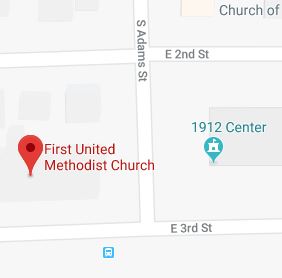
Sunday morning parking at the church is available in the high school parking lot on Third Street across from the church and in the city lots west of the church. These lots are available only on Sunday mornings. A small lot for handicapped parking is available just off of Adams Street on the north side of the church, with an accessible entrance directly into the sanctuary. A lift operates between the Fellowship Hall (3rd Street level) and the Sanctuary. William Sound System Receivers and Headsets are available to assist with hearing problems.
322 East Third Street
Moscow, ID 83843
Church Mission
The First United Methodist Church of Moscow, Idaho takes as our mission to be the body of Jesus Christ, ministering to a community which draws strength from its diversity. Our mission centers on the worship of God, expressed through varied forms of prayer, preaching, music, and ritual. See more...