

What Do You See? - April 24, 2016
"Then I saw." "I saw." Both of our Scripture readings today use those words. It might be easy to miss their significance. In both cases they mark transformative experiences and major turning points in the story of faith. "Then I saw;" when we read those words we know something big is going on.
"In a trance I saw a vision," Peter said to the apostles in Jerusalem. To really understand the significance of Peter's vision we need to know the rest of the story. Peter had been staying in the city of Joppa with Simon the tanner. In itself, this was highly unusual. Tanners cured the skins of animals --- to state
the obvious, of dead animals. Jewish purity laws, which guided Peter's life as a faithful Jew, stated that contact with anything dead made a person ritually unclean. So most Jews did their best to avoid contact with anything dead, and yet Simon Peter stayed with Simon the tanner.
Maybe it's not surprising then that Peter dreamed about uncleanness. He saw in his vision a large sheet let down from heaven filled with all sorts of creatures which Jewish law regarded as ritually unclean, not kosher, not fit for human consumption. Yet in the dream Peter heard a voice tell him, "Get up, Peter, kill and eat." Good Jew that he was, Peter refused. Three times the vision came and three times the command was repeated. The repetition reinforced the importance of the message.
At that moment Peter got a visit from a delegation sent by a Roman Centurion named Cornelius. I assume they are soldiers and they asked Peter to come with them to meet their boss. Cornelius too would have been a Gentile, unclean to a Jew like Peter. Peter went, and as he mets with Cornelius and his companions, the Holy Spirit fell on them.
As we read this morning, the "circumcised" believers, meaning Jewish Christians, criticized Peter, "Why did you go to uncircumcised men and eat with them?" Peter was breaking all the rules and it raised their anxiety level. Table fellowship between Jews and Gentiles was scary stuff. For Jews to eat with Gentiles almost made them Gentile. The only way the early church could think of to resolve this problem was to make the Gentile believers Jewish by circumcising the men and requiring everyone to live by the Jewish dietary restrictions. The hallmark of the early church was that all believers were of "one heart and soul" and it was hard for them to imagine this unity without adherence to the Jewish customs.
But then Peter saw the sheet let down from heaven. Peter heard God say to him, "What God has made clean you must not call unclean." And as Peter told the story to the other Jewish Christian leaders they too saw a new direction in God's redemptive plans. Christianity was not simply an adaptation of Judaism: it was a brand new thing. It will take another four chapters in Acts before everyone else really gets it, but Peter's vision is the start.
Now let's turn to our reading from the Revelation of John. It begins, "Then I saw." John the Evangelist, as he is called to distinguish him from all the other Johns in the New Testament, saw, "a new heaven and a new earth," and soon, "And I saw the holy city, the new Jerusalem, coming down out of heaven from God."
As he saw these new things, John also saw, "for the first heaven and the first earth had passed away, and the sea was no more." Those of us who love to walk by the ocean, to listen to its pounding surf, to feel the salt spray on our faces, wonder a bit at that phrase, "and the sea was no more." To understand we need to recognize that for much of the Bible the sea was a sign of turbulence and chaos. You don't know what lurks in its depths. It was from the sea that Leviathan, the great monster, came. Earlier in Revelation John said, "And I saw a beast rising out of the sea, having ten horns and seven heads." So for John to say, "And the sea was no more," was a sign that evil has been banished.
"Then I saw." In the new heaven and earth, in the new Jerusalem, came an echo of the story of creation from the first book of the Bible. God's new creation will be one of hope restored.
John not only saw, like Peter, he heard. "I heard a loud voice from the throne saying, "see the home of God is among mortals. He will dwell with them, as their God; they will be his peoples, and God himself will be with them." The true goal of life and the destiny of creation itself is to be taken into the life of Jesus. In Jesus God lived among us for a time. Some seventy years after Jesus ascended to heaven, John saw that God's home continues to be in the hearts of mortals. Two thousand years after Jesus' earthly life the truth continues to come to us today. God dwells with us.
Peter and John saw God's vision for a new future. Peter saw the faith of those early believers leading them across social and religious barriers they had never dreamed of crossing. Peter basically saw a new church which welcomed both Jews and Gentiles.
John saw a new creation. In a world that was filled with persecution and violence, he saw an end to evil. He saw hope restored. He saw a new beginning.
I began work here on July 1, 2004. I saw a congregation which had come together in a spirit of generosity and commitment to remodel an aging building. As a result, I saw a beautiful facility which testified to the glory of God. I saw a congregation united by the marvelous work they had done together and also a bit weary from their labors.
I saw a church building which could have become a shrine, set aside to be carefully preserved. "No red punch at coffee hour or tomato based dishes at potlucks," someone had proposed. I also saw potential for this great building to be opened to the community.
What do I see now? The carpet in Epworth Hall often needs to be cleaned because it gets dirty from so much use. I see the church calendar so full that it takes patience and good will to fit everything in. Sunday nights there's a large AA group; Tuesdays is Palouse Harmony Chorus. Sesitshaya marimbas, Boy Scouts, and often church committee meetings; Wednesday is bell choirs and Girl Scouts; Thursdays is choir, and Brownies or Daisies, and sometimes Cub Scouts; Saturday nights is youth group and AA again. And those are just the regular things each week. Last night there was a Boy Scout spaghetti feed, after worship a Baked Potato Bar, and tonight we'll welcome Family Promise for the week.
What do I see now? A congregation ready to respond at a moment's notice to crisis, to offer a space for the community to grieve together. I see a congregation which welcomed the neighborhood into our church when the High School principal called to say, "they're gutting the annex and I need space for classes to meet." I see the Body of Christ which recognizes that the building is a tool for ministry.
Twelve years ago I saw some children, maybe four or five at any given Children's Moment. I saw a youth group which was leaving the next week on a mission trip. What do I see now? Sometimes as many as twenty children at Children's Moment, not counting those who have aged out or who are too small to come forward. Easter morning I got here at 6:15 to find the youth group, a bit groggy, to be sure, starting to prepare breakfast for the congregation.
What did I see twelve years ago? A congregation with some interest in mission but mostly done by sending checks for disasters. What do I see now? Habitat for Humanity volunteers pounding nails, Family Promise volunteers making beds or serving dinner, a joyful Africa Day festival which helps us to pay our Africa University apportionment and our sponsorship of orphans at Jamaa Letu.
The question now is what do you see? Be ready to share your vision with your new pastor come July 1. What do you see? The vision must come from God and I challenge you to watch for it and then to make it a reality.
Current Church News
Get Directions
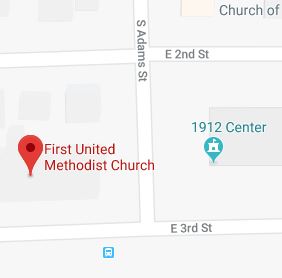
Sunday morning parking at the church is available in the high school parking lot on Third Street across from the church and in the city lots west of the church. These lots are available only on Sunday mornings. A small lot for handicapped parking is available just off of Adams Street on the north side of the church, with an accessible entrance directly into the sanctuary. A lift operates between the Fellowship Hall (3rd Street level) and the Sanctuary. William Sound System Receivers and Headsets are available to assist with hearing problems.
322 East Third Street
Moscow, ID 83843
Church Mission
The First United Methodist Church of Moscow, Idaho takes as our mission to be the body of Jesus Christ, ministering to a community which draws strength from its diversity. Our mission centers on the worship of God, expressed through varied forms of prayer, preaching, music, and ritual. See more...