

Remember Your Baptism - February 28, 2016
Today is the third Sunday in the season of Lent, which means we are almost halfway through this holy time. You may remember that Lent began as a time of preparation for candidates who would be baptized on Easter Sunday. Over the years it expanded to be a time of renewed devotion to God for all Christians. Even those baptized years ago, perhaps as infants, can use the forty days of Lent to reflect on the meaning of their baptisms. Remember your baptism and be thankful.
In our reading this morning from I Corinthians, the Apostle Paul challenged the Christians in Corinth to reflect on their baptisms, though his imagery is so bizarre it takes some work to unpack it. We've been reading from Corinthians since before Lent began. I've been telling you how they divided into factions and fought about spiritual gifts. Just prior to our reading today, Paul had challenged them to work together so that those whose faith was stronger supported those with weaker faiths. The issue for
them was eating food which had been sacrificed to pagan idols. Most food sold in marketplaces at that time came from that source. Even if they had not been present at those sacrifices, some new Christians feared that eating the food violated their new found faith in Christ. Others poo poed such concerns, noting that those idols were not God and meat was meat, kind of like alcoholics with years of recovery can eat a hamburger while beer is served to someone else with no fears of relapse. Paul emphasizes that the important thing is to care for each other, so if a person who only stopped drinking last week is along it's better to avoid a place where alcohol is served.
It's in this context then, that he considers baptism. Apparently some of the Corinthians saw their baptisms as a sign of special status or even a magic shield to ward against evil. Having been baptized they had become smug and overconfident.
To address this problem, Paul reaches back to the story of the ancient Israelites as they left slavery in Egypt and wandered in the wilderness. "Our ancestors were all under the cloud, and all passed through the sea, and all were baptized into Moses in the cloud and the sea." This is confusing. Let's go back to the story of the Israelites. God had led them by a pillar of cloud. Sometimes the cloud was behind them to protect them and sometimes it moved in front of them to guide them. A Jewish midrash, or story, suggested that when the cloud moved it passed over the people and got them wet, like walking through a fog bank can leave you damp. This, Paul says, was a sort of baptism. So too was walking through the Red Sea as they fled the Egyptian army. Those experiences with water prefigured the Christian sacrament of baptism. When we give thanks over the water in the service of baptism, we too remember, "When you saw your people as slaves in Egypt, you led them to freedom through the sea."
In the same way, Paul connects the Christian sacrament of holy communion with the manna the Hebrew people ate in the wilderness and the water they drank from the rock. Again he draws on a Hebrew midrash and applies it to Christ. The midrash says that as the people wandered in the wilderness the rock from which they had drunk followed them, so that no matter where they went they had water to drink. Paul says that rock was Christ.
These details seem a bit bizarre to us. Crazy as they are, Paul's point has truth for us now as it did for the Corinthians. The story of the ancient Hebrews became the story of the Corinthians and both, across the ages, become our story here today in Moscow, Idaho.
Paul notes that even though those ancient Hebrews got to experience God's protection and care through some of the most amazing miracles in the Bible, when they sinned, God still punished them. Being a part of the crossing of the Red Sea, the cloud, the manna, the water from the rock did not guarantee God's favor. "Nevertheless, God was not pleased with most of them, and they were struck down in the wilderness." So, Paul says to the Corinthians, "your baptism is not fire insurance or a guarantee of salvation. Taking communion on Sunday doesn't mean you have swallowed a magic potion against the evils of this world."
Sadly, the sacraments themselves have been a major source of division within Christianity. Roman Catholics and the Orthodox Church have seven sacraments. Protestants have two. We disagree about how much water to use in baptism or how old a person must be. We can't agree about wine or grape juice for communion. Some churches have communion every week while others of us average about once a month.
When I was working on my Doctor of Ministry we met for ten days at a stretch in cohorts of about a dozen students. Over the weekend we went on a retreat at a lovely center in the woods of western Oregon, about an hour's drive from Lincoln City. One Saturday afternoon we were given several hours of free time. The only other woman in my cohort, Chris, an American Baptist pastor, asked who wanted to go to the beach. I said I did so the two of us headed out. After sitting in class for eight hours a day, I was ready to move and a walk on the beach sounded perfect, even if it was January. After we had walked for a bit, however, it started to rain so Chris said, "I'm going back to the car." I wasn't done, so I kept going. By the time I finished my walk it was raining steadily and I was soaked. I noted later to the group, "The Baptist only got sprinkled but the Methodist got immersed." Our cohort included several Quakers. Quakers don't practice any sacraments and joked they do dry cleaning instead. Denominations differ about the sacraments.
Still, Christ's church is divided over the sacraments, among other things. Paul would be dismayed, for the sacraments are to unify us in Christ. In the next chapter of I Corinthians, Paul says, "Because there is one bread, we who are many are one body, for we all partake of the one bread." We use these very words during the breaking of the bread in Holy Communion. Baptists or Methodists, Catholics or Orthodox – we are all part of the one body of Christ. Liberal or Conservative, Progressive or Fundamentalist, we are all one body. It is no coincidence that in the first four verses of our reading today Paul uses the word "all" five times. To the Corinthians divided over spiritual gifts or which leader to follow, Paul said, "all" – all are in the body of Christ.
The good news for the divided church of today is that the sacraments are also a hint of the unity that is to come. They give us a little glimpse of what God has in store for us at the end of time. That crumb of bread and the few drops of juice in communion are a foretaste of heaven, like an appetizer we eat before the main meal that whets our appetite for the good things still bubbling away in the kitchen. Whether it is sprinkling or full immersion, the waters of baptism are just a hint of the deluge of the grace and forgiveness God has in store for us.
"So if you think you are standing, watch out that you do not fall," Paul warned the overly confident Corinthians. "No testing has overtaken you that is not common to everyone. God is faithful, and he will not let you be tested beyond your strength, but with the testing he will also provide the way out so that you may be able to endure it."
God is faithful. The blessings we know, be they the sacraments themselves or the riches of this earth, not only tell us of God's care, they challenge us to share with others. With great privilege comes great responsibility.
The steel magnate Andrew Carnegie is even better known today as a philanthropist. His biographer, David Nascow, wrote that Carnegie believed, "It is his responsibility to give it back, to return it to the community because the community – all of those men and women who contributed to the making of Carnegie steel, the mothers who fed their children, the day laborers, the whole large community – is responsible for making this wealth, and they're the ones who have to get it back." Our own public library, just a block from this church, was one of the last libraries to be funded through the Carnegie Endowment.
As those who are marked with God's favor in the sacrament of baptism, we are tasked with the responsibility to share. We do it by opening our building to others, from Scout groups to the Palouse Harmony Chorus, to the Border Highlanders' Pipe and Drum, who a few weeks ago made haggis here to serve at their Robert Burns Dinner at the 1912 Center. We welcome homeless families. We sponsor orphans in the Democratic Republic of the Congo. And we share the good news of Christ by singing God's praises, by sending our bell choirs to play at nursing homes. Last week Tommy's Tinklers, along with several others of us, went to Lapwai to play for them and to learn from them the challenges facing the Nez Perce peoples.
We know God is faithful. I pray that we too can be faithful. Remember your baptism.
Current Church News
Get Directions
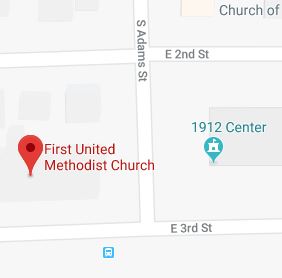
Sunday morning parking at the church is available in the high school parking lot on Third Street across from the church and in the city lots west of the church. These lots are available only on Sunday mornings. A small lot for handicapped parking is available just off of Adams Street on the north side of the church, with an accessible entrance directly into the sanctuary. A lift operates between the Fellowship Hall (3rd Street level) and the Sanctuary. William Sound System Receivers and Headsets are available to assist with hearing problems.
322 East Third Street
Moscow, ID 83843
Church Mission
The First United Methodist Church of Moscow, Idaho takes as our mission to be the body of Jesus Christ, ministering to a community which draws strength from its diversity. Our mission centers on the worship of God, expressed through varied forms of prayer, preaching, music, and ritual. See more...