

Parts Is Parts - January 31, 2016
The ad from Wendy's restaurants shows a fast food customer receiving an order of chicken nuggets and asking what part of the chicken they came from. The clerk explains they came from many parts. The customer looks confused and a bit revolted. "What parts?" he continues to ask and the clerk concludes, "Part is parts."
Do you know how many parts there are in the human body? According to my commentary and backed up by that source of all information, Google, there are 206 bones, 639 muscles, about six pounds of skin (on an average person, whatever that means), and miles of blood vessels, nerves and, of course, ligaments and other tissues. Parts is parts, right? Except, of course, the thumb bone and the skin on my nose and all my other parts are each distinct from each other even if they are all on the same body.
As we think about the parts of our bodies, I would like us to participate in a simple exercise. Reach out the index finger on your dominant hand and touch the tip of your nose. Think for a moment about the many parts involved: eyes, muscles in your fingers, hand, arm, and even shoulder, all the blood vessels, nerves and ligaments, not to mention your nose itself, and really your heart, lungs, and brain which keep all your parts alive. I'm surely missing many. A simple exercise which requires the coordination of so many parts.
The image of the many parts in the human body has been used over the ages to teach a variety of things. In the first century several authors used it to remind those of low status just what their place was. "You are a lowly big toe and don't you forget it!" they said, in essence. The bigwigs of their day made sure to put ordinary people in their place.
The Apostle Paul took this image of the human body and did a radical thing: as God does over and over in the history of salvation, Paul lifts up the lowly.
A couple of years ago I got out of my car one icy day to walk a hundred feet or so to the house where a meeting was being held. As soon as I stood up my feet slipped and I sat down, hard. I soon found that sitting hurt. I'm pretty sure I broke my tail bone, which, again according to Google, is composed of 3-5 bony segments held in place by ligaments and joints. The tail bone doesn't do much. It's not like the jaw that chews our food or the femur that helps us stand and walk. And my broken tail bone made sitting down awkward for several weeks. During that time that lowly little bone seemed as important to me as my heart.
Paul used this imagery of the importance of even lowly parts in the body when he wrote to the church in Corinth. Bless those Corinthians, they pretty much wrote the book on church dysfunction: they argued over whose spiritual gift was more important, they divided into factions and fought about leaders, they even threw in a case of sexual misconduct for good measure. So Paul wrote for them a litany of examples, starting with, "If the foot would say, 'Because I am not a hand, I do not belong to the body,' that would not make it any less a part of the body." He goes on to say, "the members of the body that seem to be weaker are indispensable."
The Corinthians' tendency to promote those who had the gift of speaking in tongues as more important than those whose spiritual gifts were less flashy, failed to understand spiritual gifts. Even more seriously it failed to understand God. "For just as the body is one and has many members and all the members of the body, though many, are one body, so it is with Christ." The very nature of God is that of unity and diversity: one God in three persons. When we rip the church into factions, as happened in Corinth, we deny the essence of God.
All parts are necessary. We know these days through the marvels of medicine, that it is possible to live without certain parts. Some of you may no longer have a gall bladder or an appendix. People learn to walk and even run with prosthetic legs. Others live just fine with a section of their colons removed or no longer hear out of both ears. It is possible – and not ideal. Each part in the body plays an important role. So it is, Paul reminds us as he did the Corinthians, that every member of the church is necessary. I'm not talking here about formal membership in the church but about anyone who attends or is connected to First United Methodist Church in some way.
All the parts of our church are to be valued. My sermon today would reach only a few of you were it not for the sound techs who work in the background. I've lost track of the number of people who have told me, "I can't usually hear the joys and concerns shared so I really appreciate the email that goes out with the information." Most people don't even know who records those joys and concerns. When they asked for some time off last summer and we used only the blue cards people missed the spontaneity of the live sharing. Without people who show up on work days and Trustees who fill in at other time to do little chores like change light bulbs, we'd be in the dark. Then there are the people who build block towers in the nursery with toddlers or color pictures or play Chutes and Ladders during Activity time. Because of them children don't have to sit for a full hour in church and parents get a break. When we hold a reception for some reason folks show up to set up tables in Epworth Hall, serve coffee, and wash dishes. All parts are valued and I haven't begun to name them all.
This morning we gather to baptize CH. At four months she has yet to make a financial pledge. (Actually, I do not know who pledged but I think I'm pretty safe in assuming she didn't.) C can't record the joys and concerns, teach Sunday School, or sing in the choir. In fact, right now she needs a lot from us: loving arms to hold her and a safe place to be. Today we will pledge to do just that for her, not only now but for the next eighteen years.
And C, like our other children, is a valued and important part of the church. She brings us joy and life whether she is sleeping peacefully, cooing or crying. She can't change a light bulb and she brings us all light.
Paul says to us, "If one member suffers, all suffer together with it; if one member rejoices, all rejoice together with it". The parts of the body exist in mutuality. I hear the gasps of shock and sorrow when someone makes an announcement about a tragedy. I hear the applause and delight when someone announces a wedding anniversary, the expected arrival of a new child, or some other joy. I see the delight on people's faces as they watch the children race to the front. I see comments on Facebook where parents support each other by picking up someone's child at day care, taking in a meal, or offering advice about caring for a baby who is teething. We suffer and rejoice together.
A couple of months ago, someone asked at a Staff Parish Relations Meeting, "Where have all the teenagers gone?" We're still working on answering that question. It is important because every part of the church is important and youth are as valued as the babies or the elders. They are not the church of the future: they are the church of today.
I think I know where some of them are: basketball tournaments and other sporting events, part time jobs, and so many other activities. And I wonder, what if we learned to cheer for them, to rejoice with them at the thrill of victory and suffer with them in the agony of defeat? I'd love to find a way to share with the congregation their game schedules, recital nights, play dates, so that adults in the church could show up to support them. What if they got birthday cards or cards of the anniversary of their baptisms from people in the church?
Parts is parts: old parts and young parts, behind the scenes parts and up in front parts, practical parts and artistic parts. Whatever part you play, I thank God for you. Together we are the body of Christ.
Current Church News
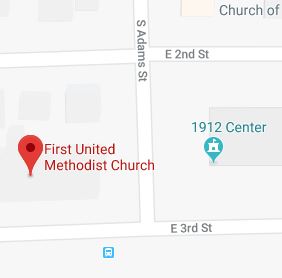
Get Directions
Sunday morning parking at the church is available in the high school parking lot on Third Street across from the church and in the city lots west of the church. These lots are available only on Sunday mornings. A small lot for handicapped parking is available just off of Adams Street on the north side of the church, with an accessible entrance directly into the sanctuary. A lift operates between the Fellowship Hall (3rd Street level) and the Sanctuary. William Sound System Receivers and Headsets are available to assist with hearing problems.
322 East Third Street
Moscow, ID 83843
Church Mission
The First United Methodist Church of Moscow, Idaho takes as our mission to be the body of Jesus Christ, ministering to a community which draws strength from its diversity. Our mission centers on the worship of God, expressed through varied forms of prayer, preaching, music, and ritual. See more...