

Will God Dwell On Earth? - August 23, 2015
God's presence among the people of Israel was often visible and nearly tangible. Back when Moses led them out of slavery in Egypt, God showed up in a pillar of fire by night and a pillar of cloud by day. When Moses went up Mt. Sinai to receive the Ten Commandments, he disappeared into a thick cloud on the mountain and the people knew for sure that he was with God.
Eventually the people made a tent to which Moses went to meet with God, who would descend in a cloud. The tablets of the Ten Commandments were placed in a box called the Ark of The Covenant. The ark symbolized for the people God's presence. It was so holy that only the priests were allowed to carry it, and even they could only touch the poles and not the ark itself. Most of the time it was kept in the tent of meeting. Sometimes it preceded the army into battle.
After King David established Jerusalem as his capital city, he brought the ark there in a grand parade. He danced before it with great joy. Once he had built himself a beautiful palace, David wanted to build a home for God, a permanent residence for the Ark of the Covenant. God, however, said, "No thanks." God preferred to be mobile and flexible. God did not want to be confined to one place. David was not the one to build God a temple. That job was left to his son, Solomon.
Our reading this morning tells about the dedication of the temple. The full story takes 66 verses, so we just read some excerpts from Solomon's prayer of dedication. Before that he had brought the Ark of the Covenant into the temple and a cloud filled the place. God had moved in.
These days God's presence among us is not as visible or as tangible. Try though I might to remember that God is present in the cloud, when I'm hiking at Mt. Rainier and a cloud covers the mountain, I just wish it would lift so I can gawk at the vistas. A cloud to me is just a cloud, though with the fires all around the west this summer, I do wish for rain.
God's presence is not as visible to us. Like John Wesley, we may feel our hearts strangely warmed. Those in the Pentecostal tradition speak in tongues. Few Methodists experience the Spirit of God in that way. We find God as we lift our voices together in praise, get a new insight at Sunday School, or enjoy each other's presence.
In our District, United Methodist Churches range from simple frame buildings to large brick structures. Our own First United Methodist Church is the most unique and inspiring church I know of. The original section, started in 1902 and the second part from the early '20's, were made of granite at the bottom and then basalt mined somewhere on Paradise Ridge for the rest. It is not uncommon for people to wander in off the street, curious about this place.
Our history has no record of a cloud filling the building when it was dedicated. And we believe God is present here. We come here for sacred rituals: baptisms, weddings, and funerals. We gather here each week to sing and pray and listen for God's word. That may come to us in the Scripture lesson, a sermon, a hymn or anthem, or perhaps in a Sunday School discussion. We break bread together in the sacrament of Holy Communion and know God is with us. We break cookies together in the sacrament of coffee hour and dish up casseroles in the holy ritual of potlucks. We know God among us as this building welcomes homeless families when we host Family Promise, when Alcoholics Anonymous gather around their sacred coffee pots to find a spiritual solution to their addictions that have often taken everything from them, when the Palouse Harmony Chorus sings in harmony, and when Scouts fill the building with their energy. God is present here.
As Solomon prayed at the dedication of the temple, he recognized that even though God had clearly shown up when the holy cloud filled it, God could not be confined to the temple. "But will God indeed dwell on the earth?" he asked. "Even heaven and the highest heaven cannot contain you, much less this house that I have built!"
There are a couple of big words to describe the two poles of God's nature: imminence and transcendence. Imminence tells us of God's presence in a close and personal way. God was imminent when God met with Moses in the cloud that came on the tent of meeting. God was imminent in the temple when the cloud filled it.
At the same time, Solomon recognized that God transcended even the holiness of the temple or the Ark of the Covenant. God was bigger than the ark. God was bigger than the most magnificent building. God was bigger than the people of Israel. Not even heaven can contain God.
Solomon's prayer asks God to hear them when they sin, individually or corporately; during times of need such as droughts or famine; and even when they go out to battle. The most surprising part of Solomon's prayer is when he asks God to hear the prayers of foreigners. The amazing thing about that request is that the most holy parts of the temple were limited to the priests. Only the high priest could go into the holy of holies where the ark was, and then only once a year. Outside of that was the Court of the Priests (for priests only), then the Court of Israel (for Jewish men), and then the Court of Women for Jewish Women. Gentiles, or non Jews, could enter only in the outermost court.
Yet Solomon prayed for God to hear the prayers of foreigners, of Gentiles. His prayer recognized that God transcends the restrictions of the temple itself and of the Hebrew society which avoided as much as possible any contact with Gentiles.
These days, I'm sorry to say, we are as likely to close churches as we are to open them. This year at Annual Conference we formally closed five churches, mostly in rural or inner city areas. We have started four churches a year, often with new models that do not involve permanent buildings.
Even as we close churches, however, we recognize that God transcends those buildings and the people who used to attend them. Their ministries continue in new ways.
One of the churches we closed this year was Kahlotus. Perhaps you have driven past the sign to Kahlotus on your way to Seattle. Maybe you've even taken the side road between Washtucna and the Tri Cities and so gone through Kahlotus. Most likely, however, you've never been to Kahlotus.
Kahlotus was never a large town, a few hundred at most. The church was never big. When the last active family stopped coming it was time to close. Churches have life cycles just like people do. One of the questions was what to do with the building? Once a church closes, the Annual Conference has to start paying property tax on it unless they find another solution. In Kahlotus' case there was a perfect solution. For a small sum it was sold to the city of Kahlotus. For them it was a miracle. They will move into the former church their library, the food bank, the Mayor's office, the community center, and even a check in spot for the sheriff's deputies.
Most of the buildings where those things used to take place were in poor shape. None of them were accessible. And the Mayor lives with spina bifida. She uses a wheelchair. The church is accessible and in better shape than most of the town.
The mayor wrote: "The hallowed and sacred halls which embrace in its rafters and walls the ceremonies, the weddings, the memorials, the fellowship, the mission-work, the whispered words of gratitude and desperation to our savior shall continue to be the safe and nurturing place it was created and christened to be. This transition has already begun to open friendships and dialogues that were not there before. It has sealed bitter feuds, and dried the blood of tragedies. It has buried hypocrisy in the capable depths of Mother Earth."
Will God indeed dwell on the earth? God is surely imminent, right here, right now and in this very place. God is among us today as God is present in Kahlotus as the mayor wheels to her office.
Even heaven and the highest heaven cannot contain God, much less the walls of any church building. God transcends the bonds of earth and the limitations of our minds. God brings life where we see only death. Truly, in Christ everything is a new creation.
Current Church News
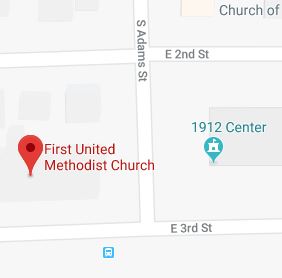
Get Directions
Sunday morning parking at the church is available in the high school parking lot on Third Street across from the church and in the city lots west of the church. These lots are available only on Sunday mornings. A small lot for handicapped parking is available just off of Adams Street on the north side of the church, with an accessible entrance directly into the sanctuary. A lift operates between the Fellowship Hall (3rd Street level) and the Sanctuary. William Sound System Receivers and Headsets are available to assist with hearing problems.
322 East Third Street
Moscow, ID 83843
Church Mission
The First United Methodist Church of Moscow, Idaho takes as our mission to be the body of Jesus Christ, ministering to a community which draws strength from its diversity. Our mission centers on the worship of God, expressed through varied forms of prayer, preaching, music, and ritual. See more...