

Justice Is Hard Work - Augurst 9, 2015
"O my son, Absalom, my son, my son, Absalom! Would I had died instead of you; O Absalom, my son, my son!"
King David's words of grief at the death of his son, Absalom, tug at our heart strings. Having watched my husband grieve at the deaths of two of his children, I have a hint of the deep pain bereaved parents experience. I think I actually quoted David's words to him when Matthew Scott died. Truly he would have given his own life in exchange for either Matt or Erin.
As poignant as David's words are, however, his cry of grief masks the full story. Always it is more complicated than it appears to be on the surface.
We've been following David's story for much of this summer, though even then our readings have missed some important pieces. Let's review:
After he became king, David stayed home from the war. He noticed a beautiful woman bathing, sent for her and slept with her. Actually, he raped her. After using her for his own pleasure, he discarded her like a used tissue until she sent word that she was pregnant. To make a long story short, David arranged for her husband, Uriah, to be killed in battle, and then married Bathsheba. The prophet Nathan predicted "Thus says the Lord, 'I will raise up trouble against you from within your own house.'"
We did not read how David's son Amnon raped his half sister Tamar, in an echo of David's own rape of Bathsheba. David did nothing to punish Amnon. I suspect it did not even occur to him that Amnon had done anything wrong. In his day women were second class citizens to be used for men's pleasure.
Tamar's full brother, Absalom, saw things differently. He waited for two years and when David had done nothing, Absalom took matters into his own hands. He killed Amnon. Then he went into exile, fratricide apparently being a worse crime than incest or rape in those days. He remained in exile for three years. Finally General Joab convinced David to allow Absalom to come home, though David still refused to see him.
At last father and son were reunited. In the seven years that had passed since the rape of Tamar, however, the damage had been done. Absalom began to sit at the city gates and to settle complaints, a role which should have been filled by the king. David's failure to mediate justice opened the way for Absalom to insinuate himself into the people's good graces. This went on for four years before Absalom began an open revolt to take the throne from his father. The civil war led to Absalom's death.
As we heard today even as the troops went out to battle, David pled for Absalom's life. General Joab, however, was not soft hearted and when Absalom was left hanging from an oak tree Joab did not hesitate to finish him off. David was left to cry, "O Absalom, my son!"
In light of the full story, you can perhaps see how David's grief seems a bit hollow. It had been eleven years since the rape of Tamar and an undefined period of time since David's rape of Bathsheba. In all that time David had failed to mediate justice. All the sentimentality in the world cannot replace the hard work of justice.
This summer, after the shooting of nine black people at a Bible study in Charleston, South Carolina, the movement to remove the Confederate flag gained strength. The South Carolina legislature eventually voted to remove it from state grounds.
That flag means different things to people. The primary objection to it is its connections to the Civil War. Many equate it with racism. Others, however, see it simply as an expression of their love for the south. Tony Burt, who grew up in North Carolina, commented that to him it represents the Dukes of Hazzard. That's the challenge with symbols: each of us sees them in our own way.
In the wake of the shootings at Emmanuel AME and a string of arson fires in black churches this summer, I've been reflecting on the Confederate flag. I don't support it. And whatever happens with the flag itself is less important than a deeper grappling with racism. The flag is just a symbol. Symbols have great power to move us. And at heart they are more about sentiment than justice.
Taking down the flag is comparatively easy. Justice is hard work. President Obama said in his eulogy for Clementa Pickney, "Maybe now we realize the way racial bias can infect us even when we don't realize it, so that we're guarding against not just racial slurs, but we're also guarding against the subtle impulse to call Johnny back for a job interview but not Jamal. So that we search our hearts when we consider laws to make it harder for some of our citizens to vote." Justice is hard work.
Justice takes a hard look at everything from economics to law enforcement, from education to employment. Those are so much harder to change than taking down a flag, important as that is. Justice is in the end about restoring relationships. It will also ask why it is that some people are so threatened by those who are different that they lash out in violence. Justice at its best would restore Dylann Roof with the families who told him they forgive him. Oh yes, justice is hard work.
This June the Pacific Northwest Annual Conference met in Pasco. This is the regional gathering of United Methodists. As some of you know I co chair the Worship Team. This year our theme was Restoring the Sacred Circle and the opening worship was An Act of Repentance for the ways the church has abused our indigenous peoples. Every Annual Conference is to do this, by mandate of the General Conference, which is the global arm of the United Methodist Church.
In my three years on the Worship Team this was the hardest task yet. We asked, "How do we do an act of repentance which moves from sentimentality to justice?" I know some of the history, and I learned more. During the 19th and 20th Centuries Indian children were taken from their families and sent to boarding schools designed to remove Indian culture from them. "Kill the Indian, save the child," was the philosophy. They were beaten for speaking their native languages. Often they were molested. When families kept contact with their children, the children were moved as much as 1500 miles away.
From the first introduction of Europeans to this continent attempts were made to exterminate Indian peoples through exposure to disease, killing of their food sources, and outright massacre. It was largely successful. Estimates are that there are only ten percent as many American Indians now as were here before Columbus bumped into what we now call America.
As we learned more of this history my team agonized. Sure, we can say, "We're sorry," but in itself that is an empty gesture. It's been said before and nothing changed. We can't take down the dams and restore the salmon runs at Celilo falls. We can't bring back the buffalo. We can't undo the abuse and horror of the boarding schools. "How", we wondered, "do we design an Act of Repentance that moves from sentimentality to justice?" Justice is hard work.
Thankfully we had help. Kristina Gonzalez, a Conference staff person, worked with us. She knows folks from the few remaining Indian churches. She connected us with Luci Simpson of the Lapwai church.
In the end we realized that the best thing we could do was to build relationships. We urged churches to get to know the tribes in their areas and to talk with them about local issues.
M R and A B were at Annual Conference as our representatives. They are recommending to our Church Council that we build a relationship with the Lapwai church which has several enrolled Nez Perce members. Justice is hard work. It means having the courage and taking the time to send people from Moscow to Lapwai, to meet people and to get to know them as individuals, to hear their stories.
Justice is hard work and I pray we will have the courage to move from sentimentality to justice. We cannot undo the abuse of the past. We can build a path to the future that lives in love.
Current Church News
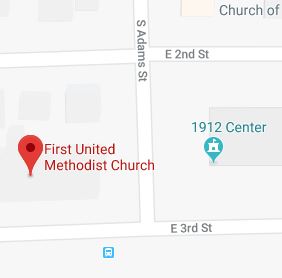
Get Directions
Sunday morning parking at the church is available in the high school parking lot on Third Street across from the church and in the city lots west of the church. These lots are available only on Sunday mornings. A small lot for handicapped parking is available just off of Adams Street on the north side of the church, with an accessible entrance directly into the sanctuary. A lift operates between the Fellowship Hall (3rd Street level) and the Sanctuary. William Sound System Receivers and Headsets are available to assist with hearing problems.
322 East Third Street
Moscow, ID 83843
Church Mission
The First United Methodist Church of Moscow, Idaho takes as our mission to be the body of Jesus Christ, ministering to a community which draws strength from its diversity. Our mission centers on the worship of God, expressed through varied forms of prayer, preaching, music, and ritual. See more...