

Hearing The Truth In Love - August 2, 2015
2 Samuel 11:26-12:13
Ephesians 4:1-16
Hearing the Truth in Love
A little over eight years ago, Doug and I attended the installation service for Kayle Rice as the new pastor at the Unitarian Universalist Church of the Palouse. Prior to the service, as we read through the bulletin, we noted that the congregation would charge their new pastor to "preach the truth as we see it." We nudged each other and wondered a bit at the wording. Sure enough, when the time came, the congregation dutifully said to their pastor, "preach the truth as we see it."
A few moments later the service included a time for a denominational official to speak. "That charge is supposed to be "preach the truth as YOU see it," she noted. I don't remember if she admitted that in all honesty, most congregations really want their pastor to indeed preach the truth as they see it, but it is true. Of course, in any congregation there are about as many understandings of the truth as there are people in worship. The pastor's job is to preach the truth as s/he sees it, which will nearly always leave at least a few people uncomfortable if not downright miffed.
Throughout the summer we have read a series of stories about the formation of the monarchy in Israel. Most of them have focused on David, from his anointing when he was just a red cheeked shepherd boy to his reign as king. Along the way these stories have led us to reflect on the use and abuse of power. We began when the old judge Samuel warned the elders of Israel that the king they requested was likely to use his power in unpopular ways. It was easy to cheer on David when as a boy he fought the giant Goliath. We reflected about how sometimes it is the seemingly little people are called to confront the giants of our world. We looked at David's wise use of power to consolidate Israel and Judah into one nation with a central capital. And last Sunday we heard how power finally went to David's head. He may have been among the first but was hardly the last politician to be guilty of sexual misconduct and cover up.
Today we hear from the prophet Nathan. This is the first time he has spoken in our readings this summer but it was not the first time for him to speak to David.
After he had built himself a fine palace, David had realized he should think about God. He decided to build a temple to house the ark of God, the box containing the tablets of the Ten Commandments. The ark represented for Israel the very presence of God. It seemed like a good idea and initially Nathan gave David the go ahead. But then God called Nathan to tell David no. God was not ready to be confined to one place. Instead God would bless the house of David as a lineage to lead all Israel forever.
David took that word from Nathan pretty well. He gave up his plans for a building program and focused on his work as Israel's leader. Then came David's misadventure with Bathsheba. In today's reading Nathan again confronts David.
Nathan begins subtly with a story about a rich man who conscripts a poor man's one possession – a ewe lamb – to feed a guest instead of drawing on his own vast resources. Nathan's story elicits David's sympathy. He is incensed at the rich man's actions. Initially he is dense, seeing only the evil of the rich man's actions and unable to apply them to himself. Nathan finally has to hit David over the head with a verbal 2 x 4. "You are the man!" he says. David's taking of Bathsheba and murder of Uriah were no better than the rich man's taking of the poor man's lamb.
With those words Nathan spoke truth to power. He spoke the truth as HE saw it and not as David wanted to believe it. It was a risky thing to do. David, after all, was the king. As his actions with Bathsheba showed, he took what he wanted with little thought for others. Whistleblowers often suffer for their courage in speaking out.
David was the king. Nathan, however, was a prophet. And prophets, in Israel, had a power all their own. They did not have the power of armies or the authority of kings. They had the power of truth.
So often we think of prophets as seers into the future. Something turns out just the way your Grandma said it would and you say, "She should have been a prophet." Sometimes there is a sense of future in the prophecies in the Bible.
More than tellers of the future, however, prophets are forth tellers. They are truth tellers, even when, especially when, the truth is uncomfortable. Sometimes Biblical prophets are the political cartoonists of their day, painting vivid pictures of the circumstances with their lives and their actions. They see the world as the arena of God's governance and when people do not live in accordance with God's will, prophets call them out: "YOU are the one!" they say in various ways and to various people.
The Apostle Paul includes prophecy as one of the gifts of the Holy Spirit. He lists those gifts at least three times: in Romans, in Corinthians, and in Ephesians. Always prophecy is included and always it is just one of several gifts. He is clear that each of us has different gifts and that all of them are to be used, "To equip the saints for the work of ministry, for building up the body of Christ, until all of us come to the unity of the faith and of the knowledge of the Son of God, to maturity, to the measure of the full stature of Christ."
Prophets have a particular role in the building up the body of Christ, for they have the power of truth. Sometimes they must speak the truth to an individual, as Nathan did to David. I need the people who have the courage to say to me, "You stepped on my toes. You did not handle that well." It is not always easy to hear and it is necessary for me to recognize my own failings.
Sometimes they speak truth to groups of people as the Apostle Paul often did when he wrote to churches to chastise them for infighting, or from straying from the beliefs he had taught them. Pastors must speak the truth as they see it, however uncomfortable that makes their congregations.
And sometimes they speak truth to the entire nation as prophets like Isaiah and Jeremiah did to Israel and Judah. The folks who have filmed some of the police brutality against people of color in these last months have spoken truth to our nation and it makes many of us uncomfortable indeed. If we have any hope of ensuring justice for all we need those prophets to show us what we do.
Paul adds another qualification to prophecy: "But speaking the truth in love, we must grow up in every way into him who is the head, into Christ." Truth can be a weapon used to harm another. Not everything needs to be said, especially when saying it destroys rather than building up. Years ago, after worship, a woman told me, "You had a lot of dangling participles in your sermon." I'm still not sure what a dangling participle is. While I was not devastated by her comment, I was confused. It was not helpful. To her credit, later that afternoon I came home to find a bouquet of flowers on my front porch and a note of apology. She realized she had not spoken in love. "Does it need to be said?" "Does it need to be said now?" and "Does it need to be said by me?" are helpful questions to ask oneself before speaking the truth.
Not everyone has the gift of prophecy. All of us, however, must receive prophecy from others. We need to hear that truth in love. As awkward and unhelpful as it was, I recognize the woman criticizing my dangling participles meant well. To his credit, when Nathan said, "You are the man," David had the integrity and the courage to look into himself and recognize the truth as Nathan spoke it. "I AM the man," he admitted. "I have sinned against the Lord.
It takes courage to recognize the truth when it calls us to task. It takes confidence to realize that the most loving thing another can do is to confront us with the unpleasant parts of ourselves. Hearing the truth in love calls us to admit, "Yes, I AM the one," so that we can open the sinful pieces of our souls, of our church, of our nation, to God's cleaning light.
Hearing the truth in love equips the saints for the work of ministry for building up the body of Christ.
Hearing the truth in love. Now that's a gift we all need.
Current Church News
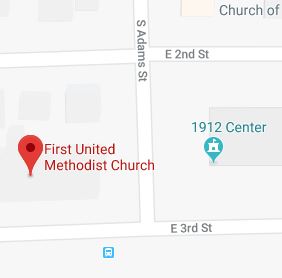
Get Directions
Sunday morning parking at the church is available in the high school parking lot on Third Street across from the church and in the city lots west of the church. These lots are available only on Sunday mornings. A small lot for handicapped parking is available just off of Adams Street on the north side of the church, with an accessible entrance directly into the sanctuary. A lift operates between the Fellowship Hall (3rd Street level) and the Sanctuary. William Sound System Receivers and Headsets are available to assist with hearing problems.
322 East Third Street
Moscow, ID 83843
Church Mission
The First United Methodist Church of Moscow, Idaho takes as our mission to be the body of Jesus Christ, ministering to a community which draws strength from its diversity. Our mission centers on the worship of God, expressed through varied forms of prayer, preaching, music, and ritual. See more...