

Power Issues, Power Lessons July 26, 2015
Power Issues
This summer I have been following the stories of the development of the monarchy in the nation of Israel. That has taken us to stories about David. Along the way these stories have challenged us to think about power and its potential for abuse. We began as the people asked the old judge Samuel for a king, thinking that such a figure would make them a stronger nation. Samuel warned them that they would not always like their kings, but when they insisted, God told him to go ahead and anoint Saul as the first king.
It didn't take long before Samuel grieved and God was sorry he had made Saul king because Saul did not follow in God's ways. So Samuel anointed the boy David as the heir apparent, a surprise lesson about God's power, for David did not look like king material.
David's defeat of the giant Goliath continued that theme. Even stronger and more experienced warriors feared to take Goliath on. David placed his trust in God and the giant was soon dead. David became king and managed to unite the two factions of Judah and Israel into one nation.
Today's story is the denouement of the power stories: David and Bathsheba. From start to finish, this story is all about power.
It begins as David remains in Jerusalem while he sends General Joab and the troops out to do battle. To our eyes this seems normal.
Though the President is the Commander in Chief, no one expects him to leave Washington D.C. to lead a battle. Indeed, when Al Queda attacked the United States on 9-11, the Secret Service spirited President Bush away to an undisclosed location. It was vital to keep him safe.
In David's time things were different. Up to this point, David has always led the troops in battle. Indeed, his primary role as king was in battle. When the people had first asked for a king they had reasoned, "that our king may govern us and go out before us and fight our battles."
Before he was king David had earned the people's respect by fighting the giant Goliath before whom everyone else cowered. As king again and again he had engaged the enemy directly.
This time, however, David remains safely home in Jerusalem. One could say here that David trusted his staff. Sometimes the greatest strength of a leader comes in his/her ability to delegate responsibilities – to train other people and then to trust them to do their jobs. Micromanagers are not always the best leaders.
In this case, however, David has become so secure in his power that he relinquishes his primary duty. He is over confident and stays home while his troops go to war. Power issue # one.
Now we come to Bathsheba. Let us be clear here: this is not a love story. David sees her bathing and sends for her. The Hebrew word can also mean to take or to seize. Bathsheba has no say in the matter. The king wants her, the king gets her. He uses her for his own pleasure and then sends her home. He discards her like I might toss out a magazine that I've read, enjoyed, and no longer need. Power issue #2.
Then Bathsheba sends word to David that she is pregnant. David sends for her husband. As we have seen so many times his initial sin will be further exacerbated by the cover up. Power issue # 3.
Bathsheba's husband is named Uriah. He is not even a Hebrew. He is a Hittite. After David questions Uriah about how the war is going he tells him, "Go down to your house, and wash your feet." His words are a thinly veiled urge to go home and sleep with his wife. Bathsheba's pregnancy could then be passed off as Uriah's child. End of problem for David. He still has little further interest in Bathsheba. He has gotten from her all he wanted.
Remember, Uriah is a Hittite. Despite that he seems to understand the rules of holy war better than David does. Soldiers were to abstain from sexual relations as a part of their consecration for war. Uriah declines the R& R David offers. He sleeps at the entrance to the palace. So much for David's plan. He says to Uriah, "You have just come from a journey. Why did you not go down to your house?" Uriah explains, "The ark and Israel and Judah and the servants of my Lord are camping in the open field; shall I then go to my house, to eat and to drink, and to lie with my wife? As you live and as your soul lives, I will not do such a thing." Even presented the opportunity to break the holy war code by none other than the king, Uriah stays true to his vows.
David then wines and dines Uriah, but even drunk Uriah does not go home to Bathsheba. So David sends him back to the war carrying his own death warrant – orders to General Joab to put Uriah in the fiercest fighting and then withdraw. Power issue #4.
The dangers of power are many. David succumbed to them all. He fell prey to the justifications people have used for generations and still use today. "I deserve this," he might have said. "I've fought the giant, and led battles. I can stay home for once. It's ok."
"The company doesn't pay me what I'm worth," an employee might say, "I deserve more, so if I pad my expense account I'm just getting what they should be paying me anyway. I deserve this."
When David took Bathsheba he might also have said, "No one will know. I won't get caught." And if Bathsheba had not gotten pregnant David would probably have gotten away with his sexual misconduct. Politicians, and others, have done that for years. Bathsheba would likely have not dared to report it. Studies today indicate that victims of rape seldom report the offenses done to them so sadly offenders do get away with their crimes. They do not get caught. And then end up thinking that what they have done is ok, which it is not.
In the last month or so many of us have been saddened and disturbed by the reports that Bill Cosby, America's Dad, drugged women so he could have sex with them. Truly, Mr. Cosby was a very funny comedian, and his actions turn out to be far from funny. He got away with it for a long time, and now at last it seems the truth is clear. What he did is not ok.
Another justification we often use is, "No one is hurt by my actions." Of course, Bathsheba DID get hurt, and people like David fail to recognize the humanity of their victims and the consequences of their actions. Fiscal misconduct often hides behind this excuse because what is taken comes from such a larger enterprise that it seems as minor in comparison as a mosquito bite on a grizzly bear. Shoplifters think that the store is not hurt by the loss of one candy bar. The truth of course, is that in the long run damage is done.
Power comes to us in many ways. Employers and managers have power over those who work under them. Parents have power over their children. Teachers and Scout leaders and counselors have power over students, children in their groups. Bigger, physically stronger people have power over smaller, weaker people. The list could go on.
The power issues in David's abuse of Bathsheba and his murder of Uriah remind us of some basic lessons.
Lesson #1: The one with more power bears the responsibility to maintain appropriate boundaries. Teachers, counselors, pastors and employers must recognize the power they have over others and that sexual relations are not appropriate. Ever. Even if the less powerful person seems to desire intimacy it is not appropriate and the person with more power must say so and mean it.
Lesson #2: In living out the trust which comes with power, stay true to your original calling. David was to be the military leader. I am to be the spiritual guide of the congregation. A teacher is to educate. Parents are to keep their children safe. Stay true to the basic calling.
Lesson #3: Be willing to risk losing the power granted. By staying home David took the route of safety. For most of us this means listening to the ideas of others, which just might be better than our own. Allow the other to get credit for the success of that new program even if you look less important as a result. Being willing to risk losing power may mean being willing to let someone else lead while we take the grunt roles. After all, as Christians we are called to servant ministry.
Power is a position of trust. May we be found trustworthy.
Current Church News
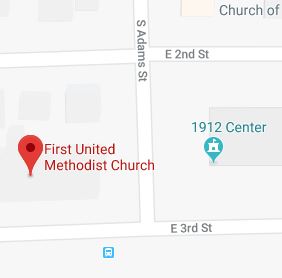
Get Directions
Sunday morning parking at the church is available in the high school parking lot on Third Street across from the church and in the city lots west of the church. These lots are available only on Sunday mornings. A small lot for handicapped parking is available just off of Adams Street on the north side of the church, with an accessible entrance directly into the sanctuary. A lift operates between the Fellowship Hall (3rd Street level) and the Sanctuary. William Sound System Receivers and Headsets are available to assist with hearing problems.
322 East Third Street
Moscow, ID 83843
Church Mission
The First United Methodist Church of Moscow, Idaho takes as our mission to be the body of Jesus Christ, ministering to a community which draws strength from its diversity. Our mission centers on the worship of God, expressed through varied forms of prayer, preaching, music, and ritual. See more...