

A Tale of Two Cities - July 5, 2015
II Samuel 5:1-10
Psalm 48
Mark 6:1-6
In the spirit of the summer travel season, this morning I want to embark on a little time travel to two cities in the Holy Land. Our bible readings take us to Jerusalem, early in the reign of King David; and to Nazareth early in Jesus' ministry.
The Holy Land is not a large place. As the crow flies it is about 150 miles from top to bottom. Jerusalem to Nazareth is about ninety miles. Today there is an interstate highway that could whisk us there as quickly as we might drive to Spokane. In our readings it takes about a thousand years to get from Jerusalem to Nazareth. There were no interstate highways so such travel would have taken days. Since we are doing some time travel anyway, this sermon won't take us that long.
Let's start in Jerusalem. At the time of our reading from 2 Samuel the kingdoms of Israel and Judah were separate. The Bible scholars among us may recall that they split after the reign of King Solomon. But this predates Solomon by nearly eighty years. It turns out that the twelve tribes of Israel had been a diverse group since the days of Jacob. After all they came from four different mothers who squabbled with each other for Jacob's attention and competed with each other in the battle of the babies. So maybe it should not surprise us that after their first king, Saul, died, they divided into Israel in the north and Judah in the south.
David had ruled over Israel for about seven years while Saul's son, Ishbaal, ruled over Judah. The two kingdoms were at war with each other. Ishbaal was then murdered. Finally the leaders of Judah came to David to ask him to be their king too. Thus began a novel experiment to unite the two kingdoms.
We first met David when he was a red cheeked boy tending his father's sheep. Now the shepherd boy becomes the shepherd king who must tend an unruly flock. He must find ways to unite them under his leadership. One way to do that was to establish a capital city.
But where? That was the million shekel question.
In the early days of our own nation, our leaders faced a similar question. Philadelphia seemed an obvious choice but then citizens from other states objected. Maybe Boston or New York? In the end our founders chose to develop a new city not allied with any state to cross the divided loyalties of the original thirteen colonies. Thus we have Washington, D.C., and that odd district which is not in any state but is the capital of our nation.
David looked to Jerusalem. It was somewhat centrally located. More importantly, it had never been conquered by any one from Israel so that no one could lay claim to it. Jerusalem was a neutral city which could unite this fragile confederation of tribes.
David captured the city as no one had ever managed to do before and thus drove out the influences of the pagan Canaanite cultures. He impressed the people of his newly wedded nation with his strength.
Sometimes Jerusalem is referred to as Zion. Zion is actually a hill in Jerusalem on which a fortress had been built. Solomon would eventually build the temple on that hill. In time Zion came to represent God's presence. Many psalms sing of Zion and we still sing about Zion as the city of God.
As God had warned the old judge Samuel about the dangers of a king, so God was also reluctant to move out of the tent into a temple. The danger of settling into a place is that people can so easily mistake the place for God. Psalm 48 ends as people walk about Zion, counting its towers. As they reveled in such beauty and might they could also have mistaken the symbol for God.
Now let's hop onto our time machine and travel a thousand years and ninety miles to Nazareth. It's just a village, really, not a grand city like Jerusalem. There is no magnificent temple here, just a humble synagogue and a cluster of houses.
Nazareth, as you may know, was Jesus' home town. We're there on the Sabbath and Jesus is teaching in the synagogue. At first the congregation is pleased that their golden boy is among them. They are astounded at his teaching and begin to wonder at his authority. After all they watched him grow up. They were there for his Bar Mitzvah. They remember his parents. They know his siblings.
Then the mood changes. Mark says, "They took offense at him." The Greek word is skandalizo. They are scandalized that the little boy they had watched play tag with their kids now speaks with such authority among them. When Luke tells this story he says they tried to throw him off a cliff. Mark simply says, "he could do no deed of power there, except that he laid his hands on a few sick people and cured them."
The good folks of Nazareth could not see beyond the familiar to recognize God at work among them. They stumbled over their pre-set notions about their local boy and Jesus' ability to work wonders among them was limited. Their offense became a self fulfilling prophecy.
Separated though they are by ninety miles and a thousand years, Jerusalem and Nazareth had the same problem. The tale of these two cities is their confusion of the local and specific with the greater power of God. In Jerusalem the temple itself became an idol. Instead of worshiping God people worshiped the temple. Now all that came after David, but even he got so caught up in his own power that he forgot he was to serve God first. We'll get to some of his later struggles in the next few weeks.
On this Independence Day weekend, this tale of two cities speaks to us. Yesterday we celebrated the many blessings of our nation: the freedom to speak and assemble, equal rights for all citizens, and so much more. I have long appreciated Victor Frankl's comment that the statue of liberty on the east coast ought to be supplemented by a statue of responsibility on the west coast. Freedom must always be paired with responsibility.
In the same way, our time travel to Jerusalem brings us back here to our own country. As we sing "God Bless America" let us never forget that God's blessings are not confined to our nation. God's love extends from the southernmost tip of Chile to the northernmost coasts of Siberia.
Furthermore, those who have the most resources and opportunities also bear the most responsibility to share with others. Our country has been blessed with abundant natural resources and a wealth of talented people. Our church is blessed with gifted people. New life is being birthed among us not only in the new babies but also in a renewed vision to reach out to our community. We are here to carry God's word of grace and peace to this town and the world.
Let us not make Jerusalem's mistake of confusing divine blessing and care with location. I am glad I live in the United States. I am glad I live in Moscow, Idaho. And as much as I recognize God at work in this country, in this community, and in this church, I know that God is not confined here. God is also at work across this globe. I have enough trouble recognizing God's presence among me in the familiar, be it the local girl made good who scandalized me with her insights, or all the new life coming into our church. I must also open my eyes to see that God moves in places I've never heard of, much less been to. The tale of two cities tells us that God is both among us here and now and that God is not limited to one place.
The tale of two cities reminds us that power comes with the responsibility to use it for the good of others. Be it deeds of power or the simple expression of welcome, let us be the place of radical hospitality and extravagant generosity.
Current Church News
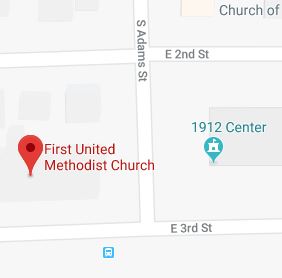
Get Directions
Sunday morning parking at the church is available in the high school parking lot on Third Street across from the church and in the city lots west of the church. These lots are available only on Sunday mornings. A small lot for handicapped parking is available just off of Adams Street on the north side of the church, with an accessible entrance directly into the sanctuary. A lift operates between the Fellowship Hall (3rd Street level) and the Sanctuary. William Sound System Receivers and Headsets are available to assist with hearing problems.
322 East Third Street
Moscow, ID 83843
Church Mission
The First United Methodist Church of Moscow, Idaho takes as our mission to be the body of Jesus Christ, ministering to a community which draws strength from its diversity. Our mission centers on the worship of God, expressed through varied forms of prayer, preaching, music, and ritual. See more...