

Living So That God Will Not Repent - June 14, 2015
Our Old Testament reading this morning begins on a poignant note: "Samuel grieved over Saul. And the Lord was sorry he had made Saul king over Israel." Some translations actually say that God repented over making Saul king. That phrase is a bit startling. I'm used to talking about the need for people to repent of their sins, but God?
For people to repent often means to turn, so that we turn from our sinful actions to God. Sometimes, however, the word translated as repent means to be sorry. Samuel grieved and God was sorry.
There are other examples in the Bible where God repents or is sorry. Before the Great Flood, humankind was so wicked that God was sorry he had made them. "This did not work out the way I had planned," God might have said. Then again after the people made the golden calf God was so angry that God told Moses, "Let me alone, so that my wrath may burn hot against them and I may consume them." Moses interceded for the people, "And the Lord changed his mind about the disaster that he planned to bring on his people." The word used for "changed his mind" is also used for "was sorry" in our lesson today.
The common theme behind these stories is God's response to human sin. In each case the situation is so bad that God asks himself, "What was I thinking?" Before the Great Flood people intermarried with mythical semi-divine figures and the earth was filled with violence. Later they worshiped a golden calf. In today's reading, Israel's first king, Saul, falls from God's ways.
Saul began well. The people had wanted a king to lead them in place of the ad hoc leaders called judges, thinking that a king would be a stronger leader who would defeat the countries that threatened them. Saul had been chosen secretly. He was a handsome man who towered over others. At God's direction Samuel had poured a flask of oil on his head – the sign that a leader was consecrated. And Saul had led them well in battle. For a time it seemed this new king would do for Israel exactly what they had hoped.
Then Saul had become impatient. In the midst of a battle which was not going well, he knew they needed to make a sacrifice to God. Samuel had told him to wait for a week so Samuel could get there. Saul waited the week but when Samuel did not show up on schedule, Saul went ahead and offered the sacrifice himself. Just as they finished with the sacrifice, Samuel showed up. He was angry that Saul had violated the separation of powers. The king was to be the military leader and leave ritual acts to the priest. In his anxiety Saul claimed powers that were not his. He also demonstrated his lack of faith that God would come through.
Saul's story and God's sorrow are yet another example of the abuse of power which we are following this summer. Saul lost sight of the source of his power. God had chosen Saul and it was only through God that Saul could lead. When he forgot to follow God's directions Saul confused the parameters of his job. In the end, his biggest failing was that he let his own ego take control so that each battle and indeed the future of the country was all about him and not about God.
God did not stay stuck in his sorrow about Saul. God guided Samuel to choose a new king. To Samuel's surprise, God chose the littlest brother among the sons of Jesse – the red cheeked shepherd boy David instead of the strong and powerful older brothers. As is so often the case, God's choice is a surprise for God does not use our typical human standards.
Once again, Samuel indicates God's choice by anointing David with oil. The Hebrew word for anoint is meshach, the root of our word for Messiah, which means anointed one. David will not actually become king for some time, but he is clearly now the heir apparent.
Much of the rest of David's story is about the risks of anointing. Just because God has tapped him does not mean that David will have an easy time. Indeed, his anointing put him in the way of danger. Soon, the red cheeked little shepherd boy will do battle with the giant Goliath who by all the odds should over power David.
His next threat will be Saul. These days we might diagnose Saul with bipolar disease. Sometimes he values David both for his strength in battle as when he killed Goliath, and for the peace that David's lute playing offers to Saul in moments of depression. At other times, however, Saul is threatened by David, even though David never openly set out to take the throne from Saul. David even refrains from killing Saul when he has the chance. Once David was hiding in a cave when Saul came in to relieve himself. David was able to cut off a piece of Saul's robe and later showed it to prove he had not killed Saul when the opportunity presented itself.
David also faced the threat of the enemy nations against whom he led Israel in battle. As soldiers today face constant threats to their lives, David could have died in any number of battles.
Anointing did not mean David's way was paved with sunshine and roses. Messiahs are less about glory than about having the guts to do difficult work.
Many years ago in a Bible Study we were discussing the definition of Messiah as Anointed One. We talked about how in the Old Testament both kings and priests were anointed as the primary sign of their selection. Jesus, of course, was anointed by the Holy Spirit as the Messiah. Given the connection with previous anointed ones, like David, it is no surprise that the long awaited Messiah was seen as a new David – a new military and political leader.
As that Bible study group discussed Messiah as Anointed One I pointed out to them that Christians are anointed with water in the sacrament of baptism. "We are little Messiahs," I said. Several people in the class looked at me in astonishment. I then explained that Christ is the Greek word for Anointed One, so again, Christian means to be a little Christ or a little anointed one.
God's choices regularly surprise us and God's choice of you or me is no different. As God said to Samuel, "Do not look on his appearance or on the height of his stature . . . the Lord does not see as mortals see; they look on the outward appearance, but the Lord looks on the heart." Against all the odds, God chooses us. Maybe not as a king or as a priest – God chooses us to carry God's message of love and grace.
Having been chosen, we must remember God chose us to do God's work in the world. When we forget God's notions of power then we, like Saul, are at risk of abusing the power God has given to us. We too must remember, "it's not all about me." It is so easy to lose sight of that. When the committee does not do things MY way I take it personally and then become angry and resentful. It's not all about me. When things go well and everything moves ahead, again I want to take the credit. It's not all about me then, either.
God does not look on the outward appearance but looks in the heart. Richard was an old man by the time I knew him. He had suffered a brain injury in a fall from a ladder and lived in a nursing home. At his best Richard had never been a handsome man. And for years he had served God. He had led the youth group, taking kids camping and hiking and along the way teaching them to love and follow God. He wasn't particularly well educated. I can't even remember what his profession had been. What I remember are the stories of faithfulness and love which he lived out year after year. God anointed him with grace and Richard passed that on. His power came from God and Richard knew it.
Opportunities for ministry lie before each of us. Maybe you've heard our pleas for Sunday School teachers or helpers this week at Vacation Bible School, and then thought, "But I don't know much about the bible. I'm not qualified to teach." Or you see the signup sheet for Family Promise volunteers but in your heart you are a bit intimidated at the thought of working with homeless people.
God does not look on the outward appearance. God doesn't examine a resume. God looks on the heart and when God calls the power to do the job comes not from our own abilities but from God who grants us the power.
We were chosen by God, anointed by water and the Spirit, for a purpose; to be disciples of Jesus Christ for the transformation of the world. The job we are set aside to do is to be agents of grace and peace in the world. If we remember that then God will not be sorry that God chose us.
Current Church News
Get Directions
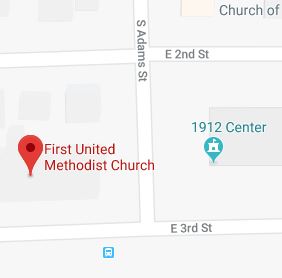
Sunday morning parking at the church is available in the high school parking lot on Third Street across from the church and in the city lots west of the church. These lots are available only on Sunday mornings. A small lot for handicapped parking is available just off of Adams Street on the north side of the church, with an accessible entrance directly into the sanctuary. A lift operates between the Fellowship Hall (3rd Street level) and the Sanctuary. William Sound System Receivers and Headsets are available to assist with hearing problems.
322 East Third Street
Moscow, ID 83843
Church Mission
The First United Methodist Church of Moscow, Idaho takes as our mission to be the body of Jesus Christ, ministering to a community which draws strength from its diversity. Our mission centers on the worship of God, expressed through varied forms of prayer, preaching, music, and ritual. See more...