

Power Corrupts, Justice Corrects - June 7, 2015
Lord Aston was a British politician and historian in the mid 1800's. He is best known for saying, "Power tends to corrupt, and absolute power corrupts absolutely."
Power corrupts. As he ran for reelection as President of the United States, Richard Nixon's campaign staff broke into the offices of the Democratic National Committee. They were attempting to wire tap phones and steal secret documents. While it is not clear that Mr. Nixon knew in advance about the burglary, it is clear that he tried to cover it up. He tried to stop the FBI investigation, destroyed evidence, fired uncooperative staff members, and raised hush money for the burglars.
The scandal not only led to Mr. Nixon's resignation as President, it forever changed American's trust in our government. Power corrupts indeed.
Decades later, rumors circulated that President Bill Clinton had engaged in sexual relationships with women other than his wife. He insisted he had not. Eventually a young White House intern submitted evidence that indeed Mr. Clinton had been inappropriately involved with her. Mr. Clinton survived the scandal, but it left many people revolted and dismayed at his behavior. As is the case with other examples of sexual misconduct, I am convinced that the root of the problem was an abuse of power. Power corrupts.
Only a few years ago, a computer professional named Edward Snowden leaked evidence that the National Security Agency had been secretly collecting and storing the calling records of American citizens. In the zeal to identify terrorists after the attacks of 2001, the line between national security and personal privacy was blurred. At the same time, Mr. Snowden's revelation may well have endangered the lives of US personnel serving overseas. Was that too an abuse of power? As a nation we have yet to answer questions about when and how information should be gathered and released. Congress continues to debate it. Both the NSA and Mr. Snowden had the power of information, and both seem to have crossed some boundaries. It depends on who you talk to which side was most corrupted by power.
Those are just three stories about the abuse of power. Less blatant and equally horrifying are the quieter stories about corrupt power: a husband controls his wife's ability to communicate with her family and friends; a fraternity forces new recruits to drink quantities of alcohol or submit to indignities; the list could go on and on.
This summer our Old Testament readings explore power and the ways it can be abused. Stories in the books of Samuel and Kings tell how the nation of Israel became a monarchy and the ways that both benefitted them and cost them.
Today we heard the people's request for a king. Previous to this they had been governed by Judges. Judges in those days were not the sorts of judicial folks we know today who decide points of law and oversee criminal and civil trials. Judges were leaders whom God raised up to guide the people in particular situations. Often they were military leaders who got them through a given crisis. Sometimes they led for only a short time and occasionally they lasted for decades. Never did they have the authority of kings and in no way did they begin dynasties.
Samuel had first heard God's call when he was just a child. By the time we encounter him in today's reading he is an old man. For decades he had guided Israel as it fully settled into the Promised Land and faced opposition from the folks who had been there first. He administered justice and listened for God's word.
The first hint of corrupt power comes as Samuel appoints his sons to be judges. The elders of Israel complain, "You are old and your sons do not follow your ways." Judges were not supposed to be a dynasty. There was no precedence for a family line to hold those positions – and yet Samuel appoints his sons in his place. Power corrupts? Maybe, though it is not crystal clear just yet.
The problem with the sons is that they take bribes and pervert justice. There's some poetic irony here, for Samuel had first served under the old priest, Eli, whose own sons were corrupt. God had called Samuel to confront Eli with the misbehavior of his children, and now it is Samuel's offspring who are the problem. Power corrupts.
So it is that the elders of Israel come to Samuel to ask him to appoint a King to replace his no good sons. Their motivation is mixed. On the one hand they want to get rid of the corruption of Samuel's sons, like today's cry to "throw the bums out!" Yet by the end of the story, their rationale is, "So that we may be like other nations." Be it the desire to get rid of a corrupt leader or the longing to keep up with the Philistines, they want a king.
Samuel warns them that kings are not all they are cracked up to be. He tells them that kings conscript labor pools and levy steep taxes, none of which are popular. Kings have a great deal of power and power corrupts.
Be it a called up leader like a Biblical judge, a hereditary ruler like a king, an elected leader like a President, or a volunteer in a community organization, power carries with it the potential for great good – and for abuse. Whoever has power must be subject to assessment. The United States wisely chose to write checks and balances into our constitution so that power is spread out over a variety of positions. Even so, as we have seen, power can corrupt.
The deeper question is what is justice? It is hard to pin down in a simple declarative sentence. Earlier this spring I attended a forum, organized by the peer ministers at the Campus Christian Center, that asked that very question of a multi disciplinary team. Included were people who addressed it from the stand points of bio-medicine, sociology, the environment, law, and theology. It was a fascinating discussion. One of the things that became clear is that justice is fluid, meaning slightly different things in different situations.
At its core I think justice is rooted in God's vision of who we are: children of God, made in God's image, and connected to each other, to God, and to creation. The Bible examines how those who have little or no power are treated, most particularly by those who have more power. Throughout this summer some of those stories come up in the lectionary, the cycle of readings we will follow. We will look at the stories of David and Goliath, powerful King David and powerless Bathsheba, David's angry son Absalom and his grieving father. What we won't cover are passages in Leviticus which call for justice for the poor by leaving grain in the fields for them to harvest or the cries of the prophets to match faithfulness to God with loving care for the poor.
Justice in the Bible looks at the way people who have it all – money, status, and control – treat those who have nothing. Jesus looked to the little ones of society – the poor, the aged, women, and children – and reminded his followers, "If you put a stumbling block before one of these little ones who belong to me, it would be better for you if a great millstone were fastened around your neck and you were drowned in the depth of the sea."
Power corrupts and justice corrects. Justice is not so much about retribution ("we'll bring those bad guys to justice!") as it is about restoration. Justice looks to restore God's order so that everyone has enough and no one has either too little or too much. Justice looks to restore people to right relationship with God and with each other. And so God promises to forgive us which is then linked to our forgiveness of others. The parable of the Prodigal son is left unfinished for though the wasteful son and his father are restored to each other, the elder and the younger brothers are still on the outs with each other. Justice is not completed in that story.
It is like a lot of our lives. The story is not finished. We know that power corrupts. Justice, however, corrects – and it is up to us to finish the story.
Current Church News
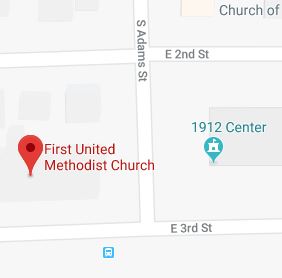
Get Directions
Sunday morning parking at the church is available in the high school parking lot on Third Street across from the church and in the city lots west of the church. These lots are available only on Sunday mornings. A small lot for handicapped parking is available just off of Adams Street on the north side of the church, with an accessible entrance directly into the sanctuary. A lift operates between the Fellowship Hall (3rd Street level) and the Sanctuary. William Sound System Receivers and Headsets are available to assist with hearing problems.
322 East Third Street
Moscow, ID 83843
Church Mission
The First United Methodist Church of Moscow, Idaho takes as our mission to be the body of Jesus Christ, ministering to a community which draws strength from its diversity. Our mission centers on the worship of God, expressed through varied forms of prayer, preaching, music, and ritual. See more...