

Lent Week 1 - February 21, 2021
Matthew 4:23-25, 5:1-12As we get started with our series on the Sermon on the Mount, I think it’s important for us to cover a few details—these are assumptions we will work from for the series. Some of you may have read these particulars in the book we’re using by Amy Jill Levine, others of you may not be a small group and so I want to make sure we all have the same details.
If you’ve been with us for worship the last few weeks, we’ve been studying the Gospel of Matthew—the passages that deal with the early days of Jesus’ ministry and the specific passages that lead up to the sermon on the mount. While we assume some chronology of the stories based on the order they appear in the Gospel, they are not guaranteed to be in this order and Matthew offers little in terms of timeline. So, we don’t
know how much time passed between calling the first disciples and then the miracles mentioned in today’s passage, or the time on the mountain. The way it reads, it sounds like it was a fairly short time frame, and we may assume Jesus only had 4 men—two sets of brothers as his disciples. OR, we could also safely assume that more time had passed—that when the passage says “Jesus sat with his disciples” it was more than the 4 because more time had passed and he had invited others to join him. The truth is, we don’t know, so there is room for us to read the story both ways.
We do know that Jesus and his disciples were Jewish. They studied Jewish scriptures and grew up in a region with Jewish values. This is important because too often in the Christian tradition Jesus is used as a weapon against the Jewish people. But we must know Jesus was a Jew. Those are his people. The Christian movement came after him—it was not his intention or his purpose to form a new religion, but instead to fulfill the teachings and prophesies of the Jewish religion. Jesus’ teachings are not at odds with Judaism but do try to push at the heart of God’s message from throughout biblical history.
While our sermon series is called the “Sermon on the Mount” it likely was not a sermon like we conceive of it, but instead, it was Jesus teaching his disciples and is more like a compilation of teachings rather than one big giant lecture. What we hear from the Gospel of Matthew is that the crowds gathered because of the miracles Jesus was performing, but Jesus’ specific teachings here were directed at his disciples. I say that because the audience matters. So listening to the lessons as disciples, rather than as foreigners outside the Jewish tradition, would allow for certain assumptions and certain common language.
I’m sure there will be other nuggets of wisdom and tradition that we cull along the way, but those are good for getting us started.
So, today’s passage is known as the beatitudes, though it starts with a few verses about Jesus performing miracles and ministering to those who were hurting, those who were sick, and those who were afflicted. Like our passage that referred to the devil, we might be tempted to breeze over those few verses, but they, like the presence of evil, are a common theme throughout the Gospel. Jesus wasn’t just a wise teacher or powerful prophet. He was a miracle worker. He was a healer. People saw him do powerful and godly things and they came anxious for more healing and more help.
I want to pause there just a moment to talk about miracles. They tend to be a sensitive subject. I’d venture that almost all of us (if not all of us) have prayed for a miracle at some point. And I’d venture that all those who have prayed for a miracle have been disappointed at some point because God did not grant the miracle for which we prayed. It may have been healing for a loved one, or for ourselves, it may have been freed from an abusive situation, it might have been a new job, or saving a broken relationship. It might be something wholly other—and I would venture that not every prayer has been answered in the way we prayed. Right? And so some of us have become wary of praying for miracles. We don’t want to have too much hope or to feel too much disappointment. A lot of us guard our hearts in this regard. And that’s ok. God certainly understands. And, I know from experience, both personally and from what I’ve heard as a pastor, that many of us have seen miracles….maybe only with hindsight, but many of us have seen God do amazing things. For some it has been forgiveness, others it has been reconciliation in a ravaged relationship, for others it was a relief from pain, others it was undue kindness and compassion, others it was safe when we were severely threatened. There are a push and a pull—places where we see the answers and places where we don’t. There’s enough assurance that we have hope that God could do something and so we pray. And there’s enough mystery that we dare not be cocky or treat God like a genie in a bottle.
Alright…back to the beatitudes. I’ve preached on these a few times in the last couple of years. I promise not to go over each and every-one (if you want that I can send you to the prior sermons to study a little!). But one perspective that I’ve shared and that Amy Jill Levine treats as a key is that Jesus is not offering platitudes. He’s not sugar-coating suffering. He is pointing to some of the gifts that can be found in hardship. For instance, he says, “Blessed are those who mourn for they shall be comforted.” Jesus isn’t praising death or even grief, he’s saying that one gift that comes with the great sorrow is the care and compassion of others, it’s the remembering and storytelling about those we have loved and who have loved us.
One thing that struck me as I read this passage again, and as I heard it more clearly in light of the passages that precede it is that Jesus calls his disciples, and then they go where Jesus does miracles, and all these folks with all kinds of afflictions come to them, and the next thing we hear is Jesus talking about those who are afflicted….and pointing out some powerful lessons.
As I lean into the humanity of the people in the Bible and listen differently, I could imagine the disciples seeing all these folks who are sick and broken, often outcast and marginalized, and maybe being a little judgmental. Maybe they are feeling pity. “O how terrible it must be to be them.” And Jesus then wants to lead them away from pity and into compassion, and so he shares the beatitudes. The beatitudes offer perspective. Jesus isn’t dismissive of the suffering, but with these sayings, he is offering, “there’s more to understand.”
“Blessed are the poor in spirit for theirs is the kingdom of heaven.” The perspective we find in the book is that the poor in spirit are those who both need help from others and those who are willing to offer help when they are able. They are humble, not proud. Amy quotes Pastor Mike Glenn in Tennessee who says that the poor in spirit are those who recognize the gap between what we have and what we should have, or what others have and what they should have. For some, that’s believing that some don’t have a safe place to sleep, and yet they should, for others, it’s that some don’t have clean water to drink or healthy food to eat, but they should. For some, it’s that some don’t have access to education or health care and yet they should. And these people who see the disparity don’t just see it, but they do something about it. They are the generous ones who give of what they have so that others might have enough. I don’t know how many of you remember, but there was a popular saying (often made into a bumper sticker) in the 90s (and maybe early 2000s) that said “Live Simply so others may simply live”. This slogan underscores a mentality that is needed to be the change agents blessed in this beatitude—living with enough, maybe even less than we desire so that others might have enough—even the basics. It springs from a theology of abundance—that God has provided enough for all of creation if we only manage our resources wisely. It’s not manifest destiny or prosperity gospel—it’s believing everyone is worthy of the most basic things and working to make sure they have access and possibility to actually drink clean water, eat healthy food, live in a safe place, learn how to read and write, and have appropriate access to health care.
Ok, so that’s obviously just one beatitude, there are 9. So, take a deep breath and settle in for another 45 minutes! =) I’m just kidding. The beatitudes are rich and worth digging into. Take some time this week. Read them. Ask questions about them. Dig in a little and see what you find. And as I said earlier, I have preached on these before, and if you want a more in-depth dive, I’m happy to share those manuscripts for you to take a look at. For today, we’re going to stop here and come back next week for another section of the Sermon on the Mount.
Current Church News
Get Directions
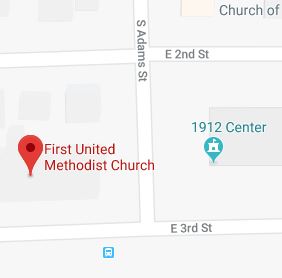
Sunday morning parking at the church is available in the high school parking lot on Third Street across from the church and in the city lots west of the church. These lots are available only on Sunday mornings. A small lot for handicapped parking is available just off of Adams Street on the north side of the church, with an accessible entrance directly into the sanctuary. A lift operates between the Fellowship Hall (3rd Street level) and the Sanctuary. William Sound System Receivers and Headsets are available to assist with hearing problems.
322 East Third Street
Moscow, ID 83843
Church Mission
The First United Methodist Church of Moscow, Idaho takes as our mission to be the body of Jesus Christ, ministering to a community which draws strength from its diversity. Our mission centers on the worship of God, expressed through varied forms of prayer, preaching, music, and ritual. See more...