

Worship Script - January 24, 2021
Matthew 4 Before we dig into this passage, we have something we need to address. This passage clearly says the devil tempted Jesus three times. I know that for a lot of mainline folks, that’s the kind of thing that makes us just skip right over a passage. The way we’re accustomed to the devil being discussed is as a scapegoat for our own bad actions. We’re accustomed to excuses like “the devil made me do it” and we want nothing to do with that notion of a devil. Or we’re overly familiar with Hollywood versions of the red man with horns. We don’t want that devil either. So with the “devil” most common to us as an easy out or some
Hollywood riff, it’s no wonder we want no part of the scriptures that speak of the devil.
But I would caution us against rushing past. If you read through the Gospels you’ll find evil, demons, and the devil to be a very real part of what is discussed. Not in the ways I just mentioned, but as a real presence, with significant power to detract, distract and destroy the work of God. It is that understanding I want us to work with today. Maybe the simplest way to say it is that the “Devil” so to speak is the personification of evil—that which draws us away from God and into sin (not forcing our action, but acting as this scripture suggests—as a tempter).
So with that, let’s dig in. Jesus was drawn to the desert by the Holy Spirit. I get that. But….the scripture also says, “so that he would be tempted by the devil.” That suggests that the Holy Spirit wanted Jesus to have this exchange with the devil. And, I have to be honest, I struggle with that. I struggle with any theology that suggests that God wants the work of the devil. Now, I do believe God can work things out, despite the devil’s dealings, but I do not think God is an advocate of that work. If the devil is what draws us away from God, why would God enable that in any way?
When I read this passage, that piece, and a couple of others feel like they are offered with hindsight, not as something that was known and understood initially.
So one of my first questions is: Did Jesus know it was the devil? I mean, if he did, wouldn’t it have been easy for him to simply say, “No!”? If he didn’t, then what kind of personification was it? Likely not the red guy with horns, but an actual person. And then I have to wonder, what was compelling about the figure? I’ve always imagined them as floating from spot to spot, but if it was an earthly figure they would have walked. What would they have discussed? Wouldn’t there have to be some rapport for Jesus to be tempted? To even take him seriously?
“Turn these stones into bread”
What if they’re chatting—visiting and the tempter is baiting him? Maybe Jesus shared about this awesome thing that had happened to him at his baptism. And how the dove came down and how God spoke this amazing affirmation over him—and Jesus spends 40 days contemplating this awesome and overwhelming thing God is doing to him and expects to do through him. Forty days out in the desert leaves a lot of time for prayer. A lot of time for God to speak to him and give him guidance and insight about what he’s being asked to do.
And now there’s this person—(presumably) there. A human! Someone to talk to! Engaging. Interested. Attentive. Taking on Jesus’ excitement and his trepidation. And feeding off of that energy.
The scripture tells us that he was hungry—which feels pretty obvious—40 days of fasting. He’d be hungry but not able to eat much—his body couldn’t tolerate it. But I imagine he was anxious to test out his calling, to see what God could do through him. What might be possible? And that was the hook for the tempter.
Let’s try it! Let’s see what you can do! After all, if you don’t try it, you’ll never know what’s possible. So, try it. Take this stone and make it bread. Surely you can. Right? I mean, if you can’t then…what can you even do? How will you be everything you’re supposed to be if you can’t even do something simple like turn a stone into bread. Just try it….
Jesus responds with scripture, “Man does not live by bread alone.” Which is true. And maybe a powerful reminder for Jesus. That it’s not just about what he’s called to do, but why. Why turn the stone into bread? So he could prove something? That’s not a godly priority. It’s a tempting one, but not godly. So he could eat? That’s more of a godly priority—God wants us to eat, but being reminded of what and why matters. Jesus likely needed broth first to break his fast…something to drink with added nutrients, but wouldn’t tax his system too much. No meat. No cheese. Maybe even no bread. Something simple. Something easy to digest after 40 days of not eating.
Then the devil took him to the holy city, to Jerusalem, to the highest point of the temple and baits him—throw yourself down and see how God saves you.
This seems like a no-brainer, right? Anyone who’s parented a teen that cow towed to peer pressure and di what someone else told them to has likely offered this retort:
Well, if Jo/sie told you to jump off a bridge, would you?!?!
Tell me you’ve said this. It seems like a timeless parenting tool... We point out the foolishness of following by pointing to the obvious. If someone, anyone told you to jump off a bridge—you wouldn’t! It’s foolish, not to mention deadly. So why simply go along with anything else they tell you to do!
So when the devil tells Jesus to throw himself off the high point of the temple we might be inclined to offer a collective rebuff of “Really?!?” But instead of being cynical (like me). We should probably pause to listen for the deeper message—what is it that would be tempting about this for Jesus?
If you are the Son of God then the scripture says God will command the angels concerning you….I can imagine that Jesus wondered how far God would go for him. I mean, as the Son of God, he has to matter to God. God couldn’t invest so much in Jesus just to walk away. Jesus had to wonder what God would do for him. And yet, again, we come back to our question of why. Jesus needs to be clear about his motivation. Trusting God to take care of him is different than forcing God’s hand. Which is a caution a lot of us should take. Trusting God’s care for us is quite different than testing God’s care for us.
(TRANSITION)
Then the devil takes Jesus to a high mountain. (now again, there has to be something compelling about this person, their relationship, and their conversations where Jesus isn’t just walking away. If he knew it was the devil, it would be easy to simply say no, so there has to be something earthly and compelling about these interactions).
And the devil says look around—everything that you see (in fact, the scripture says the devil showed Jesus “all the kingdoms of the world and their splendor”—that may be the part that led me to believe they were floating—after all they’d have to fly to see all the kingdoms of the earth—but Jesus was fully human—he was bound by gravity just like we are. So they climbed a mountain and looked around as far as the eye could see and this man says, “I’ll give you all of this if you bow down and worship me.”
Now, this part makes me think that maybe this man (not to be sexist, it’s just for more likely that it was a man in that time who engaged Jesus in these conversations). I think maybe this man convinced Jesus that he had power and wealth—that maybe before they climbed the mountain they walked through the cities—the people recognized the man, he could buy things, go where he wanted…he had some kind of show of power and prestige and then maybe when they got to the top of the mountain he told Jesus those were his kingdoms. After all—how could he offer them if they weren’t his. So now, as far as they can see the man says “this is mine, but it could be yours—all of it—the buildings, the markets, the riches—all you have to do is bow down and worship me.
Now, for it to be tempting it had to be convincing, at least seemingly feasible—like the original Ponzi scheme or something—creating the illusion of something real, building trust and baiting him to believe it all—only in the end, under duress to reveal the truth.
Remember, Jesus was tempted—that’s the premise of the story---there was something about the offer that was compelling—maybe the quick rise to power or instant riches, but somehow as much as he might have wanted it, he saw through it. Or at least knew the deal would be deadly. Bowing to worship another would not end well. And it was there Jesus had this clarity and awareness—this was no longer a smooth-talking man, he was more like a charlatan—no…worse…he was the devil. A personification of evil.
“get away from me Satan.” And the devil left.
And then, the scripture of the second temptation was fulfilled…” God will send the angels to attend to you.” And the angels came and cared for Jesus.
So what do we gain from this scripture? Maybe more of Jesus’ humanity—he didn’t just ride high above human experience—he struggled with it—like we do—with temptation, self-doubt, doubting God, wanting easy outs and quick answers. And that he had to lean on deep roots of faith—knowledge of scripture and a real understanding of both what he was called to do and why he would need to do it.
Maybe we see evil or the devil differently—maybe we can see the power of something other than God to court us and woo us to act out of pride, selfishness, greed, or even just doubt.
Maybe, hopefully? we see the value of being rooted in the scripture and invested in prayer so we can discern truth and root out temptation.
I mean, you said God said, “This is my son.” That has to mean something….
Current Church News
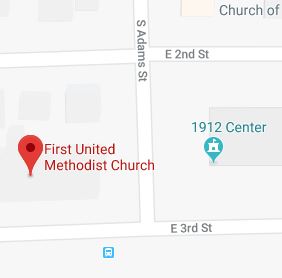
Get Directions
Sunday morning parking at the church is available in the high school parking lot on Third Street across from the church and in the city lots west of the church. These lots are available only on Sunday mornings. A small lot for handicapped parking is available just off of Adams Street on the north side of the church, with an accessible entrance directly into the sanctuary. A lift operates between the Fellowship Hall (3rd Street level) and the Sanctuary. William Sound System Receivers and Headsets are available to assist with hearing problems.
322 East Third Street
Moscow, ID 83843
Church Mission
The First United Methodist Church of Moscow, Idaho takes as our mission to be the body of Jesus Christ, ministering to a community which draws strength from its diversity. Our mission centers on the worship of God, expressed through varied forms of prayer, preaching, music, and ritual. See more...