

Flight of Egypt - January 10, 2021
A lot of times when we read the scriptures, we find the familiar. Especially around high holy days like Christmas and Easter….The stories we share are generally the same year after year. We find the angel with Zechariah and one with Mary, then Joseph, the journey to Bethlehem, then the angels with the shepherds, then the visit of the magi, and then the story of the flight to Egypt (maybe). Sometimes we leave that last one out. We know these stories. They are favorites and they are familiar. It’s part of what we love about the worship services in Advent and Christmas…they offer us the familiar…like a favorite family recipe…it’s the
best because it’s familiar. And yet, sometimes there’s some perspective, some nuance that gets raised that changes the whole shape of it.
Growing up, my family had green bean casserole at most holiday meals. It was my favorite dish. Many of your families likely had it too…green beans with cream of mushroom soup, some Worcestershire sauce, fried onions. Years later, when my sister was a young adult, dating her now-husband, she joined them for a family meal and his mom made her special recipe side dish, which my sister immediately recognized and said was something she loved. Do you sense what happened? My sister outed the mother. For many years Elise had made her recipe…one her family thought was her very own, only it wasn’t….it was the Campbell’s label recipe that thousands across the country make. And my sister spoiled the secret. She didn’t mean to, of course. And everyone moved on from that little folly. And yet, my sister had touched something in a way that couldn’t be undone. She spoke a truth that couldn’t be unheard.
For me, the story of the flight to Egypt is one that someone tinkered with. They spoke a truth about it that changed my perspective forever, it was a truth I couldn’t unhear. Years ago, I’m not sure when exactly, maybe in seminary? Maybe another time? Someone preached about this passage in a way that transforms it. For some of you, it will feel like my sister’s startling truth—shocking and unsettling, and for others, it may leave it the way you’ve always known it….the tradition you’ve always seen and enjoyed.
The preaching that changed my perspective was that when Mary and Joseph and baby Jesus went to Egypt, they did so as refugees. I’d heard my whole life that Herod felt threatened by the upcoming “King of the Jews” and that he threatened the lives of all the Jewish boys under 2, and that Joseph took his family to Egypt, but never had I considered that that meant the holy family lived as refugees—fleeing political violence in their home country, living in a foreign land, estranged from their people, their language, and their traditions and subject to the compassion (or lack thereof) of those they encountered. Once someone pointed it out, it made sense.
After all, what is a refugee but someone fleeing political, religious, or other violence or persecution seeking refuge in a foreign land? Joseph received his direction to leave from an angel in a dream, but that wasn’t the end of it. Once Herod learned the wise men wouldn’t return to him to identify the special child, he grew angry and ordered all the boys in Bethlehem to be killed. It wasn’t just Joseph and Mary and Jesus who were at risk, it was any of the Jewish families with young boys living in Bethlehem, and likely any of the nearby towns. Herod was known as an angry and violent man, so any threats he made would have been taken seriously.
Imagine if you were one of those families in Bethlehem hearing the order. You’d likely pack up as much as you could, then realize you could only carry so much and have to leave some beloved, and maybe even necessary, things behind…not sure when you’d return or if your things would still be there. You’d likely leave in the dark of night so that Herod’s men would be less likely to see you, or stop you, or question what you were doing. Maybe without being able to hug those you love or even say goodbye.
I imagine for most of us in modern-day America, we can hardly fathom this kind of reality. We’re accustomed to our freedom. We don’t face this kind of political persecution. We wouldn’t have to leave in the dark of night with only a backpack or small suitcase. We wouldn’t leave behind most all of our worldly possessions just because some leader felt threatened. We don’t fear the military knocking down our door, rummaging through our house, or holding a gun to a family member’s head. I’m not saying there aren’t injustices or violence against people here in the US, but it’s not the same as what the holy family faced, and not the same as what others around the world today do face.
I want us to stop for a minute and look at some pictures from Paul Jeffrey. He is from our annual conference and served as a photographer and missionary around the world. He has been with refugees as they fled, as they waited for water, as they set up camp in the middle of nowhere away from all they were and had built for themselves, and as they adjusted to this chapter of their lives.
(Image 1, 2, 3, 4, 5, 6, 7)
Our privilege can make it easy to look at these images and see what the refugees do have or their smiles and joy and dismiss their loss.
At least they have a shelter.
Well, they have some water.
Well, they have access to some food.
Look, they’re playing soccer, or hula hoop.
It is true that people are resilient. People can make due to a variety of circumstances, even minimal provisions. And yet, the truth is these people and millions more over the years have lost their homes, their place of safety, their places of worship, their household items, the opportunity for education, their clothes, their livelihood, the familiar foods, the wells they’ve dug, and often, even their families.
I imagine that most, as they live in places thousands of miles from here, we can keep them, their stories, and their losses at arm’s length. We can say it’s heartbreaking, but as long as they are them—unknown and unnamed—over there, their trials and burdens don’t become our concern. BUT….if we hear about Jesus and his family, if we recognize that they too were refugees, we might see a greater connection to them and responsibility for them. If we look in their faces and see the holy family, then we’ll likely be compelled to help, to do something. Maybe it’s sending money to the United Nations or other relief agencies so there are food and medicine in the refugee camps, or maybe it’s getting connected with World Relief in Spokane like our Sunday school class did to meet refugees and hear their stories and discover how we can be helpers and advocates now. Maybe it’s connecting with the General Board of Church and Society, learning about US legislation and foreign policy that is affecting these lives, and looking for ways we can change the systems and laws that affect them. Maybe it’s writing letters and advocating that the US do more to aid those in need. Maybe it’s slowing down to look again at the pictures, looking at their faces and asking, “What would I do if this were Jesus?”
Whatever it is, wherever we start. I hope it’s something. I hope we feel the weight of their stories and recognize these are God’s people—they deserve my care and compassion. I have so much, I can do more. I’ll be honest, I know I can do more. I know I should do more. I’ve only ever really made one investment in the life of a refugee. His name is Waleed Al-Asowad. He was one of our tour guides in Syria when I was there in 2005. He and his family fled Syria in 2013 when the violence of ISIS was tearing apart.
(notes from emails sent from Max Miller, professor, and leader of the Middle East Travel Seminar (METS) trips for more than 20 years to the Middle East).
Waleed is of Palestinian heritage. The family home was somewhere in the Haifa/Jaffa area, which his parents left sometime in the late 1940s or early 1950s when that part of former Palestine became Israel. Many of the Palestinian refugees who left the Haifa/Jaffa area at that time made their way to Lebanon and Syria. Several large Palestinian refugee camps emerged in both countries. One of these is the al-Raml camp on the Syrian coast, originally on the outskirts of Latakia. But over time the camp’s temporary housing and facilities gave way to a permanent settlement, while the city of Latakia expanded around the camp. So the al-Raml camp of today is a depressed Palestinian ghetto surrounded by the city of Latakia,
[In 2013] the Palestinian refugee camps in Syria, Lebanon, and Jordan, including al-Raml, [were] being flooded with another wave of Palestinian refugees from Damascus and other places in Syria where the fighting [had] spread. So Waleed with his wife and three daughters [were] part of [that] wave of Palestinian refugees. They [went] to the al-Raml camp, where … he [had] some relatives. Thankfully they … found a place to live. But there [was] no work. And with all the other refugees flooding in, prices of everything … skyrocketed.
From the refugee camp, Waleed and 2 of his daughters made it to Egypt and eventually Sweden. The time, accommodations, and trip from Egypt to Sweden cost about $13,000 for the three of them. That was possible only because Waleed had served as a tour guide for the group I traveled with for years and years, so the Americans that knew him from those visits donated to help him and his family. They then had visa interviews and much waiting before they could safely stay in Sweden. All of which would require thousands of dollars more in order to live, get established, and continue in the refugee immigration process.
Waleed’s story is not the norm. Most refugees do not have American donors giving thousands and thousands of dollars to help with their resettlement. Millions of refugees live under tarps, in temporary huts, without clean water, access to travel, or even the necessary documents like a birth certificate, visa, or passport to move from one country to another.
The pain, the fear, the persecution, and the plight of the holy family exists today in countries around the world. And I believe as people of faith we are called to look for the face of Christ in each one and to act with compassion and generosity.
Let us pray.
Current Church News
Get Directions
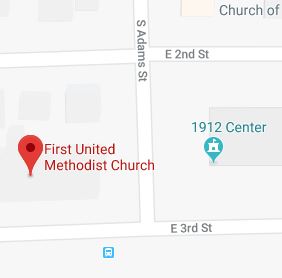
Sunday morning parking at the church is available in the high school parking lot on Third Street across from the church and in the city lots west of the church. These lots are available only on Sunday mornings. A small lot for handicapped parking is available just off of Adams Street on the north side of the church, with an accessible entrance directly into the sanctuary. A lift operates between the Fellowship Hall (3rd Street level) and the Sanctuary. William Sound System Receivers and Headsets are available to assist with hearing problems.
322 East Third Street
Moscow, ID 83843
Church Mission
The First United Methodist Church of Moscow, Idaho takes as our mission to be the body of Jesus Christ, ministering to a community which draws strength from its diversity. Our mission centers on the worship of God, expressed through varied forms of prayer, preaching, music, and ritual. See more...