

Advent Week 1 - November 29, 2020
Luke 1: 5-15, 24-25, 57-60I have to be honest, for years, I have ignored Elizabeth. It hasn’t been intentional. It’s just that Zechariah reads as the center of this story. It’s about him, the holy of holies, the angel, being made mute…yeah, we skipped all those parts this time because that’s what we normally hear. But Elizabeth…not so much. I have talked about her when Mary goes to visit and stay, but not here. I’ve never spent much time listening to hear her story and her perspective. From the scriptures, we get the sense that she’s older and obviously barren. The scriptures are sure to tell us that both she and Zechariah were fully righteous before the Lord, which in biblical terms means her barrenness wasn’t a punishment for her lack of faithfulness. I know that’s the kind of theology I balk at. Of course, God isn’t punishing anyone with barrenness because they weren’t faithful. I mean, if sinfulness or unrighteousness meant you couldn’t have babies, none of us would be here, would we? I mean, our parents weren’t
without sin, nor their parents before them, nor their parents before them, etc, etc, etc. And, to be fair, even if they had been sin-free, we aren’t and so we wouldn’t have had kids either. In other words, anyone that tells someone struggling to conceive that it’s because of God’s judgment or discipline or whatever is full of rubbish. I can say that plainly today, and even though most, if not all, of you, agree with me—at least cognitively, emotionally it’s another thing.
I say that as someone who’s felt the loss. Two years after we had Ruth, I got pregnant again. We were elated. We had our first ultrasound and heard the heartbeat. At the end of the first trimester, we told people, including my church. The very next week I started having trouble and by that Sunday evening I was in Urgent Care and after a long ultrasound with a silent and stoic radiologist, the doctor told me—the baby had died in utero. I’d worked enough with pregnancy loss that I knew it wasn’t me. One in four women loses a baby in the first trimester. It happens….a lot. I wasn’t to blame. And yet, a week or two later, I ran into a woman we worked with at the church. She was an addict stuck in her addiction and living on the streets. She had one child in foster care because of her addiction and she was delighted when she saw me. She wanted to share the news—she was pregnant again!
There were a lot of reasons I could have been upset about it, but the hardest for me, just weeks from my miscarriage, was that this woman wasn’t taking care of her body or the babies. She continued to use, and yet “God let her have that baby,” but I, who didn’t use drugs, or drink, who ate healthy food and avoided all the forbidden things—I wasn’t allowed to keep my baby. You see, there are a HUGE wall and a big crevasse between good theology in your head and the devastating loss in your heart. All the theology in the world didn’t stop the hurt of not having a baby, especially when I was confronted by others, particularly others who seemed so undeserving, who were pregnant.
So when I hear the story of Elizabeth…even with her faithfulness and righteousness and years of loving the Lord, I also know that as good and holy as she was, she hurt and she likely questioned God. And unlike me, she didn’t have a first child to hold. She was stung both by the pain of an empty womb and empty arms and likely by the piercing judgmental words of those around her. Because they didn’t know that one in four women loses a baby in the first trimester. Their theology didn’t say God wasn’t harsh. Their theology said God promised children to all of Israel. Their theology said if you didn’t have a baby it was because you had a problem and God needed to teach you a lesson. So Elizabeth was also stuck with the cultural disgrace of being barren. And yet somehow she persisted in faith. She and Zechariah continued to hope. Hope.
I see them as having real hope because they even persisted in prayer. They weren’t throwing the dice and hoping that somehow there might be luck in all of it. They continued to pray, which to me means they continued to believe it was possible. They could expect God to hear them and give them a baby. They kept waiting….not giving up and not giving in.
And when I see that kind of hope I have to ask how—how is it possible that they didn’t give up? Why on earth did they keep praying? I mean, it’s one thing if you’re young and it seems possible. But if you’re older, if your past childbearing years, then what? How do you hope then? I don’t fully know, that’s not my story, but I see Elizabeth did.
And what that suggests to me is that she had experienced other things in life, other hardships, other losses, other times of defeat and she made it through those and came out on the other side. She went through the kind of stuff that rakes you across the coals, but she came through it, maybe scarred, but knowing there was another side. Do you see what I mean? She had the kind of conviction that couldn’t be broken. And that conviction doesn’t rain down like manna from heaven. That kind of conviction only comes through hardship and tribulations. That kind of conviction is earned.
And that kind of conviction will see you through the next trial….giving you hope, reminding you THERE IS ANOTHER SIDE. Quite frankly, I think that’s the kind of hope we need right now—we need the kind of hope that reassures us that we can get through hard things. We can sacrifice, we can adapt, we can bend and flex and flex again and it will get better. We don’t have the timeline. We can’t say for certain when the true change will come when the light will be full and not just a flicker, but we can say with certainty, we will get through this. And as people of faith hopefully that comes as a witness to others—one where we can see how God at work has been at work in the past (maybe only in retrospect), but we can see God and know God was with us, so that when we come to the next hard thing, we’re sure—God is with me, God has not given up on me, God will get me through this.
It may not all play out the way we planned, but really, it rarely does. But, I pray we have true esperanza—hope that’s full of both expectation and waiting—we can do this. We will get through this. There is another side.
Thanks be to God. Amen.
Current Church News
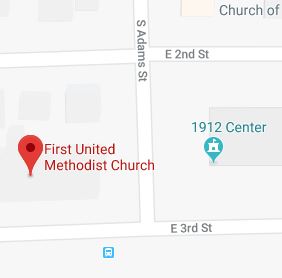
Get Directions
Sunday morning parking at the church is available in the high school parking lot on Third Street across from the church and in the city lots west of the church. These lots are available only on Sunday mornings. A small lot for handicapped parking is available just off of Adams Street on the north side of the church, with an accessible entrance directly into the sanctuary. A lift operates between the Fellowship Hall (3rd Street level) and the Sanctuary. William Sound System Receivers and Headsets are available to assist with hearing problems.
322 East Third Street
Moscow, ID 83843
Church Mission
The First United Methodist Church of Moscow, Idaho takes as our mission to be the body of Jesus Christ, ministering to a community which draws strength from its diversity. Our mission centers on the worship of God, expressed through varied forms of prayer, preaching, music, and ritual. See more...