

Lead Us Not Into Temptation, - May 24, 2020
Scripture
Today’s version of the Lord’s prayer comes from Brian McLaren in his book, “We Make the Road by Walking”.
Our Father, above us and all around us, May Your unspeakable name be revered. Here on earth, may Your kingdom come. On earth, as in heaven, may Your will be done. Give us today our bread for today. Forgive us our debts as we forgive. Lead us away from the perilous trial. Liberate us from the evil. For the kingdom is Yours and Yours alone, the power is Yours and Yours alone, the glory is
Yours and Yours alone. Now and forever, Amen. Alleluia.Alleluia.Alleluia.Alleluia.
This is the word of God, for the people of God, thanks be to God.
Sermon
Lead us not into temptation, but deliver us from evil.
This might be the most misunderstood portion of the Lord’s prayer. According to the author and scholar Sarah Ruden, the language we are accustomed to is just not the language of the first-century prayer Jesus offered--not for this line anyway. It sounds similar, but on exploration it feels pretty different.
This is how she translates it:
And do not bring us to the time of trial, but rescue us from the evil one.
As I said, it sounds similar but has a pretty different context and connotation.
Let’s focus on each half. The first part of the verse says, “And do not bring us to the time of trial”. We commonly hear this as “temptation”, do not lead us into temptation, and generally, interpret that as our bent to sinning. Right? Lead us away from our inclination toward sin and temptation. That seems like an appropriate thing to pray for. And I wouldn’t say it’s a bad thing to ask, but in light of my studies, I think we might be invited to understand it differently.
“Do not bring us to the time of trial” is about 1st-century persecution of Jesus’ disciples under Roman rule, at least according to Ruden. She says this was about a real threat of violence.
Ruden studies languages and she focuses on the translation, not the theology. She says the word in Greek is peirasmon. It translates as “hardships that test character or commitment, or judicial or administrative investigation, which could include torture.” But she leans toward the second definition for how it was used in the Gospel. Judicial or administrative investigation, which could include torture. She says, “Christians were tortured sadistically, often in public, in efforts to make them recant their beliefs and conform, and to name other Christians.” With this understanding, she argues that this “must be what they begged in this prayer”--to be spared.
For me that changes the shape of this verse. Firstly, I struggle….I’m not persecuted. I’m not risking my life by proclaiming my faith. I’m not at risk like the first-century followers of Christ seemed to be. So, how do I pray this prayer? If I’m not asking to be protected from persecution, what should I be asking for? Maybe to acknowledge my place in systems of persecution. Maybe I need to see how I'm a part of systemic oppression and pray that God would lead me away from that. Maybe I need to be praying to see my privilege so that others don’t feel compelled to pray for protection from me, or the systems of injustice I protect, implicit or explicitly.
I don’t have a perfect explanation of how we pray this verse. But I do think we need to rethink it. Some who pray this prayer are still being persecuted, misunderstood, and misrepresented. They will want to pray for protection. Others live with privilege and power that doesn’t warrant praying for protection from persecution.
So, maybe, for those of us in that group, which is most of us worshipping together today, maybe there is a place for praying “lead us not into temptation”--temptation being the ways we sin...implicitly and explicitly, knowingly and unknowingly. We all need guidance away from that. I know, it sounds like I’m contradicting myself. I’m not trying to. I promise. I’m trying to pick up the nuance of the original language as Ruden explains it to help us see it with greater depth and hopefully greater truth, while also understanding that there is a place for all of us to pray in this verse. Those who are persecuted have every right to pray for protection. And those of us who are part of the problem, part of the systems of oppression and injustice, even when we do our best not to be, we need to pray for deliverance from that as well. We need to ask for wisdom to see what role we play and the courage to change the ways we contribute to the persecution of those around us.
And then the other part of the verse, deliver us from the evil one. I’m guessing most of us are more accustomed to praying “deliver us from evil” and we’re more comfortable praying against evil, than we are praying against “the evil one”. Am I right?
But, according to the original Greek, Jesus is very clearly praying against the evil one. Even if that feels uncomfortable to you, I want us to take a minute to sit with it. To ask for protection from the “evil one” is to admit there is an evil one. The “evil one” is also known as the “enemy” or as the “devil”. I’m sure each of us has an image that comes to mind. And I wouldn’t be surprised if it’s a red guy with horns. I don’t think that’s who we’re talking about--not some cartoon figure. But it seems we are talking about someone...not just an ambiguous power of evil, but the evil one...a figure, an individual, one who is to be resisted. One from whom we need protection.
I think this distinction might be helpful because “evil” as some generic entity feels kind of innocuous. I mean, we can talk about it like it’s something, but if it’s just some blob of ill will randomly out there, then it’s almost like we could simply walk away from it.
But if the evil one is an individual, a single entity--then that individual can pursue us. The evil one has the power to chase after us, to persecute us, to tempt us, to lie to us, to con us. That’s kind of a big deal. I don’t know about you, but with that understanding, then I definitely want to pray for protection. I mean, if it’s just ambiguous evil, I’ll pray for some wisdom to see it and courage to walk away. But if what we’re talking about is the evil one, or the enemy, then I want help staying safe.
I know I’m not going to solve this theological debate in a single sermon, especially not when you’re not here to push back with questions or doubtful side glances. But I do hope you’ll think about it. Massage it a little. Sit with it, even if it’s uncomfortable. Pray about it. Ask God to give you insight and understanding.
And hopefully we can all pray for an end to injustice and persecution and protection from any and all forces that come against us and turn us from our relationship with God.
Current Church News
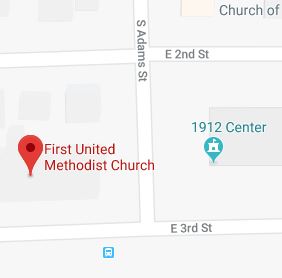
Get Directions
Sunday morning parking at the church is available in the high school parking lot on Third Street across from the church and in the city lots west of the church. These lots are available only on Sunday mornings. A small lot for handicapped parking is available just off of Adams Street on the north side of the church, with an accessible entrance directly into the sanctuary. A lift operates between the Fellowship Hall (3rd Street level) and the Sanctuary. William Sound System Receivers and Headsets are available to assist with hearing problems.
322 East Third Street
Moscow, ID 83843
Church Mission
The First United Methodist Church of Moscow, Idaho takes as our mission to be the body of Jesus Christ, ministering to a community which draws strength from its diversity. Our mission centers on the worship of God, expressed through varied forms of prayer, preaching, music, and ritual. See more...