

The Barrier of Unforgiveness - May 17, 2020
Lords Prayer shared by JR. Forasteros
Practice what you preach. That’s what they tell you. At least, that’s the phrase I heard growing up. Practice what you preach. Do what you say other people should do. As an adult, who happens to be a preacher, nothing seems to bring that home quite like preaching on forgiveness. Every time I am scheduled to preach on forgiveness, some situation happens that reminds me that I still have work to do. This week was a wound from something that happened more than 4 years ago where after a tough fallout and practice at forgiveness, I also practiced boundaries and was clear I did not need to nurture the relationship or work toward reconciliation. I could let go of the anger and resentment, but not restore the friendship. This week in an email that person seemed to be making attempts at reconnection. We have a working relationship and he said he hoped to see me when this was over and we could do coffee. My only thought was “nope.” It gave me pause to wonder if I had really forgiven
him or if I was still holding onto stuff. Then, only to drive the point home, God pointed out a tense relationship with someone where the bitterness and resentment are very clear. We don’t have a relationship to speak of, but we interact regularly due to proximity in daily life. In my mind, I regularly give him what for and this week was bowled over by how irritable I was even at the thought of talking with him. I try to be cordial but I'd much rather we acted as neither existed. And the tirade in my head only shows me I’m walking around with a hardened heart.
So, here I am before you, confessing that I am human, I struggle to live the gospel faithfully, and I need to pray for God’s help with forgiveness too. My brother David, who is also a preacher, once shared a word of wisdom from one of his seminary professors. He said, “Preach what’s saving you each week.” So, please know, that as I preach this sermon, it is for you, but it’s also for me. I’m looking for a word of hope. I’m searching for the good news in broken relationships. I’m trying to wrap my head around what it means to ask God to forgive me as I forgive those who have wounded me. At the very least, if you’re struggling to forgive, or with the implications of this passage, you are not alone.
Forgiveness is something we are asked to do, over and over again. In fact, in one of his teachings, Jesus tells us we are to forgive “seventy times seven times”....490 times. Which, really means beyond measure, because I’m fairly sure that at some point we simply stop counting. Maybe for some of us, we stop at 20 times, others of us hold on a little longer and make it to 100 in our record-keeping, but I’m fairly certain that at some point all of us stop counting the number of times we need to forgive someone. Which isn’t surprising since 7 is a complete and perfect number in the biblical world. So to ask us to forgive 7 times, or 7 times 7 times, or 7 times 70 times (the various ways that passage has been interpreted and understood), is really to ask us to forgive until it’s complete.
Forgiveness is so important and central to what we do as believers that its part of the prayer Jesus teaches us. Jesus gives us a complete prayer to pray. He doesn’t say, “this is a prayer for when…..” defining its use by circumstances, he simply says, “and when you pray, pray in this way”. That means it’s a 24/7 prayer. And that 24/7 prayer teaches us to pray for forgiveness, for ourselves, and for forgiving others.
Specifically in this verse, it’s worth digging into the Greek. As United Methodists, we use the word “trespasses”. Other traditions use “debts” and others use “sin.” This is to say, translation is a semi-fluid industry!! To try and clarify the Greek, I’m going to lean on Sarah Ruden again. She’s the one I mentioned last week when we talked about “daily bread”. In this verse, she’s very clear that the word in Greek is debts. And generally, she understands that as literal debts. And she clarifies some of the rhythms of the language to say it says--can be fully understood as: “And free us from our debts, once we have, as we have, set our debtors free,”
To which I think, “criminality”! Once we have, as we have...gah! I just want to be forgiven!!!! I don’t want it to be contingent on me forgiving other people, because obviously, as I shared, I struggle to forgive completely.
So, once we have, as we have….
As I read to prepare for this sermon, it was not uncommon to find the thought that God’s forgiveness is contingent on ours. I may struggle with some wording here but that just doesn’t make sense to me. Not in the sense that God needs us to forgive so that God can forgive us. I don’t think God’s forgiveness is contingent like that. If God will only dole out as much forgiveness as we can offer in the way we can offer it, then why do the whole Jesus thing?
Yes, Jesus was a teacher and an example and that wouldn’t be negated if he weren’t the Son of God who died on a cross. Right? Teaching us could be achieved without the incarnation and certainly without the crucifixion and the resurrection. You don’t need to be crucified to be known as a good teacher. But redemption and conquering sin and death, do seem to require the sacrificial work of Jesus. So, if the true power of Christ is to redeem, forgive, and save and that power is greater than any other power on earth, then doesn’t that prove that God’s power and will to forgive and redeem is greater than even our capacity?
So God isn’t limited by our unforgiveness. And if God isn’t limit4ed, then why does Jesus teach us to pray this way? And forgive us our debts as we forgive our debtors. Why is our forgiveness tied up with how we forgive others?
I’ve been rolling this around for a while and think that our unforgiveness, our unwillingness or inability to forgive hinders our ability to receive what God is offering.
Think about it this way. You are the recipient of God’s giving. For God to give, you must be able to receive. The easiest is image is to have our hands out. With our hands out, we can receive what is given to us. Now, imagine unforgiveness as a brick. Some incidents are worth one brick, some maybe just a half, but some, some offenses are worth 5 bricks or 10. We hold bitterness, anger, and hurt from what has happened and holding onto those things prevents us from being able to receive different things….godly things.
To forgive is to let go of the anger, the hurt, and the pain. To be very clear it is not about excusing the behavior and is not the same as reconciliation. It’s about letting go of the emotion that binds us. To forgive is to put these things down so that we have open hands ready to receive what God is offering us.
Now, in a fairly healthy place, with only a small amount of unforgiveness, we can simply lay these things at the cross. But, if we are burdened, we might not even be able to start without help. To get to forgiveness, we might have to say, “God, I need you to take this from me because I can’t even set one little bit aside. I need your help with the weight of this.
From Christ, we know God doesn’t want us to be burdened by the pain of the past and the weight of unforgiveness. God wants us to be free to follow where God calls and receive the gifts God is offering.
Current Church News
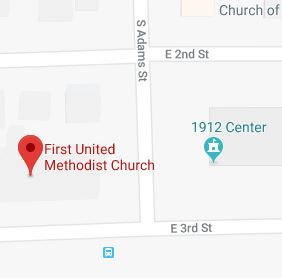
Get Directions
Sunday morning parking at the church is available in the high school parking lot on Third Street across from the church and in the city lots west of the church. These lots are available only on Sunday mornings. A small lot for handicapped parking is available just off of Adams Street on the north side of the church, with an accessible entrance directly into the sanctuary. A lift operates between the Fellowship Hall (3rd Street level) and the Sanctuary. William Sound System Receivers and Headsets are available to assist with hearing problems.
322 East Third Street
Moscow, ID 83843
Church Mission
The First United Methodist Church of Moscow, Idaho takes as our mission to be the body of Jesus Christ, ministering to a community which draws strength from its diversity. Our mission centers on the worship of God, expressed through varied forms of prayer, preaching, music, and ritual. See more...