

Stand Firm - September 15, 2019
1 Peter 3:13-18a When I served in Riverside, we worked a lot with folks who were chronically homeless. We were not a downtown church. But homelessness was an everyday issue for us. In large part, because it was a big urban city, but also because the city had “cleaned up” downtown, which didn’t mean they fixed the problems with homelessness, drugs, and prostitution, only that they pushed those people further away from the main street. Which landed them in our neighborhood. They slept at the church and hung out (and drank) during the day. It first came to us as an issue—a problem. The
trustees had it on their agenda first…what do we do with these people?!
It was easy, early on, to think we could just make them leave so we wouldn’t have to deal with the problems they brought. But…they were people. I lived just across the street from the church and when I’d come and go I’d talk to the men who were staying there. I learned their names….David and Allen….and turning away individuals you can call by name is a whole lot harder than getting rid of those people.
And the trustees (the guardians of the property) were amazing. They took a pastoral and ministerial approach…how could we help people rather than push them off further down the road to become “someone else’s problem”? We started by inviting them to the Sunday morning breakfast we had each week. And pretty soon, word got out. You could get a hot meal at Wesley United Methodist Church. So more people came. And they brought their dogs, their backpacks, and their shopping carts full of their things. All of which allowed them to be more visible to our neighbors…who started to complain.
According to them, our neighborhood didn’t have “trouble with the homeless” until we as a church started feeding them. I hope you’ve been around long enough to know we didn’t cause a problem of homelessness by offering a hot meal once a week! But it was hard. The police were against it. The neighbors were against it. Some of our members were against it. But, we had been intentional and prayerful about how we could actually help people. Maybe we couldn’t get them sober, but we could value them and offer a hot meal. And maybe, in time, that message of grace and love would create space for a change in heart, or healing from the past, or hope for a different future.
From there, the ministry grew…someone started a clothes closet. Then we opened up the showers so they could have a hot shower in the morning. Then a Bible study began, outside, just for them….it was incremental….but it was powerful. The ministry took shape over the course of a couple of years. It wasn’t perfect. It wasn’t easy. It proved to be a very mess ministry on a lot of levels. Nevertheless, we knew it was part of our calling as Christians…to feed the hungry and clothe the naked…to take care of God’s children.
I remember one day, about 6 months in, when we were still mostly just feeding people, a woman from the church came to the parsonage to talk. She was not happy. Her primary concern was how it all looked. What would people think about us if we were the church with all the shopping carts out front?
Always one for the obvious I said, “they’ll think we are the church that serves the homeless…?! I wasn’t trying to be snarky…but probably kind of was. What would it mean to be known as the homeless church? That….we were a church where people on the margins knew they could go? I was ok with that. The trustees were ok with that. Our church council came to be ok with that. We had a mission and a ministry and we could stand firm in our calling, regardless of some of the resistance.
Now, that wasn’t just a chance for me to be nostalgic or share about a powerful ministry…it’s deeply connected to today’s passage. Today’s passage, 1 Peter is understood to be a pastoral letter written by a disciple of Paul, to a variety of churches in Asia Minor. They were likely churches established by Paul during his ministry and they needed continued guidance from a pastor as they struggled with Roman authorities. It’s not clear how much they might have suffered persecution, but we do know Romans, in general, were wary of Christian converts and other “outside religions” because they expected them to “cause immorality, insubordination in the household, and sedition against the state.” (Harper Collins Study Bible, introduction to the book of 1 Peter)
It wasn’t that the new Christian churches were doing those things—only that they were feared because they might. The Christians in that place and that time weren’t trusted. And consequentially, they were struggling to keep hope and focus as a church. It seemed as though everywhere they turned the people were against them. So, seemingly, they wrote their pastor for advice (remember in the early church, the church planters, the apostles who got the faith communities going were more like traveling evangelists, they were there to get things up and running and then they were off to the next place to start the next church. They weren’t present for day to day advice, so the church people would write a letter asking questions and sharing concerns. As with all the epistles, we don’t have their letter to their pastor, asking for help. We only have the response, part of which we heard today.
• Who will harm you for doing good?
• Even if you suffer for doing what’s right, you are blessed.
• Do not fear what they fear (that which is new and different)
• Instead, focus on honoring Christ
• Always be ready to share why you do what you do and why you choose to live with hope and not fear.
o AND when you share always do it with gentleness and respect
• Behave in a way that keeps your conscience clear
o So then when you say things, you know the truth and can rise above it.
Basically, what their pastor was saying was do your best to do the right thing…follow Christ…and be clear about why you’re doing what you’re doing. So if anyone asks you about it, if anyone complains about it, you have a solid answer for why you choose to be and do like you do. And if they still complain…that’s on them…you’ve chosen to do what is right and good, and that’s what matters.
In essence, people might not always agree with what you’re doing. They might not speak well of you. You might not be popular. But that’s not the point. Our life and our works are meant to be driven by the Gospel. Our life is meant to emulate Christ. That’s what matters. And if we’re doing that, then who cares what they say?! Just because people say it, doesn’t make it true.
Look, I get it. People’s words affect us. What they say about us can build us up and it can wound us. Just because we can do our best to rise above the fray doesn’t mean we aren’t burdened by it. But our call to the gospel isn’t about being popular, or important, or powerful, it’s about following the ways of Jesus.
Are you clear on why you do what you do? Is it rooted and grounded in the grace, hope, and love of Christ? If not, examine yourself. Study the Bible. Look for the standards you should be embracing. And if so, if you are doing your best to live like Christ, then stand firm. Do what is good. Do what is just. Do what is right. And let them say what they will say.
Current Church News
Get Directions
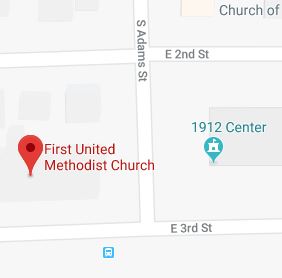
Sunday morning parking at the church is available in the high school parking lot on Third Street across from the church and in the city lots west of the church. These lots are available only on Sunday mornings. A small lot for handicapped parking is available just off of Adams Street on the north side of the church, with an accessible entrance directly into the sanctuary. A lift operates between the Fellowship Hall (3rd Street level) and the Sanctuary. William Sound System Receivers and Headsets are available to assist with hearing problems.
322 East Third Street
Moscow, ID 83843
Church Mission
The First United Methodist Church of Moscow, Idaho takes as our mission to be the body of Jesus Christ, ministering to a community which draws strength from its diversity. Our mission centers on the worship of God, expressed through varied forms of prayer, preaching, music, and ritual. See more...