

The Social Gospel - September 1, 2019
James 2:14-26 It’s almost as if this passage were written just for us as Methodists. Works, meaning good deeds, as an expression or extension of our faith is another major hallmark of Methodism. And there’s really a key reason why—John Wesley lived in a certain time. I know it sounds too simple, we all live in a certain time, right? So, let me explain.
Theology is dialogical—no, not diabolical, though some theologies could be categorized that way, but Sunday morning worship is not a time for throwing stones. Theology is dialogical in the sense that it’s reactive and responsive. There’s one perspective, then another. It’s like thesis—antithesis—synthesis—There’s one perspective, then another,
and then another. It’s a form of argument. And a form of evolution. Theology is always moving—always dialoguing—always looking from different vantages.
For some context: the catholic church was once the church. In very simple terms, there were mostly just Catholics. And, at some point, the church started selling indulgences, which were basically ways of paying for your sins. Quite literally. The church pretty much put a price on each sin and made you pay up for absolution.
• Did you lie this week?
o Pay up
• Did you steal this week?
o Pay up
• Did you commit adultery this week?
o Pay up.
• Did you sin in any way?
o Pay up!
Literally, the church was selling forgiveness. And, not surprisingly, some people thought this was offensive. One of those people happened to be Martin Luther, not Martin Luther King Jr, but Martin Luther who wrote the ______________ (95 theses). Among his grievances against the catholic church was that you don’t sell salvation. You can’t sell faith or face or forgiveness. His tagline would have been, “By faith alone!” (Much like Paul describes to the Romans). How are you saved? By faith alone. Which comes through grace and is an act of God. It does not depend on our doing, it depends on God.
So, on one side, you basically have the Catholic church promoting works righteousness—saving yourself by what you do. And on the other side you have Luther saying, “Faith alone!” Do you see the tension? The evolution? The dialogue? Theology is dialogical. It’s responsive. It might look like some group just popped up out of nowhere, but normally, if you look at the context you’ll see the evolution of denominations within Christianity develop as a response or reaction to something.
Now, Luther was in the 1400s and Wesley came in the 1700s which seems light years apart in time, but it really wasn’t. Mostly because the printing press was just warming up and because the church tends to change at a snail’s pace.
So, enter John Wesley, a part of the church of England, and he looks at the argument between the Catholic church and Luther and says, basically, “I think it’s somewhere in the middle.” Yes, you are saved by grace through faith. It is a gift from God. AND if that does not become a viable part of how we live our daily lives then we probably were never really saved at all.
Back to, James 2. You say you have faith and I have works, and I say I will prove my faith by my works. In other words, what we do matters. We can say whatever we want, but if we don’t live it out, people will always wonder if we actually believe it. We should wonder if we actually believe it.
If I say I love my husband, but I only treat him with contempt, he’s probably going to wonder about the nature of my love. If I say I love kids, but I’m always impatient and harsh when they’re around, you might think maybe I should stick with adults. And if I say I love God, but I’m selfish and bitter and unyielding, you might wonder about that too.
Not that we aren’t flawed. Not that we don’t fail. Not that you won’t catch me missing the mark, but if I’m genuine about what I say, then you’ll see that reflected in how I live.
When James highlights the examples of Abraham and Rahab, he’s saying these 2 said they believed in God and we know that by how they lived—they did what God asked. They humbled themselves. They helped God’s people. We know their faith by their actions. And the same should be true of us. If we profess Jesus as Lord, if we claim redemption through him, if we say we’ve been transformed by grace and love, then that should be obvious in how we live our lives. I may not get it right all the time, but you can see I’m trying. That’s the beauty of sanctifying grace….we keep working at it. We keep practicing. We keep learning how to be open, loving, kind, generous, merciful, forgiving…you get the picture…this is the way we grow to be more like God. And people will see that in us. They may even ask, why do you bother with him? Why are you kind when she’s so awful….and our answer should be, because I’m practicing my faith…I’m living my faith through my works.
So, if we’re following Jesus, and let him live through us—what are our metrics?
• Loving our neighbor as ourselves
• Forgiving as we have been forgiven.
• Clothing the naked.
• Feeding the hungry.
• Sheltering the homeless.
• Welcoming the stranger.
• Including the outcast.
• Visiting the sick and imprisoned.
• Following the teachings and commandments of Jesus.
If Jesus is Lord, he’s the top authority in our lives and we will do what he says. Not perfectly, but earnestly and to the best of our abilities. John Wesley said, “There is no holiness but social holiness.” Meaning there is no good news except that which helps others. There is no lived expression of holiness that is solitary and isolated, it’s all in the context of community. If, our faith is just for us—it’s not faith at all. Because Jesus didn’t just come for one, he came for all. The good news of Jesus is meant to be shared. Not just with our words, but with our actions. Faith without works is dead.
It’s why we are the social justice church. It’s why we have a building on capital hill and pay people to lobby for good and just laws---laws that reflect the commandments of Jesus. Not to have a church state, but to have a representative state that is representative of us when we are the church—with values of caring for the poor, and making sure everyone has access to clean water, enough food, education, a safe and secure environment.
Within the Methodist tradition, we know that how we live our lives individually matters. How I treat people matters. Whether or not I feed the hungry matters. Whether I practice self-control to hold my tongue when I have sharp words of reproach matters. AND…we aren’t just individuals, we are part of a community and how we live in that community and what we do for others living in that community matters. Speaking up about injustices and institutional prejudice, and laws that need reform is not about being political, it is about following Jesus.
Current Church News
Get Directions
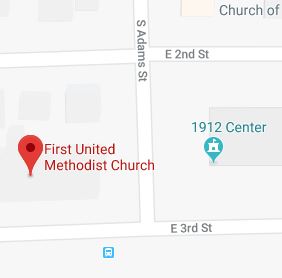
Sunday morning parking at the church is available in the high school parking lot on Third Street across from the church and in the city lots west of the church. These lots are available only on Sunday mornings. A small lot for handicapped parking is available just off of Adams Street on the north side of the church, with an accessible entrance directly into the sanctuary. A lift operates between the Fellowship Hall (3rd Street level) and the Sanctuary. William Sound System Receivers and Headsets are available to assist with hearing problems.
322 East Third Street
Moscow, ID 83843
Church Mission
The First United Methodist Church of Moscow, Idaho takes as our mission to be the body of Jesus Christ, ministering to a community which draws strength from its diversity. Our mission centers on the worship of God, expressed through varied forms of prayer, preaching, music, and ritual. See more...