

A Little Perspective - August 25, 2019
Acts 10:9-23 Probably the most defining thing about Methodism is what we talked about last week: grace, particularly the three categories John Wesley used to understand the different ways grace affects our faith journey. Grace becomes the framework for how we understand faith and apply it to our daily lives.
I would say the second most defining piece of Wesleyan beliefs is the quadrilateral. The what?! The Wesleyan Quadrilateral! John Wesley defined the concepts for how we interpret scripture and then Albert Outler, another famous Methodist defined it as a teachable model—a quadrilateral—four sides that help us
understand and a means for studying scripture. There are 4 sides, or tools, or lenses…depending on how you want to talk about it.
1. Scripture
2. Tradition
3. Reason
4. Experience
This means that each passage, not generally just a single verse, but a verse within its context—a passage of scripture can be interpreted using these tools.
The first lens is scripture—scripture is both the thing we study and the lens through which we look. Particular scriptures may say certain things but they also belong to the whole of scripture and we believe the overarching messages of scripture hold it all together—themes of God in relationship to people, humanity’s bent to sinning, and the journey of trying to reconnect and restore the ensuing brokenness. We see scripture as dynamic—it’s a library of books—not just one—filled with the riches of human experience—at our best and at our worst.
We believe the scriptures are holy. They are inspired by God in a myriad of ways. We believe God was present when the events took place. God was in the telling and retelling of the stories. God was in the writing of the scrolls. God has been in the reading and the hearing of the scriptures through the ages. And God continues to breathe inspiration as we seek to read the scriptures for ourselves.
But that’s not all of how we read the Bible—as we study we can and should use other resources to help us find deeper meaning. One of those resources—one of those sides of the quadrilateral is a tradition—meaning the Christian tradition. How have other faithful people interpreted these passages over the years? In doing that, we recognize some bias, right? For centuries who was it who was reading and interpreting the scriptures? Generally, though not exclusively, it was white European men, which is great. They’ve been faithful and shared their faith in powerful ways that have brought it to us today. AND, they didn’t include the diversity of perspective out there—they weren’t thinking of how women or people on remote islands, or far off countries might hear their words—they were thinking of their own lives and context.
The next tool is reason—which we might assume means logic. But reason and logic are really both too subjective. After all, what’s “reasonable” to me might not be what’s “reasonable” to you. Reason, as part of the quadrilateral, is better understood as the sciences—or as I like to call them, “the ‘ologies”—sociology, psychology, anthropology, archeology, geology. These sciences help us study the scriptures with perspective and wisdom. Reason helps us understand cultural context and norms and sometimes gauges the historical accuracy of events. Which in turn helps us dig in—not necessarily always proving everything as historically accurate but finding context and roots for our passage.
Finally, the 4th side of the quadrilateral is experience. It’s the side that really affirms God is still working--in you and in me—and in our experience of God and in the world matter. Experience asks, “how do you hear this passage?” It allows us to question some of the norms of tradition and seek god’s continued inspiration. And it begs us to ask others, particularly those who are different from us, “How do you understand this passage?” In the last 80 years or so there have been big theological movements from this side of the quadrilateral that has added great depth to the tradition…the feminist movement, liberation theology, black theology, mujerista theology, womanist theology—they each start from the diverse experience of different groups of people and the ways they see and hear and experience scripture that might be different from what “always was”, but the depth and truth of what they have shared have been so profound they’ve become entire movements within the Christian faith.
So, those are the tools we use in reading scripture. And, at this point, you’re probably thinking, “that’s a lot of work!” or “I don’t know what the tradition or the sciences would say about each passage, where would I even start?!”
And I would say, a lot of these things actually happen very naturally for us. If you’ve ever read a scripture and thought, “well that doesn’t say the same thing as this other scripture.” You’ve started using the quadrilateral. And if you’ve ever thought, “well, that’s not what the church says…” then you’re using the quadrilateral. And if you’ve ever thought, “but that was a different culture and a different time.” Then you’re using the sciences of reason. And if you’ve ever said, “but that’s not how it is for me or someone I know” you’re using experience. We do these things all the time. We can’t help it. The difference is some traditions say, “you can’t be asking all those things, you just have to take what the Bible says and go with it.” And our tradition says, “no way, these questions are good for us, they help us see the bible with openness and humility. We say, don’t just ask the basic questions—dig deeper. Ask more! Use the quadrilateral for all it’s worth.
Are you still with me? That was a lot of preamble, but it’s critical for how we engage the scripture. This is part of my work each week, it’s how I get into a story or teaching in the Bible. And to articulate it here helps all of us see what’s happening. It’s not magic to interpret the Bible, it’s method—and that’s part of why we are Method-ists!
Now, onto our scripture! Peter, one of the 12 disciples from a strong Jewish family who lived in a strong Jewish community is learning to do the work of an apostle in starting churches and sharing the Gospel. And, as a faithful Jew, Peter kept the law, which included only eating kosher food and only spending time with other Jews who kept the law—who were ritually clean. Peter went up to the rooftop to pray. (All of that is part of the reason side—looking at the context, and culture and norms of what was happening to help set the scene for our passage. And while he was praying, he entered a type of ecstatic state. Not the “I won the lottery” kind of ecstatic, but ecstatic in the sense of holy and set apart. He’s not asleep. He’s in a thin place—where there’s only a sheer veil between heaven and earth. It’s a place of spiritual receptivity—and it’s there that God speaks to him. God shows him an image of a sheet descending from heave and full of all types of animals—4-legged, fish, reptiles, birds—and God tells Peter, “Go and kill” and Peter immediately refuses—which tells us a few things. 1) the animals were a variety—both clean and unclean, kosher and non-kosher—cows and pigs, fish and shellfish, an assortment. And when Peter heard “go and kill”, he actually heard, “Go and eat!” That’s why he refused—because eating unclean or non-kosher food is not what good Jews do.
Are you ready for it? Side one, that’s not what the scriptures say!!! Exodus says not to eat the unclean animals. Leviticus says not to eat the unclean animals. Deuteronomy says not to eat the unclean animals!! Our scriptures say NO! And then side two—I’m not the only one who thinks this way-all of us Jews do. For centuries the Jews have been faithful to God and God’s laws and followed these rules. The tradition says don’t eat unclean animals.
He’s not going through an academic exercise, it’s a spiritual one—what does my faith say? What do the scriptures say? What do other faithful people say and do? Don’t eat the unclean animals!
And yet, here is God reiterating, “it’s ok!” And Peter just can’t step out of his box. He only knows how to see it this one way and then God says, “Don’t say anything I’ve made is profane.” Which does two key things. 1) It harkens back to another scripture—any guesses which one?
Genesis 1: 20-21, 24-25 where God creates the animals of every kind, of the sea and of the air, and of the land, God makes them all and calls it “Good!” And then God created humanity—men and women in God’s image and it was ____________ (very good!). God pulls on the scriptures. It’s not a sword fight of scripture, but understanding that certain stories, certain rules, are more important than others. There is a value, they are not all holding rank position. God in creation is more important here, that’s what God tells Peter. In essence, I made it and it was good. It’s for you to enjoy! And, it gives Peter an experience of his own to hold onto—a time of prayer and connection with God that is profound where Peter hears and sees a clear message—these things are fine to eat…but, not just that—it’s not just about food…it’s about all the things God created, including people…those people—those unclean people, the ones God sent to talk to Peter, the ones who (knock, knock, knock) are at the door right now, waiting for Peter. That’s the next part of the story—these men, sent by Cornelius, a gentile, a ritually unclean man, who does not keep kosher, but is faithful and prayer full, show up and want to spend time with Peter. Before this vision, Peter probably would have held the line. Maybe talk to them from a distance outside, but not share with them around the table in the living room. But God came in this vision and spoke to him…everything I have created is good. Please stop drawing lines in the sand. See that these people and what they eat are part of my creation, part of what I call good and very good. You can let your guard down a little.
God speaks through the scriptures and experiences of Peter creating a new line of tradition, one that we share in today. One where you can have a bacon cheeseburger and still come to worship and participate in all parts of worship. That may sound pretty ordinary to you, but it would have shocked the sensibilities of religious norms of a 1st century Jew.
Our reality is, God keeps speaking—through the scriptures as our norm, our baseline, our foundation, but also sometimes teaching us to break out of the box a little, to see and hear with new ears so that God can do something new in us and through us.
Current Church News
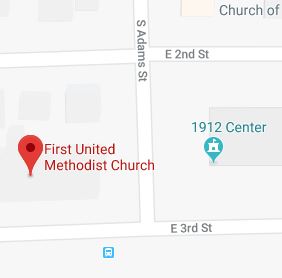
Get Directions
Sunday morning parking at the church is available in the high school parking lot on Third Street across from the church and in the city lots west of the church. These lots are available only on Sunday mornings. A small lot for handicapped parking is available just off of Adams Street on the north side of the church, with an accessible entrance directly into the sanctuary. A lift operates between the Fellowship Hall (3rd Street level) and the Sanctuary. William Sound System Receivers and Headsets are available to assist with hearing problems.
322 East Third Street
Moscow, ID 83843
Church Mission
The First United Methodist Church of Moscow, Idaho takes as our mission to be the body of Jesus Christ, ministering to a community which draws strength from its diversity. Our mission centers on the worship of God, expressed through varied forms of prayer, preaching, music, and ritual. See more...