

All About That Grace - August 18, 2019
Ephesians 2:1-10 This passage is rich with theology. It’s a pretty clear statement of faith relation to Jesus. And it’s going to allow us some generality and some nuance. All too often in the church, we take for granted some basics of the faith. As we move around in this series we’ll have the opportunity to touch some core beliefs—not just for Methodists, but for most Christians and then to examine some of the nuances that helps us see and define
ourselves. To see it today, we’re going to break the passage up a bit. First, let’s focus o the first 3 verses.
You were dead through the trespasses and sins 2 in which you once lived, following the course of this world, following the ruler of the power of the air, the spirit that is now at work among those who are disobedient.
In short:
1) There is this problem with sin.
a. Technically we were all walking in the way of sin
2) We were following the wrong guy—“the prince of the air” aka the devil
3) All of us lived in sin and were bound to the power of the flesh.
4) And because of all that, we deserved God’s wrath.
Now, for many of us—that part makes us really uncomfortable. Talking about being dead because of sin or following the powers of darkness, or being totally submissive to sin, or worthy of wrath... It makes us uneasy. For lots of reasons, right? There’s a reason most of us don’t go to “those” churches where they talk so much about how awful we are.
Most of us can’t point to a before and after a point in our life—a “that was my life as a sinner” and “here is my life as a saint” kind of distinction. It’s not so stark, not so divergent. Most of us don’t think “that’s when I was part of the walking dead” and now is my “alive life.” Which is fair, but it doesn’t mean we weren’t plagued by sin or that we shouldn’t see a difference in how our life might be defined before and after our relationship with Jesus. It also doesn’t take into account that fact that the people in the church in Ephesus definitely had a pre0Christ life and a post-Christ life. There weren’t cradle Methodist (or Lutherans or Baptists or Catholics). This was a church plant—an early church, one of the first churches, and they did have a clear line of life before and life after.
Now, was their pre-life riddled with sin in the way the passage suggests? Maybe. Maybe not. But either way, the letter points to a larger theological claim—without God’s grace and intervention, we are subject to sin. We don’t like to think of ourselves as inherently sinful. But it’s a central doctrine within the Christian world. BUT we also need to remember that our inclination to sin comes AFTER the story of creation where God looks at humanity and says we are, “very good.” Said the other way, first and foremost, we are created in the image of God and considered very good. And then in our free will, we choose disobedience and sin and fall subject to the power of sin. At our core, we are valuable and good. And we are inclined to sin so much so that it comes to define us.
BUT THEN God who is rich in mercy and loves us abundantly intervenes on our behalf through Christ. That’s verse 4. God is rich in mercy and full of love and helps us out of our own mess. In Methodist terms, God gifts us “prevenient grace”—the grace that goes before our knowledge or understanding and makes us “posse nonpecare”—capable of not sinning. God gives us the power to move beyond sin and choose God.
In our theology and understanding, we don’t dig ourselves out of the mire of sin. God does that through Jesus. And at that point we have to pause a minute because a lot of us then think, “well, what about all those people that came before Jesus, are they just out of luck and stuck in the death grip of sin?” No. Theologically speaking, Jesus, as the Son of God, as the second person of the Trinity, transcends time and isn’t stuck to 3AD or 33AD. The work that God does through the incarnation, the crucifixion and resurrection is understood in Kairos, in God’s time, not in chronos—chronological time. It works for all of humanity. Remember, Jesus is the fulfillment of God’s saving work that happens throughout the Old Testament and is then fulfilled and completed in the life, death, and resurrection of Jesus.
The author of the letter emphasizes 3 different times…we are saved by grace through faith. Verse 8 is very clear—this is not about your doing. It is not about your works. You are saved by grace. You aren’t earning your freedom from sin. It’s not about what you do. It’s about what Jesus does for you.
That’s a hard stop. We don’t save ourselves. No one does. Our capacity for good comes as a gift from God. Our ability to not sin is a gift from God. The greater gift of redemption we find in Christ comes from God. Do you see the theme here?
It’s basically heresy to say, “I do this by my own measure and means.” When we profess the Christian faith we are laying claim to these beliefs at our core. We are created in the image of God. We are broken and sinful people in need of grace. God offers that grace through Jesus Christ, who is not bound by time or place.
Ok, so now the Wesleyan nuance to this scripture and these doctrines. John Wesley, who inadvertently founded the Methodist denomination (we’ll share that story another time) talked about grace in 3 distinct ways. And his definitions of grace weren’t for God, they were for us in our understanding of faith and discipleship. He used 3 key words: Prevenient, Justifying, and Sanctifying Grace. Just like I talked about with the kids. Prevenient grace is the grace that goes before our knowing or understanding. It’s God’s hold on each of us. It’s the connection that can’t be broken, cut, untied, burned, or disconnected in any kind of way. And it is true for everyone. God’s prevenient grace is applied to everyone everywhere. It’s the hold God has on a tiny baby, and a forgotten man on the streets and a woman sold into trafficking. No matter who you are, where you are, what language you speak, your immigration status, your work status, your marital status…God has a hold on you. It’s a hold of grace. Which means it’s a free unmerited gift. We NEVER earn grace. It is always a gift. Prevenient grace is God’s unbreakable connection to us. And God uses it throughout our lives to call out to us. “Hey, it’s me.” “Hey, I love you!” “Hey, I have a suggestion for you!” “Hey, knock that off!”
And when we start to listen to that voice, when we realize there’s a connection between us and the divine, that’s the beginning of justifying grace. It’s where we start to see, I’m not perfect, I do need help getting out of sin and my own messes. And God is offering that help through Christ. We hear different language for this in the church…it’s our conversion. It’s our profession of faith. It’s when we are JUSTIFIED and set right with God, forgiven of our sins. According to Wesley, in the life of faith, it’s the beginning of our discipleship.
He basically says it’s one thing to claim God and God’s grace, it’s another to continue in that grace. To grow in grace is what we call Sanctification and it’s made possible through sanctifying grace. It’s the thing that compels us to keep trying to get closer to God. It’s the journey. It’s the path. It’s why we need the church, why we need worship, why we need Bible study, why we need to serve other people…those are ways we continue to receive and understand God’s grace…to grow in depth of our relationship and our ability to imitate Christ.
When John Wesley was alive there were those who claimed “once saved always saved” or “once you’ve claimed Jesus as your Lord and Savior, you’re good for eternity.” He basically pushed back and said, “If I claim Jesus as Lord but am not transformed in my actions, then I haven’t really made him Lord of my life.” To be saved is to continually be active in BEING saved. It’s not a one-time thing, it’s an ongoing relationship with God.
Now, I can quit. Right? I can give up on trying to get closer to God. I can go the other way. I can give up. I can sit and throw my hands up and ask “what good is it anyway?” Does God’s gift stop being available? No. Grace is still there. And no matter what I do or where I go or what I believe, God still has a hold on me. Nothing can stop that. And I may come back to a point of reaffirming, “I’m a sinner, I need help. I can get that help through Jesus.” Whatever happens, God is constantly trying to get our attention and draw us into relationship.
Current Church News
Get Directions
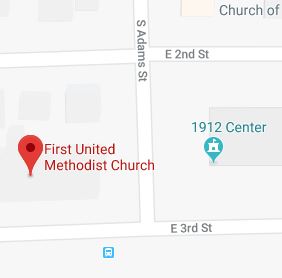
Sunday morning parking at the church is available in the high school parking lot on Third Street across from the church and in the city lots west of the church. These lots are available only on Sunday mornings. A small lot for handicapped parking is available just off of Adams Street on the north side of the church, with an accessible entrance directly into the sanctuary. A lift operates between the Fellowship Hall (3rd Street level) and the Sanctuary. William Sound System Receivers and Headsets are available to assist with hearing problems.
322 East Third Street
Moscow, ID 83843
Church Mission
The First United Methodist Church of Moscow, Idaho takes as our mission to be the body of Jesus Christ, ministering to a community which draws strength from its diversity. Our mission centers on the worship of God, expressed through varied forms of prayer, preaching, music, and ritual. See more...