

Make It Your Buisness - July 21, 2019
Jeremiah 22:3-5 Jeremiah was a prophet to the Israelites. If you have been here as long as I have, you’ve heard me share a number of times about how God’s people, the Israelites, were called to lives of faithfulness—lives of obedience to the law so that they might maintain healthy, fruitful, and loving relationships with God and with each other. They would stay the course for awhile, and then, as humans like us, who are prone to error they’d start to veer. And when they began to get too far afield, God would send a prophet—a truth-teller who would remind them of the law and hold them accountable. “Hey! You! Where are you going? God told you to
come over here and you are way out in Timbuktu, get back here!” Prophets were not popular people. No one likes being told they are wrong. No one wants to hear God is angry at them. No one wants to think they’ve been so loose on the rules that they are causing their own demise, but those were the messages the prophets carried. “Hey! People who call themselves followers of God, fix this!!!! You can’t keep doing what you’re doing. If you fail to listen, if you fail to return to God’s path, it’s going to get ugly.” Sometimes the warning was of famine, sometimes draught, sometimes war. And to be clear, the consequences tended to be natural consequences. It wasn’t just God raining down wrath and terror, it was people causing their own problems and then failing to be part of the solution.
Within Jeremiah’s various messages, we have today’s words: Attend to matters of justice. Set things right between people. Rescue victims from their exploiters. Don’t take advantage of the homeless, the orphans, the widows. Stop the murdering!
His words are straightforward, maybe even morally obvious, and yet the people needed to be reminded. They needed to be told over and over again, not just by Jeremiah, but by other prophets along the way. Stop the injustice. Do what is right in the eyes of the Lord. Care for the people—even the forgotten ones, the poor ones, the weak ones, the isolated ones. We know these teachings. They generally aren’t new to us. And yet, over and over again, we, too, need to be reminded.
Today’s movie is Selma. It takes us back to the 1960s and the Civil Rights Movement. The laws have declared an end to segregation, but the laws aren’t being enforced, so segregation lives on—not just at drinking fountains and in dinners, but in daily practices, in the ways African Americans are excluded. In Selma Alabama, and across the US, one fight was about voting rights. Technically, legally, African Americans had the right to vote, but….they couldn’t always gain access. In a minute we’re going to see the story of Alice Cooper, a woman who was ready to register to vote, and had already been to this office before and been denied her rights. Here she is back, with her paperwork in order…
Clip #1 Alice Cooper (6:40-8:25)
“It’s right when I say it’s right.” How do you overcome a system that is actively fighting against you? It’s impossibly hard when those who enforce the laws don’t care to, and you have no power to wield over them. And, since it’s been 55 years, we like to think we’re past all this. Right? We know the story didn’t end with Alice Cooper, but we should also know that practices of discrimination against voters, particularly people of color, is still happening. It’s not just conspiracy. It’s not fake news. There are hundreds of thousands who have been purged from voting lists, without proper notification and time to correct address information. There are those who aren’t allowed to vote when their current address doesn’t match their driver’s license. These are issues we don’t often see in the Pacific Northwest, but they are happening all over our country. Cases in Georgia, North Carolina, West Virginia, and Texas. But it’s not just the South—it’s Ohio, New York, Maine, Indiana, and Michigan.
Unjust practices are all around us. It can be easy to minimize it when you live in a town like Moscow. We don’t generally deal with racial profiling, or race-based discrimination….at least not when we’re white. I say that tongue in cheek, but also with a good bit of challenge….it’s easy for white folks to ignore race issues because we aren’t generally the victims of racism. And it’s easier to ignore race issues when you live in a town that is mostly white. We aren’t facing the challenges that big cities are. It’s often what makes Moscow feels so nice, so calm, so easy. We don’t have big-city problems. And yet, we’re also deceiving ourselves if we think racism doesn’t happen here and isn’t our problem.
I don’t know about for you, but for me, this is a challenge of living here. In Los Angeles, we had to deal with our prejudices because they were often right there on the surface of our daily lives staring us down. But here, it’s like I have to fight to stay engaged in fighting injustice. I don’t have to fight for awareness—I can still read articles and watch news reports, but I’m not forced to change much in my daily life. So if I want to be a part of changing what is racist and bigoted in our country, I have to work for it, in a way that is unique to this town.
In the course of the Civil Rights Movement, a lot of people were killed. Jimmy Lee Jackson was one of them. He was part of a peaceful protest. But one march happened at night and the press wasn’t in town, so the local law enforcement came down hard on those who were marching. They beat them with billy clubs. They kicked them and punched them and chased them down. Jimmy was with his mother and grandfather and helped them run away, but they were chased down, beaten, and Jimmy was shot by an officer as he tried to defend his 82-year-old grandfather who was being beaten on the floor. At his service, Martin Luther King Jr shared these words:
Clip 2: Who killed Jimmy Lee Jackson? (53:00-54:20)
Who killed Jimmy Lee Jackson? It’s easy to say, “It wasn’t me!” That was 55 years ago. But what about Treyvon Martin? Freddie Gray? Sandra Bland? Philando Castile? Who killed them? I wasn’t there either. Not even remotely close. It wasn’t me. I can make that argument. But if I take the words of MLK seriously, I have to pause, I have to ask myself, have I been complicit with injustice? Or have I been a voice for change? Have I worked to make a difference in our laws and practices? To combat institutional racism? Or have I been ok with that being someone else’s problem?
I’ll venture you can guess the answer. I’ve been heart broken, I’ve been enraged, I‘ve been sickened by the ways people are treated because of the color of their skin, the hijab that they wear, the accent in the way they speak, and their country of origin. And sometimes I speak up. Sometimes I write to my representatives. But I could easily be condemned for failure to act. And that can lead me to feel guilty, ashamed, and then paralyzed. If I keep failing to get it right then why try at all?
And the prophets would reply because it matters!!! There is a path, a way of life that is better—one that is elevated by God---and you can get on it. Don’t give up! Imagine if the Israelites had given up on their first failure. We wouldn’t have half the Bible!!! But instead they would repent, they would try again, they would seek to get back on God’s path and they would succeed…for awhile…they’re imperfect after all, just like us, and then they’d get called back again.
Yes, we have to be reminded. And yes the reminders are hard to hear. We don’t like being wrong. We don’t like being condemned for our actions, or our inactions. But sometimes we need a swift kick in the hindquarters to be reminded—there is a better way. There is a way of justice. There is a way that gives dignity and respect to all persons. Faithfulness requires persistence. It means going back to the hard things again and again to make a difference.
In the fight for voting rights, MLK had the chance to negotiate with President Johnson. They very clearly did not see eye to eye. But he persevered and he encouraged others to persevere. The Southern Christian Leadership Conference organized a march from Selma to Montgomery to advocate for true voting rights. And on their first time out, a little over 500 people marched. The violence was terrible. It was a peaceful protest. A simple march that began across the bridge, and then awful violence as people were whipped, beaten, kicked, and gassed.
As the leadership dealt with all that had happened they had to evaluate what to do next. This is what happened:
Clip #3—Back to the bridge (1:20:55- ________)
The organizers knew they had to persist. Justice would not be delivered on a silver platter. They also knew they needed help. They needed the presence and voice of those who could have claimed: “It’s not my problem”. And after witnessing the violence on TV and hearing Martin Luther King call out for help, they came. Thousands of people traveled to Selma to be a part of something better…getting back onto God’s road where people are treated as people and not judged by the color of their skin.
Let’s watch.
Clip #4 “You came” (1:25:15-1:28:09)
We are called to stand with the people. We are begged to seek justice and break down institutions that break down people. We are called to be justice bearers…we are called to attend to those who are marginalized and oppressed, and we are to fight for those who suffer injustices. Not just when it’s our problem but when it’s a problem.
As Christians, we are called to be the people of change. We are called to look for the symptoms of injustice—inequity, poverty, and violence—and to look for a way to help change the deeper issues of injustice. The scriptures, both the one from today and many many more, call us to do something for those in need, to free the captive, to rescue the oppressed, to care for the widows and the orphans. It is a big responsibility, and it is our responsibility. God wants us to be on God’s path. Which requires us to make a change in our world, one where we can live peacefully with brothers and sisters who are different from us, one where we speak up when people act and speak from a place of hate, one where we are the hope and light to those around us and that only happens if we join in God’s work.
Martin Luther King Jr said these words: We will be greatly misled if we feel that the problem will work itself out. Structures of evil do not crumble by passive waiting. If history teaches anything, it is that evil is recalcitrant and determined, and never voluntarily relinquishes its hold short of an almost fanatical resistance. Evil must be attacked by a counteracting persistence, by the day-to-day assault of the battering rams of justice. We must get rid of the false notion that there is some miraculous quality in the flow of time that inevitably heals all evils. There is only one thing certain about time, and that is that it waits for no one. If it is not used constructively, it passes you by.
May we not wait on justice, but actively pursue it, not simply for our sake or our welfare, but for the welfare of all involved. Amen.
Current Church News
Get Directions
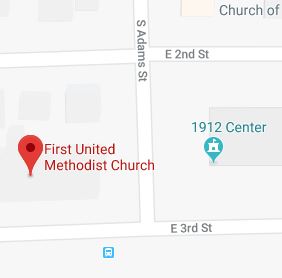
Sunday morning parking at the church is available in the high school parking lot on Third Street across from the church and in the city lots west of the church. These lots are available only on Sunday mornings. A small lot for handicapped parking is available just off of Adams Street on the north side of the church, with an accessible entrance directly into the sanctuary. A lift operates between the Fellowship Hall (3rd Street level) and the Sanctuary. William Sound System Receivers and Headsets are available to assist with hearing problems.
322 East Third Street
Moscow, ID 83843
Church Mission
The First United Methodist Church of Moscow, Idaho takes as our mission to be the body of Jesus Christ, ministering to a community which draws strength from its diversity. Our mission centers on the worship of God, expressed through varied forms of prayer, preaching, music, and ritual. See more...