

What Are We Going To Do Without You? - May 15, 2016
"What are we going to do without you?" a friend of Doug's asked me after he heard we were moving. I understood that behind his question was sadness at our impending departure and a recognition of the ways we have both been involved in Moscow. Part of me asks the same question: "What are Doug and I going to do without both the community of Moscow and First United Methodist Church?" You've been with us through seven deaths in our families and the first five and a half years of Doug's recovery from alcoholism. You've loved us and supported us in some very tough times. Transitions are hard at the best of times,
and the grief many of us feel is very real.
"We're not the Messiah," I replied to Doug's friend. Yes, we have both played a role in this church and this community. And just as you survived and thrived before we came, so too will you after we leave. I appreciate people's expressions of appreciation – and it is not good for my soul to put too high a value on myself.
In our reading today from the Gospel of John, Philip asks Jesus, "Lord, show us the Father and we will be satisfied." Jesus and the disciples were also in a time of transition. Philip's question and Jesus' response come as part of what is sometimes called the Farewell Discourse. Jesus had been telling the disciples that he was leaving them, though they didn't quite get what he meant. "Do not let your hearts be troubled," Jesus had said. "And if I go and prepare a place for you, I will come again and will take you to myself." Thomas said, "Lord, we do not know where you are going." Philip said, "Show us the Father and we will be satisfied. They could have said, "What are we going to do without you?" In their transition they too knew grief and fear and uncertainty.
Jesus sounds a bit exasperated as he responds to Philip: "Have I been with you all this time, Philip, and you still do not know me? Whoever has seen me has seen the Father."
Jesus probably gets exasperated with me too because my first response to a passage like this is to ignore it. First of all, there's the difficulty of sorting out Jesus' relation to God. More on that in a moment. Secondly, a part of me is uncomfortable with the male dominated imagery for God. I understand that many people find the Father image for God to be comforting and meaningful. I also understand that other people have difficulty with referring to God as Father. Out of sympathy for them I tend to limit my use of Father to The Lord's Prayer and to draw on the rich reservoir of other images for God at other times. God is so big that no one image is sufficient to fully describe God.
All that said, in this context, Jesus calls God Father and to use terms like Parent, Creator, or the first person of the trinity does not get at the intimacy and relational quality of Jesus' connection to the One he calls Father.
Recognizing the struggle with the male imagery let's further unpack this connection between God and Jesus. When Jesus was born as a baby in Bethlehem, God took on human flesh. In his earthly life, Jesus gave us a window into the divine life. God lived in Jesus for those thirty-three years and the part of God that lived in the earthly Jesus had existed since the beginning of time. God dwelt in Jesus as the divine part of Jesus had always existed in God. Or as Jesus said in today's reading, "I am in the Father and the Father is in me."
This is confusing stuff. Some people connect best with Jesus. We know the stories he told, the people he healed, the name of his mother. He can seem like our best friend and we like to picture him walking with us each day. Others of us connect best with God, often in God's role as Creator. We feel God's presence and majesty in the beauty and power of creation, whether that's in the wheat that is now green and lush on the hillsides around us and will be a golden bounty in a few months, or in the pounding surf of the ocean.
The mystery of God is that the compassion of Jesus and the power of the Creator are One. Jesus' voice on behalf of lepers and tax collectors is one with God who formed a covenant with Noah to never again destroy the earth with a flood. Jesus' willingness to suffer and die on the cross show us the depth of God's love for all humankind.
"What are we going to do without you?" the disciples basically asked Jesus and he answered them, "I have said these things to you while I am still with you; But the Advocate, the Holy Spirit, whom the Father will send in my name, will teach you everything, and remind you of all that I have said to you." Though Jesus knows he will no longer be present with them in a physical way he now promises his continued presence in the Holy Spirit.
Today is Pentecost Sunday when we celebrate the gift of the Holy Spirit. The Greek word of what our translation today calls the Advocate is parakletos It means one who stands alongside, so Advocate is a fair translation. Sometimes you will see it as Comforter, Counselor, or Helper. Through the Holy Spirit God stands with us. Often the term is used in a legal context, like an attorney who stands with someone who has been accused of a crime. The Holy Spirit also stands with us in other times of need, like a mother who assures a child frightened of going to a new school., "I'll come with you the first day." God stands with us like a friend who comes along to a doctor's appointment to hear the results of an important test.
We know the continuing presence of Jesus with us today through the Holy Spirit who is not limited by time or space as was the earthly Jesus. The Holy Spirit can be present with us right now in Moscow, Idaho and at the same moment with our kids at Jamaa Letu in the Democratic Republic of the Congo and with people in Alberta whose homes have been destroyed in the massive wildfire.
And that takes us back to earlier in our lesson. Jesus said to the disciples, "Believe in me that I am in the Father and the Father is in me; but if you do not, then believe me because of the works themselves." Our faith is based not on an intellectual concept but on the work of salvation God did through Jesus. As St. Ignatius put it, "God became human that humans might become like God." Jesus' compassion and mercy demonstrated through healing and acceptance, Jesus' wisdom in his teaching, and Jesus' forgiveness even of those who nailed him to the cross --- we believe on the basis of those works.
Next comes something even more astounding. Jesus said, "Very truly, I tell you, the one who believes in me will also do the works that I do, and, in fact, will do greater works than these." Wow! What a stunning thought: we can do greater works even than Jesus did? What are we going to do without you, Jesus? Greater works!
We can do greater works because the Holy Spirit empowers us to do them. For two millennia the church has comforted the afflicted and afflicted the comfortable, just like Jesus did. The Universal Church has built hospitals and universities, orphanages and retirement homes. The Church has proclaimed God's salvation on every continent and offered forgiveness to every soul.
What are we going to do without you? Maybe that is your question as Doug and I prepare to leave Moscow. We have done some great things together. We have reached out to families and welcomed children into the world and into the love of God. We have proclaimed the love of God to people struggling with loss and grief, with the chains of addiction and the burden of resentment. We have opened our doors to the high school, barbershop singers, homeless families, and alcoholics. We have brought together our community in times of great grief.
What are you going to do without us? Greater works. It is not mine to dictate what those will be. I do know that you are receiving a pastor with a young family because the Bishop hopes she can help you build on last summer's bounty of babies. The Holy Spirit, the Comforter, the Counselor, the Helper, the Advocate, will stand alongside you; the Holy Spirit will empower you to speak the language of love to a world in need. What will you do without me? Greater works. What will Doug and I do without you? Greater works.
Current Church News
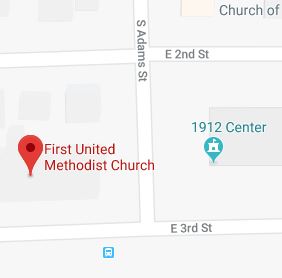
Get Directions
Sunday morning parking at the church is available in the high school parking lot on Third Street across from the church and in the city lots west of the church. These lots are available only on Sunday mornings. A small lot for handicapped parking is available just off of Adams Street on the north side of the church, with an accessible entrance directly into the sanctuary. A lift operates between the Fellowship Hall (3rd Street level) and the Sanctuary. William Sound System Receivers and Headsets are available to assist with hearing problems.
322 East Third Street
Moscow, ID 83843
Church Mission
The First United Methodist Church of Moscow, Idaho takes as our mission to be the body of Jesus Christ, ministering to a community which draws strength from its diversity. Our mission centers on the worship of God, expressed through varied forms of prayer, preaching, music, and ritual. See more...