

The Moments That Change Everything - February 7, 2016
One of the highlights in the Bible is when Moses climbed up Mt. Sinai to meet with God. God gave to Moses the tablets of what we now call the Ten Commandments. Moses' encounter with God was so powerful that he became radiant – the skin of his face glowed and the people feared to come near him. So Moses wore a veil to shield them. From time to time, Moses and God continued to meet. Moses took off the veil when he was with God but donned it later to protect the people.
Centuries later Jesus too climbed up a mountain to meet with God. He took with him Peter, James, and John. As he prayed, like Moses Jesus too glowed: "the appearance of his face changed and his clothes became dazzling white." Moses and Elijah, the two greatest figures of the Old Testament, appeared. When Peter suggested he build memorial booths to mark the occasion a cloud overshadowed them and a voice said, "This is my Son, my Chosen; listen to him."
A few years after Jesus' resurrection, a fellow named Saul began to persecute the followers of the Way, as those first Christians were called. As he traveled to Damascus to arrest some of them, a light flashed, he fell to the ground, and a voice asked, "Saul, Saul, why do you persecute me?" In this encounter with God Saul was transformed. Saul the persecutor came to faith in Christ and became known by his Greek name, Paul, and took the message of Jesus throughout the known world.
Moses, Jesus, Paul: each of them encountered God in a dramatic way that forever changed them. The big word for those encounters with God is theophany, which means an appearance of God.
I'm no Moses or Paul, and certainly not Jesus. My own theophany was far from dramatic and yet it too forever changed me. As a young teen I did not believe in God. I accused those who did believe of being weak. I saw religion as a crutch. My friends and I used to have heated debates about faith. Amy and I were on the no faith side and the others in my group were on the faith side. Then the second semester of my freshman year in high school my Dad went on sabbatical and we traveled in Europe for six months. It meant that at the age of fifteen I was basically in solitary isolation with my parents.
One day while we were in Tubingen, Germany, I got a letter from Amy. In her letter Amy mentioned going to a Young Life meeting. "Traitor," I thought. And then, "Maybe God does exist." I had a warm sense.
That was all. No flashes of light. No one mentioned my skin glowing. At first nothing changed. But when we got home (and was I ever glad to see my friends!) I was willing to go with them to Young Life, including a Bible Study. And when Amy invited me to come with her to United Methodist Youth I went – and never missed another meeting.
My theophany was so quiet I could almost have missed it. Yet in that hesitant acknowledgment that God might exist my life was transformed. God came to me in that pension, though it took years before I had the words to say that.
Moses' encounter with God was so dramatic he had to wear a veil to protect others from the radiance of his experience. In our reading today from 2 Corinthians, Paul reinterprets the veil. He suggests that after a time, Moses wore the veil not to protect the people from the glow but rather to preserve for them the illusion of the glow. Down from the mountain the glow faded but as long as he wore the veil people assumed the glow was there.
Paul extends the fading of the glow to the fading glory of the old covenant which God had first formed with the Israelites when God gave those tablets of the Ten Commandments to Moses. It was a great start, but, says Paul, in Jesus we have a new covenant. "To this very day whenever Moses is read, a veil lies over their minds; but when one turns to the Lord, the veil is removed."
When I have taken youth confirmation classes to visit the mosque in Pullman, all of the women and girls have worn head scarves. Most, but not all, Muslim women wear the hijab, as it is called. Many wear it whenever they are in public. Lately there's been debate about the hijab. Some people see it as a threat, fearing the unfamiliar and suspecting women in scarves of hiding something dangerous from the rest of us. Other people see the hijab and the full body covering called a burka as a sign of women's oppression.
Muslim women who choose to wear the veil explain their choice in a variety of ways. For some it is a sign of modesty, like some Christian women who wear long skirts and head caps. For others it is a statement of identity, like Methodists putting a cross and flame bumper sticker on their cars. And the biggest reason Muslim women give for wearing the hijab is as a sign of their personal devotion to God, much like a Christian might wear a cross. In Western cultures, with our suspicion of Muslims as potential terrorists, it takes courage for Muslim women to show their faith. Some have been verbally harassed and a few have even been attacked.
Paul had been verbally attacked by some outsiders who had come to Corinth and taught a different approach to faith than he had. Paul and the Corinthians had a tense relationship. He had written a painful letter calling them to account, promised to visit, and then chosen not to come for fear of further deepening the conflict. Some of the outsiders had accused him of dishonesty and vacillation.
In response to these accusations, Paul wrote, "Since then, we have such a hope, we act with great boldness, not like Moses who put a veil over his face to keep the people of Israel from gazing at the end of the glory that was being set aside." Paul's boldness was based in the new covenant he knew in Christ. "And all of us, with unveiled faces, seeing the glory of the Lord as though reflected in a mirror, are being transformed into the same image from one degree of glory to another, for this comes from the Lord, the Spirit."
Paul had been knocked to the ground by the power of his theophany, of his encounter with the Risen Christ. Temporarily blinded, he learned to see God in a new way once he encountered Christ who came to him on that road to Damascus. And as he became a new person in his new faith, Paul was transformed, forever changed, so that he took on the very image of Christ.
After my first tentative affirmation that God might exist life could never be the same again. God's existence is more than an interesting fact, like saying there are still Ivory breasted woodpeckers alive today after the fear they had become extinct. That God is real made a difference in my life. That little theophany in the pension in Tubingen continues to shape who I am to this very day.
You see, ordinary people like me and you have our own theophanies. They are not necessarily so dramatic that we emerge with glowing faces, but our encounters with God change who we are. In quiet ways people of faith model Christ in the world every day.
In 1980 three Roman Catholic nuns and a lay worker were murdered in El Salvador, during their Civil War. The following Good Friday, in Washington, DC, a small service was held in the park across from the White House. It was a cool rainy day. Among the attendees was a family of a mother, father, and a reluctant ten-year-old named Peter. Peter refused to sing the hymns or to wear the arm band with four black crosses which had been passed out to remember the women who had been murdered. The folks at the Vigil began to march down Pennsylvania Avenue, stopped in front of various government offices to sing and pray. Though they had a parade permit, they were surrounded by the police. Peter moved closer to his father, began to sing, and put on his arm band.
Later that day Peter asked, "Why were the police so afraid? Didn't they know the women had been murdered? Did our vigil make a difference?"
Three years later Peter still had that arm band. Sometimes he would take it out to look at it. Perhaps for Peter the arm band was a reminder of how he and his parents had spoken boldly. Like Muslim women who have the courage to publicly proclaim their devotion to God by wearing the veil, Peter wore the arm band. Like Paul who encountered the Risen Christ and was forever changed, young Peter was different. No blinding flashes of light, no glowing faces, just an arm band. For me it was a quiet moment in a German pension, and that theophany changed everything.
Current Church News
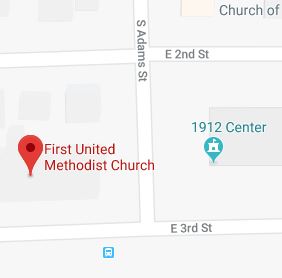
Get Directions
Sunday morning parking at the church is available in the high school parking lot on Third Street across from the church and in the city lots west of the church. These lots are available only on Sunday mornings. A small lot for handicapped parking is available just off of Adams Street on the north side of the church, with an accessible entrance directly into the sanctuary. A lift operates between the Fellowship Hall (3rd Street level) and the Sanctuary. William Sound System Receivers and Headsets are available to assist with hearing problems.
322 East Third Street
Moscow, ID 83843
Church Mission
The First United Methodist Church of Moscow, Idaho takes as our mission to be the body of Jesus Christ, ministering to a community which draws strength from its diversity. Our mission centers on the worship of God, expressed through varied forms of prayer, preaching, music, and ritual. See more...