

Life Changes & the Journey Begins - October 10, 2021
Exodus 1:1-11For the next period of time, we will be looking at our current world and community view through the lens of the Exodus story and the ensuing journey through the wilderness to the Promised Land. The scriptural story covers the Old Testament Books of Exodus, Leviticus, Numbers, and Deuteronomy — beginning with the birth of Moses to his death just before the Israelites enter the Promised Land under the leadership of Joshua.
It is kind of a long haul if you want to consider reading it verse by verse and chapter by chapter. I will propose that you will find in this story a particular story that parallels life no matter wherever you find yourself at this time. In fact, this story has been used as an example of the journey
through the most difficult times of struggle in history, as well as the struggles of many of the significant leaders throughout history.
When I hear people today tell me how much they are struggling I feel called back to look at this story one more time to compare the struggles of the wilderness to the struggles of our current pandemic reality and the struggle we face to move toward a post-pandemic life. I am looking to find the Promised Land that awaits us and calls us as we move forward.
It is a story for the world, our nation, our community, our congregation, and even for our families and our individual lives. I encourage you to follow this journey together.
A bit of a warning here — just as we know that the Scriptures are not presented to us in chronological order, that is, the way the Scriptures are positioned in our versions of the Bible is not the order in which they may have been written in time, the sermon stories may bounce back and forth as well. In the Scriptures, we refer to redacting when we do this. When the pastor is doing it mostly it is trying to tie points together that may occur in the beginning and end or middle of the story.
I started last week with the story of the last and final plague God sent over the land of Egypt to convince Pharaoh to let Moses take the Israelites out to worship, and eventually on away from Pharaoh’s bondage toward freedom in the Promised Land of Canaan. A part of the night of the plague of the death of the firstborn was the marking of the Israelite households so that the angel of DeaPassover “passover” their homes. And a significant event from that story was the first meal of the Passover from which we draw a part of our Communion story. I referred to that meal as “one last meal in Egypt.”
Today we return to the first chapter of Exodus where the scriptures set the scene for a new relationship between the family of Abraham, Isaac, and Jacob and Yahweh.
According to Rabbi Jonathan Sacks’ teachings on these books of the Hebrew Scriptures Exodus introduces this relationship change by a few shifts in how the people of God and the people from the Egyptian world observe and order their communities and perspectives.
In the beginning of Exodus occurs a shift from the Israelites who arrived in Egypt during the time of Jacob’s family’s journey to be reunited with Joseph. When the Israelites migrated to Egypt they saw themselves as a large, multigenerational family. Abraham’s son Isaac had as one of his son’s Joseph. It was an “all in the family” story. God had promised Abraham many descendants. And in Egypt, the Israelites prospered and through the years fulfilled the call of creation to be fruitful and multiply.
Pharaoh noted this:
In Exodus Chapter One we read: These are the names of the Israelites who came to Egypt with Jacob along with their households: 2 Reuben, Simeon, Levi, and Judah, 3 Issachar, Zebulun, and Benjamin, 4 Dan and Naphtali, Gad, and Asher. 5 The total number in Jacob’s family was seventy. Joseph was already in Egypt. 6 Eventually, Joseph, his brothers, and everyone in his generation died. 7 But the Israelites were fertile and became populous. They multiplied and grew dramatically, filling the whole land.
8 Now a new king came to power in Egypt who didn’t know Joseph. 9 He said to his people, “The Israelite people are now larger in number and stronger than we are. 10 Come on, let’s be smart and deal with them. Otherwise, they will only grow in number. And if war breaks out, they will join our enemies, fight against us, and then escape from the land.”
This is the first change in the relationship. Israel is now seen not as a family, not as Joseph’s family, but as a people. That is the word Pharaoh uses: “the Israelite PEOPLE are now larger in number and stronger than we are.” Israel is now the NATION that was promised to Abraham in Genesis 12:2 when God said to Abraham, “I will make you a great NATION.” As the promise is fulfilled in a larger number of family members the relationship from the outside is seen quite differently. From the voice of one outside of the family comes this new identity as a people, the Israelite nation. And from that point forward even to today the identity of Israel has changed.
The new leader of Egypt, one who did not know Joseph and the family story sees them as a new group of people who if they chose to organize against pharaoh could be a problem. Before Egypt, God worked through the family of Abraham and the story revolved around enlarging the family, and the importance of the conception of children. Now that Israel has enlarged the relationship shifts from sibling rivalry to conquest and covenant.
The book of Exodus then will be about the birth of this new nation and with that comes the creation of a political system, a need for covenant principles that will bind people together who do not share the same family lineage. Exodus becomes the time of the first laws that come with the need to understand and relate to people who are not family, rather that are community.
Now that Israel has become a nation living within another nation, namely, Egypt pharaoh seeks to create a system, something we now loosely relate to political systems, whereby one nation defines its relationship with another by how one can profit from the other. The concept of symbiotic relationship or mutual benefit is not yet known. But the idea of trying to keep the Israelites from joining with other nations was not based on a good versus evil plan — it was strictly one of power. “Let’s make sure they don’t go to the other side and fight against us.”
This brings us to another truth from this story. It is a truth that an atheist, not a theologian observed. It was Nietzsche who noted: Power destroys the powerless and powerful alike, oppressing the one while corrupting the other.
I am not quite sure why the Egyptians thought that servitude was the best mechanism, but remember this IS A STORY. Perhaps it came from pharaoh’s paranoia: “They might join someone else and fight against us.” Perhaps it was greed: “They would be good workers to build our cities and our pyramids” which were mostly burial places for the kings and pharaohs. A bit of ego perhaps.
Or maybe this story is here based on a nightmarish dream of Abraham years ago. In Genesis 15:22-14 we read:
“As the sun was setting, Abraham fell into a deep sleep, and a thick and dreadful darkness came over him. Then the Lord said to him ‘know for certain that your descendants will be strangers in a country not their own, and they will be in slammed and mistreated for 400 years. But I will punish the nation they serve afterward and afterward they will come out with great possessions.’”
The dream is coming true in this moment. As a new nation in a foreign land, the people begin the descent into slavery.
So for today, what lessons are here for us:
First, if you look at the story from the beginning you see that God was making provision for God’s people first as a family, then as a nation.
It was God who led Joseph into the favor of the Egyptian kings. It was God who gifted Joseph with the ability to interpret dreams which led to his place of honor AND his plan on how to preserve food for the times of famine to come.
From that place of honor Joseph was the one to whom his brothers came looking for food without knowing or recognizing that this was the brother, they sent away years ago. And it was through the opening of their hearts to repentance and forgiveness that the family was reunited in Egypt.
It was God that allowed the family to prosper and to multiply and grow.
God had promised both the prosperity and foretold the years of servitude to Abraham years before either occurred.
YET God never withheld the promises — the times of plenty, the times of famine, the times of easy prosperity, and the times of hard servitude and bondage to others. God was always faithful.
At that time in our history and in our personal lives, we are perhaps wallowing in our weariness a bit too much. I read in the news, I listen to other clergies, and I have been listening to you as well. I hear many of the same phrases: “I am struggling. I am tired. I want to be back in worship. I want to see my kids and my grandkids.” There is nothing false in those statements. It is where each person sees themselves. It is the truth on which the speaker stands.
What I am desirous to hear is where God has brought you thus far in this journey. What is the story you are writing about the pandemic? What is the story of faith your children will retell? What has God provided for you that you never even dreamed you might need?
The lesson for today I hope is that we look at the journey we have traveled to this point. Where have you seen God touch you?
If God was with the Israelite nation from the first promises made to Abraham of a family, do we not believe that the God who bore the people’s pain in bondage will bear our pain as we weave in and out of the confining period of a virus? Do we have faith enough to place our cares into God's hands?
I know it is hard. At least I find it is sometimes quite difficult for me. I assume therefore it has been at times for you. But when I look back at my jotted notes throughout this I keep finding phrases is such as “just remember God is here even when you don’t see God.” And even “God has a plan. Trust God and trust the plan.”
The first step on the journey through the wilderness begins with the step of faith. Take it with me this week.
Let us pray:
God of Abraham, Isaac, and Jacob. God of Joseph and Moses and Aaron. God of Sarah, Rebekkah, and Miriam.
Hear our prayer:
We pray for families and friends. Those we have seen each day and those we have yet to be able to visit. Our love for one another has brought us comfort we could not physically comfort each other. Our common memory has brought us together and held us fast to one another with cords that cannot be broken.
We pray for our church family. In many ways we are doing okay, at least we think we are. We hold fast to the journey that will bring us together again when it is safe. We look forward to the day when our voices will be united in one place to pray for each other. Until that day we continue to hold a place in our hearts and we pray for each other in our own ways and our own places until that day arrives.
We pray for our community. For schools and employees and students. For health care communities and for all who work there to keep us well and restore our health. For community workers who keep our roads open, our water flowing and our community strong.
In this moment, right now we pray for ourselves. Reach into our beings, our hearts, our souls. Open them that we might hear your word. Open our hearts that we might hear the beauty in the sounds of nature and the voices of the people around us both family and friends. Open our mouths that we might speak kindly to others, not demanding our voices be heard but listening with our hearts to hear others first.
God gives us strength for the journey. Help us to tie on our traveling shoes, to gather our cloaks and hats, our walking sticks with faith that we might follow your will and your way.
Lead us, guide us. Be with us. Keep us strong, brave, and safe. Today, tonight, tomorrow, and each day. In your love and name, we will walk on.
Amen.
Current Church News
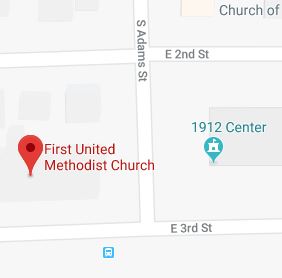
Get Directions
Sunday morning parking at the church is available in the high school parking lot on Third Street across from the church and in the city lots west of the church. These lots are available only on Sunday mornings. A small lot for handicapped parking is available just off of Adams Street on the north side of the church, with an accessible entrance directly into the sanctuary. A lift operates between the Fellowship Hall (3rd Street level) and the Sanctuary. William Sound System Receivers and Headsets are available to assist with hearing problems.
322 East Third Street
Moscow, ID 83843
Church Mission
The First United Methodist Church of Moscow, Idaho takes as our mission to be the body of Jesus Christ, ministering to a community which draws strength from its diversity. Our mission centers on the worship of God, expressed through varied forms of prayer, preaching, music, and ritual. See more...