

One Last Meal - October 3, 2021
When Joseph was rewarded for his interpretation of Pharaoh’s dreams . . . When Joseph was revered in all of Egypt for his ability to prepare for the time of the great famine . . .
When Joseph brought his family to Egypt to live near him . . .
All was well.
The Israelites were honored guests in this foreign land and lived there for generations. In the first chapter of Exodus we read,
“Eventually, Joseph, his brothers, and everyone in his generation died. But the Israelites were fertile and became populous. They multiplied and grew dramatically, filling the whole land.
Now a new king came to power in Egypt who didn’t know Joseph.” (Exodus 1:6-8 CEB)
And life changed.
Pharaoh convinced the Egyptians that the increasing number of Israelites would outnumber the Egyptians and in case of war, the Israelites would side with the enemies and overthrow them. As a result, the Egyptians put foremen over the workers who increase their production quota while removing the provisions necessary for the work. Each task in their construction-based economy became more difficult and the resulting effort subjected the Israelites to a life of bondage and servitude rather than collegial work patterns of the past. Soon the Israelites were at the point of breaking.
We will fast forward in this story for today and return to parts of it in the weeks to come. For now, we turn to the twelfth chapter of Exodus right before Moses will lead the Israelites out of Egypt, through the parted waters of the Sea of Reeds or the Red Sea, and into the beginning wilderness journey to the Promised Land.
Today we begin with the directions from God through Moses to the people to protect their households from the final plague of the killing of the firstborn and to the event that one day becomes the story of the Seder meal during the Passover commemoration.
Today we talk about the final meal they eat in Egypt. It is not the Seder meal nor is it a meal similar to our Communion meal. None the less it is a supper unlike any other.
God gave very specific directions for what would be served, who should be present, how the meal should be consumed, even what to wear. The meat was a 1-year-old lamb of a sheep or goat, cooked over an open fire. There was to be no meat leftover so if the household was small, sharing with another household was encouraged. Any remaining meat was to be burned in the fire the next morning. When the lamb was slaughtered the blood was to be used to place a stripe of sacrificial blood all around the door frame, including the top. This mark would show which of the homes were inhabited by the Israelites and the destroyer of the firstborn will pass over the homes. Death will not enter where the instructions of God have been observed.
Those who eat the meal are to eat it standing up, dressed in their traveling clothes and with their walking stick in their hand. This is not a meal like our family meals of today. There is no lingering to share the good times of the past. This is not like a church potluck. It is not a communal meal. It is a time for the quiet, probably anxious whispers of a family wondering what was about to happen.
When they heard all that God told them through Moses we read that “The people then bowed down and worshipped. The Israelites went and did exactly what the Lord had commanded Moses and Aaron to do.”
After the meal, at midnight the Lord struck down all of the firstborn in the land of Egypt. All except those from houses whose doorposts were marked in blood as the Lord required. Even the firstborn of the flocks of Egypt died. When Pharaoh and all of his court got up that night and saw the devastation of the death of their children and flocks Pharaoh called Moses and Aaron and ordered them to get up from their homes, all of the Israelites and their children. “Get away from here. Go out and worship your God far from here. Take your flocks as well. Just go. And bring a blessing on us with your departure.
Now, after that one final meal, the Israelites were free to leave Egypt and their bondage and servitude. Freedom was at the end of this journey.
We know, thousands of years later that this was not a short nor an easy walk to freedom. Tradiforty-year us it was probably a forty-year journey through the wilderness. A journey full of hardships of famine and fear. Some on the journey questioned whether the journey was a wise idea. However, for the oppressed the journey to freedom is seldom an easy one or a short one.
Nelson Mandela was imprisoned and served 27 years of a lifetime sentence for conspiring with others to overthrow the government which subscribed to the apartheid system which institutionalized racial segregation in South Africa. After his release he said:
“I have walked that long road to freedom. I have tried not to falter; I have made missteps along the way. But I have discovered the secret that after climbing a great hill, one only finds that there are many more hills to climb. I have taken a moment here to rest, to steal a view of the glorious vista that surrounds me, to look back on the distance I have come. But I can only rest for a moment, for with freedom come responsibilities, and I dare not linger, for my long walk is not ended.”
Very few, if any of us, will ever know the oppression, the servitude, the long hours of forced labor, the bondage of incarceration that the people of Israel or Nelson Mandela experienced. We must be careful when we tell stories or share words from other generations and cultures.
Almost everyone around the world has experienced in some way or manner the very minor oppression that has felt very major to many during the global pandemic of Covid. The times of quarantine and sheltering in place, requested of us for our own good, for the community and the world's good have not settled well for some of us. We bristle when our freedom is hindered. Our situation is somewhat more closely related to the Israelites than to Mandela. He lost his freedom due to the stances he took. The freedoms we feel we have lost during Covid were not our doing, and like the Israelites, they were chosen for us rather than us voluntarily finding our own way to deal with the virus. So there the similarity ends.
But the storyline of the long walk to freedom crosses all boundaries. As Study Exodus for the next series of sermons, I could not help but consider the similarities.
I believe that we are just beginning the long walk to freedom. Long, because it will take many more months, even years before we are able to understand scientifically what set up the perfect storm that led us here.
Long, because while the economy cycles through recessions and stellar performance the supply and demand created through this crisis is catching up globally. Long, because we as people are more hard-wired for quick fixes today than we have ever been before. And the word I hear from more people is “DONE.” I’m done. With Zoom meetings. With online class. With online worship. With cooking all my meals. With not seeing friends. I’m done.
So were the Israelites. They called out to Yahweh to save them from their bondage and slavery. And God heard. Little did they know that the answer would be a hasty departure followed by a 40-year trek in the wilderness.
So was Mandela. He conspired to overthrow a government of oppressive proponents of Apartheid. The difference was he was probably aware of the consequences of being caught. Yet years in confinement also ended in his physical and metaphorical long journey to freedom.
I am going to challenge us, however, to remove the word “done” from our phrasing about those practices that have brought us thus far on our journey. To be honest, I am also saying that I am “done” as well. Lately though when I have caught myself use the word “done” during my quiet time walks, or during my prayer, I am beginning to hear God speak clearly to my heart. “So . . . what?” Being “done” does not change anything. It doesn’t change anyone. In fact, maybe my child you should consider the effect of that phrase on those around you who are also tired and weary. Being done doesn’t get anything done. There is more to the journey. Catch your breath. Take a look at the beautiful vista around you. And walk on.”
Don’t bring others down by your “doneness.”
So, where does this line of thought intersect with the last meal in Egypt and World Communion Sunday and October 2021? Our communion is not a remembrance of Passover, although it originates as a story from a Passover meal between Jesus and his Disciples.
Communion for us is a reminder of the ways God calls us to be in covenant with one another and most especially in covenant with God. Our liturgy, if we observe the full liturgy, begins with a time of confessing to God and one another our sins, our shortcomings, intentional and unintentional. After we confess our sins we receive forgiveness from God and one another.
Confession is a great start to a new long journey together. If we bring our irritation, our frustration, our anger with us on this journey it won’t help anyone else. In fact, it may hurt others and it is bound to hurt you.
Sharing a symbolic meal is also a great start to a new long journey together. If you did not bring some kind of bread and water or juice with you I invite you to find some now.
Rebecca, Daniel, and Cordelia Haley agreed to share this meal earlier for us to share today. The beginning confession is one that is shared so that our youngest friends in church could help us understand how simple a sin can be, as well as how hurtful our words and action can be. During that time the liturgy won’t be familiar. But you will hear a time when they repeat the words of confession and pardon, as well as parts of the liturgy of the service. You are invited to repeat those words where you view this service as well.
As always, all are welcome to God’s table
Current Church News
Get Directions
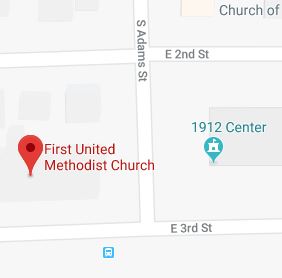
Sunday morning parking at the church is available in the high school parking lot on Third Street across from the church and in the city lots west of the church. These lots are available only on Sunday mornings. A small lot for handicapped parking is available just off of Adams Street on the north side of the church, with an accessible entrance directly into the sanctuary. A lift operates between the Fellowship Hall (3rd Street level) and the Sanctuary. William Sound System Receivers and Headsets are available to assist with hearing problems.
322 East Third Street
Moscow, ID 83843
Church Mission
The First United Methodist Church of Moscow, Idaho takes as our mission to be the body of Jesus Christ, ministering to a community which draws strength from its diversity. Our mission centers on the worship of God, expressed through varied forms of prayer, preaching, music, and ritual. See more...