

What Do You Need? - September 19, 2021
We continue this morning with the four questions from the series “I’ve been meaning to ask …” and last week’s question, “Where does it hurt?” leads us right into today’s question: “What do you need?”
We all hurt at some time in our lives. We all need something or someone during times of hurt, pain, or distress. We need each other at times in
our lives. And in return, we each have something we can offer another.
The story of Job is about a man who experiences a very sudden, extremely traumatic loss. His flocks are in the field under the watchful eyes of his servants and one by one the flocks are attacked, the donkeys and oxen are stolen and their herdsmen killed. The sheep and their shepherds are lost in a sudden fire. The camels and herdsmen are captured. And the final blow comes when all of his children are feasting in a house where the walls and roof collapse killing everyone inside. Even though he is devastated he praises God while he mourns and weeps.
Then he is physically attacked by a debilitating skin disease that leaves him covered in sores which would make him an outcast in society. Even as his wife continues to urge him to curse God Job will not blame God for what has happened. And he retreats outside to scrape his sores with a shard of pottery. And he sits in silence. Not cursing God. Not blaming others. Simply alone, brooding about the situation in which he now lives. No livelihood without flocks and herdsmen. No family beyond his wife without his children and their spouses and their children. Alone. Just Job and God.
His three best friends hear of his situation and from their different towns, they come to sit with Job as if to observe the Jewish Shiva, although he is not an Israelite.
They sit with him for 7 days without saying a word. Their presence, their silence is what Job needs now.
- - - -
The situation of Paul is different. In fact, it may be a story closer to some of our own. He is near the end of his life and ministry, imprisoned in Rome. He is probably a bit lonely, frightened, cold. “Come quickly, Timothy. Please.” Knowing how long it takes to travel by land and water he adds “Come before winter.” Come before you can’t come.”
Everyone else who traveled with Paul has abandoned Paul it appears except for Luke and Onesiphorus. Now more than ever Paul needs friends. Spiritual friends, friends who can attend to his physical needs for food and a blanket or a cloak. And companionship. Someone to continue to discuss the plans to spread the message and story of Jesus to those who never knew him.
Unlike Job, we don’t know the outcome of his appeal, but we can understand his desire to see Timothy, Mark, and Luke.
- - - -
Everyone needs something or someone at some time in their lives.
It is important that we pay attention to what these two stories offer to the people in need.
• Not a casserole to feed the gathered who might be hungry. There will be other times for that.
• Not a bouquet of flowers or a plant for the house. There will be other times for that.
• Not a pretty card with an appropriate poem or saying inside. There will be times for that.
Each of these men needed someone to simply be present with them. Companions in their contemplation of what has happened and what may or will come next. Spiritual friends who can sit quietly and pray silently for their needs without comment.
Sometimes we hear the term “holding space” for someone. “Holding space” means being physically, mentally, and emotionally present for someone. It means putting your focus on someone to support them as they feel their feelings. You are not trying to offer advice, nor are you trying to make the person “feel better.” In fact, when you are holding space for someone you are responsible for providing a safe space and time for them to sit with their feelings, without seeking judgment or opinion.
I have noticed in many ways that many of us are not very comfortable in being present without doing something, or sharing a word, or offering to help. We have not had much training in how to “be there” for someone without any other expectation from them or ourselves. Perhaps it is similar to the Mary and Martha dilemma when Jesus visited their home. We feel that sitting is simply not enough. At times, it is more than enough.
At the time of a death, we could learn something from the practice in the Jewish community of sitting Shiva. If you are not familiar with it let’s look briefly at its components.
• Shiva is derived from the word Sheva, which means seven, signifying the seven days of mourning. It is a time referred to as – sitting shiva and its primary purpose is to provide a time for spiritual and emotional healing, where mourners join together. A person sits shiva for a parent, spouse, sibling, or child. Shabbat (the Jewish Sabbath) is considered part of the shiva period and does not end the mourning.
• Traditionally, shiva is held in the home of the person deceased because it is believed that is where the spirit of this person will continue to dwell and where memories have occurred. Shiva focuses on the mourners and is when family and friends come to comfort them.
• A memorial candle is lit because in Jewish tradition it is believed that a person’s soul is like a flame that brings light into others' lives. The candle burns for 24 hours. In subsequent years, a yahrzeit candle will be lit to commemorate the date of death.
• The people sitting shiva sit on low benches as a sign of mourning. This is a symbol of depression that the mourner is experiencing.
• During shiva a mourner is expected to ignore their own physical beauty.
• Mirrors are covered to remind the mourners that shiva is a reflection of loneliness and not about social acceptance.
The other thing to notice about the story of Paul is how he was able to ask for what he wanted. These were not trivial requests. The cloak or coat would provide him comfort during the coming months of winter. Yes, the travel from near to Jerusalem to Rome was somewhat excessive when travel was difficult. But that travel was familiar to Paul and his followers and friends. After all, this travel was associated with the spread of the Christian message throughout the Mediterranean area and therefore the world. There are speculative comments by scholars that perhaps Paul’s request for the manuscripts was to provide Mark and Luke more of what they might use eventually to write their gospel accounts of Jesus' life.
No matter what or why he asked, Paul was able to state what he needed. For those of us who find ourselves in times of hurt and pain, it is well worth the effort to think about what would really help alleviate the pain or meet the need and be comfortable asking for help. Do any of us considering this question this week find we are uncomfortable asking for what we need? Probably so. Certainly, it can become excessive, but how will we receive it if we cannot ask? How do we ask people to share with us in tough times if we can’t express our pain and ask for help. I can assure you, as your pastor, that there is enough pain to go around within our community and our congregation.
I can also assure you that if we are able to step outside of ourselves just a bit more we can see that pain in one another. And I can assure you that if we can see the pain we can also become the ones who share the space with another, sitting with one another even while we maintain a physical distance. Our ministry Is, to be honest, caring, and loving to one another. It is a ministry of grace. It is a ministry of love and care. It is a ministry each one of us can offer. It is a ministry that will see us through not just these tough and trying times but in all of the tough and trying times yet to come. It is why God called us to this time, this space, and this fellowship. Thanks be to God.
Let us pray.
God of grace, God of creation, God of love and compassion,
In this world of pain, of loss, of hurt, of confusion,
Lead us as we seek to find ways to be present to one another.
May we like Job’s friends learn to show us and sit silently with those in pain.
May we like Paul learn to ask for what we need.
May we like Timothy and Mark learn to be responsive to the request and move quickly to gather what is needed and make our way toward our friends as quickly as possible.
In the name of Jesus who comforts us and sustains us in the times of trial.
Amen
Current Church News
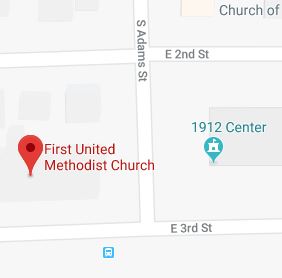
Get Directions
Sunday morning parking at the church is available in the high school parking lot on Third Street across from the church and in the city lots west of the church. These lots are available only on Sunday mornings. A small lot for handicapped parking is available just off of Adams Street on the north side of the church, with an accessible entrance directly into the sanctuary. A lift operates between the Fellowship Hall (3rd Street level) and the Sanctuary. William Sound System Receivers and Headsets are available to assist with hearing problems.
322 East Third Street
Moscow, ID 83843
Church Mission
The First United Methodist Church of Moscow, Idaho takes as our mission to be the body of Jesus Christ, ministering to a community which draws strength from its diversity. Our mission centers on the worship of God, expressed through varied forms of prayer, preaching, music, and ritual. See more...