

Sermon Script - August 8, 2021
Last May, I was listening to a podcast called Dare to Lead by Brene Brown.
Her guest that day was Priya Parker. Who had written a book that I had read earlier in the year called the art of gathering, how we meet, and why it matters. I listen to a lot of podcasts, and I enjoy most of them, learn something from most of them, and quickly move on to the next episode or next podcast. But this particular podcast episode. Was so impressive and so timely coming out of the 2020 pandemic pause that I
have listened to it multiple times, and each time I hear one more new phrase or idea.
So far, I found what they were talking about together to be so true in terms of the community. In terms of the church, as we try to navigate returning to meeting again in person, face-to-face, in a variety of settings.
Now here’s a couple of the things that they mentioned. That I think we as a church need to really think about. The first thing is, there is going to be a lot of awkwardness. That awkwardness is going to last for quite a while.
What do we mean by that?
Some of it is very simple but very important. A simple case in point is how do we greet one another?
As kind of the new kid on the block, I can share how awkward it is to move into a new community. When your meeting people for the first time but not really sure how to greet one another. 2 years ago I didn’t think much about it when someone put their hand out and said, 'Hi, my name is Bill.' I stuck my hand out, we shook hands, and I replied, ‘My name is Kim. It's nice to meet you.' But some of us aren’t comfortable yet shaking hands, and there is this Awkward moment of one hand goes out, the other one does not or, you put your hand halfway out but not all the way out.
Then there are those who are huggers. They greet you with, ‘Hi, I'm Jennifer it’s nice to meet you. Oh, I’m a hugger' (with arms wide open). Well, I’m not, and I never have been. Don’t get me wrong, like anybody I need a hug once in a while, and I want to give one, I want to receive one, and for the most part, I have never even minded shaking hands. But for now, I am not comfortable with either. And it is very Awkward to meet people, and you don’t have anything in common yet, and you don’t have a common understanding of what is comfortable.
After this much time apart due to a virus. Even what was normal, is different. There is also the awkwardness of wearing a mask. For a while, I think it may be a short while. We have been practicing in some environments asking one another are too comfortable taking your mask off, would you prefer I leave mine on. But with the cases across the united states, and in our own county increasing, and increasing significantly. It may be as groups gather again and where required to wear masks. And there's going to be many other awkward things.
You know, in this length of time, someone may have lost their job and we don’t know about it yet. So that awkwardness of saying, so how’s your job going, are you back in the office? That may put someone in an awkward position. Some relationships may have changed, and we may blunder into discovering as part of an awkward conversation. I think these research writers are correct, there will be many awkward moments in the days to come as we gather again.
Now the second thing they mention is that not only will some conversations and greetings be awkward. Some may well become divisive. Now I am not naive enough to believe in particular, having not met any of you yet. That we are all going to agree on whether refusing to shake hands or hugs may seem silly, but some are going to say it’s very important to them.
From the very beginning requiring face masks, as well as physical distancing, had divided us into two or more groups feeling that it’s well within our rights to require masks or to not wear a mask. To respect distancing or to get into someone's space. These are just 2 of the points that were made in the podcast. Awkward. Not sure how to begin. Divisiveness. But one thing they have in common, I believe, and the researchers seem to confirm this. Is that the way we get through the awkwardness and the way we are going to get past the divisiveness, Is to be very intentional about our willingness, to engage in meaningful dialog from the first moment when we re-enter new space. Whether is a church, or classroom, or a workplace, or a family gathering. The more willing that we will be to spend significant time in conversation and true dialog with one another. The better off we may find ourselves when we finally reach the other side of this pandemic.
Now I want to rephrase that more from a pastor's perspective here. The first time we get together to worship, or the first time we gather together as a community of faith in small groups, anywhere around the church. The most important thing we can do will be to remember the depth of our relationships with one another. That will be more valuable than our opinions or our beliefs about any of these issues.
Open a genuine conversation will be far more important than the monologs that we might be tempted to use to make our point.
Now you may remember that for the last two weeks when we considered our baptismal vows. I referenced the scholar and pastor Walter Brueggemann
. I’m using one of his concepts again this morning as well. He refers to the dialog as having a quality, of thickness to it.
When people engage in a dialog within their relationship and the conversation goes back and forth between the two people without either one dominating but each on contributing and sharing their thoughts, each time the dialog shifts from participant to participant. You are putting down a thin layer into the conversation. The more you go back and forth, a thin layer on top of another thin layer. The dialog grows in its thickness and its depth. As the dialog grows thicker, the trust in the relationship also frequently grows and enriches us. If only one person speaks into the conversation over and over again. If you interpret and dominate with your thoughts and not allowing the other person to add to the dialog. It remains this very thin layer, and the relationship itself will bear witness to that thinness as well.
You see throughout the story of Jesus through the gospels Mathew, Mark, Luke, and John. We repeatedly find Jesus taking the time to dialog with people. Even those people who challenged him. In the darkness of night, Jesus went back and forth with Nicodemus. Talking about what eternal life would be and what the whole concept of being born again meant. It wasn’t a one-way conversation. Nicodemus would ask, and Jesus would respond, and Jesus would ask, and Nicodemus would respond.
When Jesus encountered Zacchaeus way up in that sycamore tree, he confronted him about his past, and he asked him to come down, and he went with Zacchaeus to his house for dinner and conversation, and Zacchaeus was changed. That conversation, the thicker it became.
The disciples often drew apart with Jesus to have an upfront, close, and probably very personal conversation. Conversation between a teacher and his followers about understanding the nature of God and life. In fact, we read several times the disciples continue those conversations on the road as they walked along with Jesus.
You know this community of faith that we call the church. Our friends in faith. The people you have sat in pews around for years in this congregation. Through the years, you’ve had deep conversations with one another, lives have been changed through back and forth conversations and dialogs. As we look at coming back, as we gather, it would certainly be a missed opportunity if we don’t avail ourselves of the opportunity to talk with one another about what life was like during this tie apart. So much has changed and yet so much is the same. We will understand each other's joys and concerns in a deeper way when we reconnect if we take the time to intentionally have these kinds of thick conversations, where we share with one another, where we learn from one another. When we hear one another's pain and one another's joys.
Now you may have figured out a pattern in my preaching. That is that there are times when each week I will give you something to think about. Well, this week the topic or the takeaway from this week's message. I hope you will consider, do you have a story of joy or heartbreak of patience or frustration that has changed who you are today, from who you were in March 2020? Are you willing to find someone in our congregation to share your story with, and to at least listen deeply to their story?
You know as we turning one relationship into another. We have to be willing to invest the time. The energy. The love. The concern, and really listen. We have to commit. Will you commit to having thicker conversations with people?
To go back and forth? Rather than just being one-sided, and all about you, all about what you want or care for. Are you willing to believe how we converse with one another will show our love for one another?
This week imagine the conversations you would want to have or better yet find someone that you have been missing, and invite them on the phone, or out in the park to sit, and share your story with one another. Begin to reconnect even before we're able to walk together into the sanctuary. I trust I believe our lives will be so much richer if we can do this.
Let us pray.
God of conversation. God of Rich relationship. God, who knows our heart, and our friend's hearts. Help us commit to being in relationship before we commit to anything else with one another. If we come back into the church before we reconnect. Will we be doing it for ourselves for everyone? When we look from one side of the sanctuary to the other. Will we see someone we’ve missed. Will, we want to share and ask the question. How has life been, and how can we help each other? Lead us into deep conversation. Don't let us get so busy with our feet walking towards the church that we forget the purpose of being in the church. Which is to love one another in your name. To care for one another, and those outside the church in your name. To be one with you for all the people in the world, for this is our prayer, and this should be our commitment in you’re son's name that we pray.
Amen
Current Church News
Get Directions
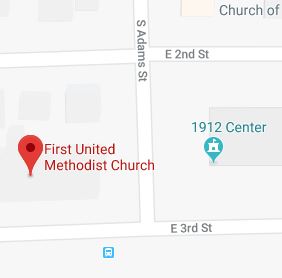
Sunday morning parking at the church is available in the high school parking lot on Third Street across from the church and in the city lots west of the church. These lots are available only on Sunday mornings. A small lot for handicapped parking is available just off of Adams Street on the north side of the church, with an accessible entrance directly into the sanctuary. A lift operates between the Fellowship Hall (3rd Street level) and the Sanctuary. William Sound System Receivers and Headsets are available to assist with hearing problems.
322 East Third Street
Moscow, ID 83843
Church Mission
The First United Methodist Church of Moscow, Idaho takes as our mission to be the body of Jesus Christ, ministering to a community which draws strength from its diversity. Our mission centers on the worship of God, expressed through varied forms of prayer, preaching, music, and ritual. See more...