

One Flock? - April 26, 2015
Taken together, today's passages from the Gospel of John and the Acts of the Apostles raise a question for me. In Acts, Peter ends his sermon before the Sanhedrin, the Jewish High Council, by claiming, "There is salvation in no one else" (he means Jesus) "for there is no other name under heaven given among mortals by which we must be saved." In the Gospel of John, Jesus states that he is the Good Shepherd and then says, "I have other sheep that do not belong to this fold. I must bring them also and they will listen to my voice. So there will be one flock, one shepherd."
There is salvation in no one but Jesus, and, Jesus has sheep who do not belong to this fold. The question these two verses raise for me is, "Can people from other faith traditions be saved without first converting to Christianity?"
We live in a world which is increasingly intercultural. Even in a town as small as Moscow there is an Islamic Center. There is a mosque just ten miles away in Pullman. Growing up in Pullman there was no such thing. I know people who are Buddhist and Baha'i and Jewish. As a kid in Pullman I knew some Jews and that was about it.
Then there are those of no faith at all. The Pacific Northwest is often referred to as the "None Zone," because on surveys which ask for demographic information, more people mark, "None" when it comes to religious preference than indicate any sort of religious affiliation.
The traditional Christian response to my question is that those people – those of other faith traditions and those of none at all – cannot be saved. Verses like our text from Acts seem to indicate that this is so. So too do other Bible verses. After our passage from John, Jesus says, "you do not believe, because you do not belong to my sheep." That would indicate that people from other faiths do not belong to Jesus. A couple of chapters later Jesus says, "I am the way, the truth, and the life. No one comes to the Father except through me." There's no other path to God except through Jesus. Period.
In this traditional understanding, the other flocks Jesus mentions in today's passage, may refer to other Christian denominations. Though some may practice infant baptism and others only believer's baptism, where the baptizee has to be old enough to decide for him or herself, both in the end confess Jesus Christ as Lord and Savior.
Another interpretation of "other flocks" is that in New Testament times it meant Gentiles, or non Jews. Jesus and the first disciples were all Jewish and the early church quickly learned that God's Spirit was moving among the Gentiles. Indeed, within a few years after Jesus' resurrection, the church was composed mostly of Gentiles. So when Jesus talked about other flocks, he may have meant non Jews who would become Christian, who would find salvation in Jesus' name.
In this traditional understanding, some say that Jews are saved because they were God's Chosen People, the ones with whom God first made a covenant. God keeps God's promises. All others, however, are condemned. That would include Mahatma Gandhi, a Hindu, who led India to independence from Great Britain through a non-violent movement. He later inspired Martin Luther King, Jr. It would include the Dalai Lama, a Buddhist, who won the Nobel Peace Prize in 1989 for his leadership in the Tibetan liberation movement which again emphasized non-violence and reverence for life. It would include many of my relatives – and maybe some of your loved ones too.
"I have other flocks," Jesus said. To really understand this verse I think we need to see it in context. Jesus contrasts a good shepherd with a hired hand who cares nothing for the sheep and is in it only for the job. When a threat presents itself, the hired hand thinks of personal safety whereas a good shepherd will risk life and limb to protect the sheep. "The good shepherd lays down his life for the sheep."
As the Good Shepherd, Jesus emphasizes the mutuality of knowledge between shepherd and sheep. "I know my own and my own know me," he says. That knowledge is based in the mutuality of knowledge within the godhead. "Just as the Father knows me and I know the Father." The doctrine of the Trinity is confusing to many Christians. At its core it tells us that relationships are so key to God that God IS a relationship of three persons, Creator, Redeemer, and Sustainer.
As the Good Shepherd, Jesus also tells us that his love is sacrificial. "For this reason the Father loves me, because I lay down my life in order to take it up." Like the captain of a sinking ship who sends everyone else to the lifeboats and safety before leaving the ship himself, like a mother bear who will charge a bison weighing twice as much as she does in order to protect her cubs, so Jesus laid down his life for the sheep.
"I have other sheep that do not belong to this fold." Could those other sheep be people who do not confess in Jesus by any name? Other passages in the Bible also give us clues that Jesus' sacrificial love extends to the other. As the early church wrestled with how to include Gentiles – their "other" - Peter had a vivid dream through which he came to understand "God shows no partiality." John 3:17 tells us God did not send Jesus to condemn the world but that the world might be saved through him. In his parable of the lost sheep Jesus pictures for us a shepherd who leaves most of the flock to seek out one lost sheep. And in the parable of the judgment of the nations (sometimes called the parable of the sheep and the goats), both the sheep and the goats are equally surprised at who is received into the kingdom of God, for Jesus had come to them both in the guise of needy people.
All of these passages together suggest to me that God's love includes people from more categories than I can imagine, including those from other faith traditions, and maybe even none. I know I am outside traditional Christian teaching here and many of you may disagree with me. That's ok.
"So there will be one flock, one shepherd." Groups that work for ecumenical cooperation, like Greater Church Councils of major cities, strive for connections between churches of different backgrounds, seeking to be one flock at least in a few areas. It was not the primary purpose behind the formation of Family Promise, and we have found that churches who work together to shelter homeless families are connecting in ways they never have before.
As Jesus presents this vision, however, the unity of the flock is based not in the uniformity of the sheep but in the singleness of the shepherd. We don't have to do things the same way, whether that's words to hymns, baptism by sprinkling or immersion, or the roles of lay people versus clergy. I would be so bold as to suggest that we do not all have to refer to God by the same name. Some sheep have long ears and some have short ones. Some sheep are black and some are white. What makes them one flock is not that they are the same but that they follow one Shepherd.
And our Shepherd, whom we know as Jesus, comes to each person uniquely. Jesus' sacrificial love reaches out to people all over the world, in many languages and styles of worship. Our salvation, the salvation of every person, is dependent not on us but on Jesus. It is dependent on Jesus' love which was so deep that he gave his life for us. I would say he gave his life for us ALL. The important thing is not what we do, be that giving a lot of money to charity or saying a prayer; working for a good cause or confessing our faith in Jesus through a prescribed formula. The important thing is what God has already done for us. God loves us enough that God came among us as one of us and in the end was willing to suffer and die to show us the extent of God's love for us. The Good Shepherd lays down his life for the sheep – or the goats – or the mules – or the dogs – or the chickens. Whatever flock we belong to, I believe God loves us all.
What do you think?
Current Church News
Get Directions
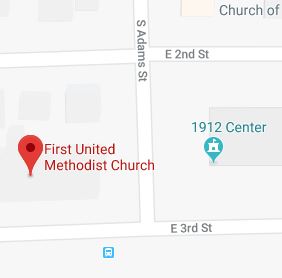
Sunday morning parking at the church is available in the high school parking lot on Third Street across from the church and in the city lots west of the church. These lots are available only on Sunday mornings. A small lot for handicapped parking is available just off of Adams Street on the north side of the church, with an accessible entrance directly into the sanctuary. A lift operates between the Fellowship Hall (3rd Street level) and the Sanctuary. William Sound System Receivers and Headsets are available to assist with hearing problems.
322 East Third Street
Moscow, ID 83843
Church Mission
The First United Methodist Church of Moscow, Idaho takes as our mission to be the body of Jesus Christ, ministering to a community which draws strength from its diversity. Our mission centers on the worship of God, expressed through varied forms of prayer, preaching, music, and ritual. See more...