
-
Home

- Sermons
Here We Are, Send Us - May 31, 2015
"In the year that King Uzziah died," begins our reading today from the Book of Isaiah. Honestly, I hear that and think, "Who was Uzziah and why should I care?" I know the name only because I've read this passage so many times.
Elsewhere in the Bible we read: "After the death of Saul, when David had returned from defeating the Amalekites." "In those days a decree went out from Emperor Augustus."
Over and over the Bible sets its stories in historical context, like you or I might date a letter May 31, 2015, or say to each other, "Where were you on 9-11?" We know that God enters into human history and that means God steps into political and social events.
So it is that Isaiah had a profound encounter with God in a time of great political transition. The King had died. Uzziah, as it turns out, had been king for 52 years –longer than any other king of Judah. He had brought to Judah economic prosperity and with it expanded international power and influence. The loss of such a leader would leave a nation in turmoil and confusion. The historical context matters.
The Spirit’s Sighs - May 24, 2015
It has now been a month since the earth in Nepal groaned with a 7.8 magnitude earthquake. Buildings collapsed, an avalanche cascaded down Mt. Everest, and devastation ensued. We know now that more than 8000 people died and thousands more were injured.
After the initial quake, the earth continued to groan with a series of aftershocks which went on for days, causing further damage and traumatizing survivors. Even those whose houses still stood slept outside for fear of later collapses. Then last week another major quake hit, causing a few more deaths and further traumatizing survivors.
I've never been through a major earthquake so I can only image the terror and agony of those who have experienced one. I am grateful for organizations like the United Methodist Committee on Relief which give me a way to help when disasters strike.
What’s The Deal With Ascension? - May 17, 2015
Did you know that last Thursday was Ascension Day? I would guess that not many of you took time to commemorate it. Certainly no one got the day off from school or work just because it was Ascension Day. Most people did not give it a thought.
Most Christians know at least the bare outlines of Jesus' crucifixion. Some of you came to the Maundy Thursday service we observed with our friends from The United Church of Moscow and First Presbyterian Church in which we remembered Jesus' last supper with the disciples. A few more of you came to our Good Friday service when we remembered Jesus' death on the cross. Many came on Easter Sunday to celebrate Jesus' resurrection.
Jesus' ascension is less familiar and yet it is central to our faith as Christians.
This morning we read two stories about Jesus' ascension. Both come from the pen of the same person, whom we call Luke. One is from the Gospel of Luke and the other is from Volume 2, what we call the Acts of the Apostles. Indeed, if we see these two books as a series, the stories we read today merge together, for we read the very last words in Luke's Gospel and the very first words of Acts.
Loving One Another - May 10, 2015
When I was working on my Doctor of Ministry, one of the classes I took required us to administer a survey to our congregations. I asked a number of lay people in the church to fill out the survey and then we received an assessment of the church's strengths and weaknesses. That church was small, without a lot of programs, so we scored low on things like Inspiring Worship and Holistic Small Groups. Our greatest strength was Loving Relationships. That little congregation knew how to care for each other in good times and in bad.
Bearing the Fruit of Love - May 3, 2015
From 1985-1992 I lived in Omak, in north-central Washington State. At that time it was mostly ranch and orchard country, with acres of apple and pear orchards. In the seven years that I was there, orchardists began to replace their red delicious apple trees with newer varieties such as Gala and Fuji. In 1997 I moved to Toppenish in south central Washington State. This too is orchard country.
These days if you drive through central Washington, north or south, you will still see many apple and pear trees, along with other fruit. And you will also see fields of grape vines.
Both fruit trees and grape vines are pruned each winter. Even to someone like me, it is obvious which fields have been pruned. After the branches and vines are cut off, soon to be burned, the remaining trees or vines look sparse and thin. Compared to unpruned vines, the pruned ones seem decimated. You wonder if they can survive. Go back six months later in the late summer, however, and those are the vines and trees which are heavy with fruit.
"I am the true vine," Jesus says in our reading today. "And my Father is the vine grower. He removes every branch in me that bears no fruit. Every branch that bears fruit he prunes to make it bear more fruit." This passage is an analogy. Jesus is the vine, God is the gardener, and you and I are the branches.
More Articles ...
Current Church News
Get Directions
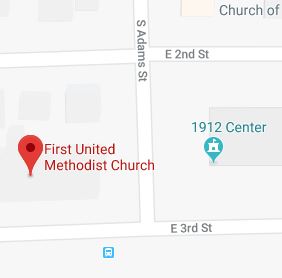
Sunday morning parking at the church is available in the high school parking lot on Third Street across from the church and in the city lots west of the church. These lots are available only on Sunday mornings. A small lot for handicapped parking is available just off of Adams Street on the north side of the church, with an accessible entrance directly into the sanctuary. A lift operates between the Fellowship Hall (3rd Street level) and the Sanctuary. William Sound System Receivers and Headsets are available to assist with hearing problems.
322 East Third Street
Moscow, ID 83843
Church Mission
The First United Methodist Church of Moscow, Idaho takes as our mission to be the body of Jesus Christ, ministering to a community which draws strength from its diversity. Our mission centers on the worship of God, expressed through varied forms of prayer, preaching, music, and ritual. See more...