
-
Home

- Sermons
Power Issues, Power Lessons July 26, 2015
Power Issues
This summer I have been following the stories of the development of the monarchy in the nation of Israel. That has taken us to stories about David. Along the way these stories have challenged us to think about power and its potential for abuse. We began as the people asked the old judge Samuel for a king, thinking that such a figure would make them a stronger nation. Samuel warned them that they would not always like their kings, but when they insisted, God told him to go ahead and anoint Saul as the first king.
It didn't take long before Samuel grieved and God was sorry he had made Saul king because Saul did not follow in God's ways. So Samuel anointed the boy David as the heir apparent, a surprise lesson about God's power, for David did not look like king material.
David's defeat of the giant Goliath continued that theme. Even stronger and more experienced warriors feared to take Goliath on. David placed his trust in God and the giant was soon dead. David became king and managed to unite the two factions of Judah and Israel into one nation.
Today's story is the denouement of the power stories: David and Bathsheba. From start to finish, this story is all about power.
It begins as David remains in Jerusalem while he sends General Joab and the troops out to do battle. To our eyes this seems normal.
A Tale of Two Cities - July 5, 2015
II Samuel 5:1-10
Psalm 48
Mark 6:1-6
In the spirit of the summer travel season, this morning I want to embark on a little time travel to two cities in the Holy Land. Our bible readings take us to Jerusalem, early in the reign of King David; and to Nazareth early in Jesus' ministry.
The Holy Land is not a large place. As the crow flies it is about 150 miles from top to bottom. Jerusalem to Nazareth is about ninety miles. Today there is an interstate highway that could whisk us there as quickly as we might drive to Spokane. In our readings it takes about a thousand years to get from Jerusalem to Nazareth. There were no interstate highways so such travel would have taken days. Since we are doing some time travel anyway, this sermon won't take us that long.
Let's start in Jerusalem. At the time of our reading from 2 Samuel the kingdoms of Israel and Judah were separate. The Bible scholars among us may recall that they split after the reign of King Solomon. But this predates Solomon by nearly eighty years. It turns out that the twelve tribes of Israel had been a diverse group since the days of Jacob. After all they came from four different mothers who squabbled with each other for Jacob's attention and competed with each other in the battle of the babies. So maybe it should not surprise us that after their first king, Saul, died, they divided into Israel in the north and Judah in the south.
David had ruled over Israel for about seven years while Saul's son, Ishbaal, ruled over Judah. The two kingdoms were at war with each other. Ishbaal was then murdered. Finally the leaders of Judah came to David to ask him to be their king too. Thus began a novel experiment to unite the two kingdoms.
Love Is Stronger Than Fear - June 21, 2015
"Why are you afraid?" the boy David asked the army of King Saul. Well, of course they were afraid. The Philistine army had encamped on one side of a mountain and the Israelite army on the other. The Philistines sent out their most fearsome warrior, a giant named Goliath. And Goliath was clearly a force to be reckoned with. He was huge: ten feet tall. His size alone would intimidate most people. Add to that he had the best technology of his day – bronze armor and a spear as big as a weaver's beam. Like most bullies, Goliath was loud and brash: "Today I defy the ranks of Israel!" he challenged, "Give me a man that we may fight together." The war could be reduced to a battle between two warriors. King Saul and all Israel were indeed frightened and who could blame them?
The soldiers of Saul's army were no fools. None of them volunteered to fight Goliath. To do so would have been a suicide mission.
Living So That God Will Not Repent - June 14, 2015
Our Old Testament reading this morning begins on a poignant note: "Samuel grieved over Saul. And the Lord was sorry he had made Saul king over Israel." Some translations actually say that God repented over making Saul king. That phrase is a bit startling. I'm used to talking about the need for people to repent of their sins, but God?
For people to repent often means to turn, so that we turn from our sinful actions to God. Sometimes, however, the word translated as repent means to be sorry. Samuel grieved and God was sorry.
There are other examples in the Bible where God repents or is sorry. Before the Great Flood, humankind was so wicked that God was sorry he had made them. "This did not work out the way I had planned," God might have said. Then again after the people made the golden calf God was so angry that God told Moses, "Let me alone, so that my wrath may burn hot against them and I may consume them." Moses interceded for the people, "And the Lord changed his mind about the disaster that he planned to bring on his people." The word used for "changed his mind" is also used for "was sorry" in our lesson today.
Read more: Living So That God Will Not Repent - June 14, 2015
Power Corrupts, Justice Corrects - June 7, 2015
Lord Aston was a British politician and historian in the mid 1800's. He is best known for saying, "Power tends to corrupt, and absolute power corrupts absolutely."
Power corrupts. As he ran for reelection as President of the United States, Richard Nixon's campaign staff broke into the offices of the Democratic National Committee. They were attempting to wire tap phones and steal secret documents. While it is not clear that Mr. Nixon knew in advance about the burglary, it is clear that he tried to cover it up. He tried to stop the FBI investigation, destroyed evidence, fired uncooperative staff members, and raised hush money for the burglars.
The scandal not only led to Mr. Nixon's resignation as President, it forever changed American's trust in our government. Power corrupts indeed.
More Articles ...
Current Church News
Get Directions
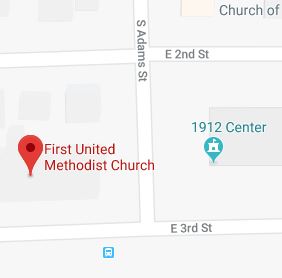
Sunday morning parking at the church is available in the high school parking lot on Third Street across from the church and in the city lots west of the church. These lots are available only on Sunday mornings. A small lot for handicapped parking is available just off of Adams Street on the north side of the church, with an accessible entrance directly into the sanctuary. A lift operates between the Fellowship Hall (3rd Street level) and the Sanctuary. William Sound System Receivers and Headsets are available to assist with hearing problems.
322 East Third Street
Moscow, ID 83843
Church Mission
The First United Methodist Church of Moscow, Idaho takes as our mission to be the body of Jesus Christ, ministering to a community which draws strength from its diversity. Our mission centers on the worship of God, expressed through varied forms of prayer, preaching, music, and ritual. See more...